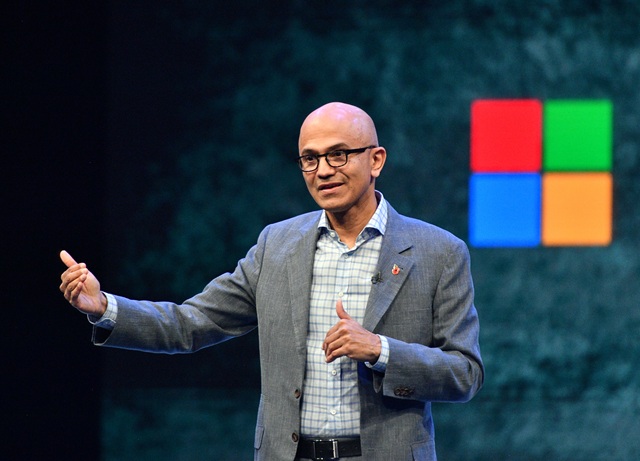
Satya Nadella helped accelerate the artificial intelligence boom that has reshaped the technology industry. Now, the Microsoft chief executive is challenging the direction of the race he helped build, arguing that the future of AI should not be controlled by a small group of companies developing increasingly powerful and expensive systems.
In an interview with The Wall Street Journal, Nadella outlined a vision for the next phase of artificial intelligence development focused on lower-cost models, greater user control and broader public trust. His comments place Microsoft alongside a growing effort to reshape the competitive landscape surrounding leading AI companies, including OpenAI and Anthropic.
Nadella delivered a sharp assessment of how the AI race has evolved, criticizing a model in which a limited number of companies capture much of the value from the technology while warning of extreme risks involving safety, employment and security. He argued that companies cannot simultaneously predict widespread disruption to white-collar jobs and demand enormous resources to build ever-expanding AI infrastructure.
“You can’t say, hey, all white-collar jobs are gone and this could even be a weapon and we will use all the power to build data centers,” Nadella told The Wall Street Journal. He said the public would not accept a future where only a handful of models and companies were responsible for “doing all of the learning for the world.”
Although Nadella did not directly name OpenAI, Anthropic or Alphabet’s Google, his comments reflected concerns about the influence of the companies leading the development of advanced proprietary AI models. Microsoft’s strategy is increasingly focused on moving the industry toward a broader ecosystem where businesses and users can choose among different models based on cost, capability and control.
The company has already begun introducing products designed to reduce the financial burden associated with AI adoption. In recent weeks, Microsoft has launched a series of lower-cost models aimed at customers facing rising expenses from AI services. It also introduced Copilot Cowork, an autonomous AI agent that allows users to select different AI models, including cheaper options, while completing longer and more complex tasks.
Microsoft is also considering hosting a version of DeepSeek, a low-cost AI provider based in China. OpenAI and Anthropic have accused DeepSeek of distilling, or copying, elements of their advanced models. A move by Microsoft to make a version of DeepSeek available through its platforms could increase the Chinese company’s adoption while intensifying price competition among AI developers.
The shift marks a significant change for Nadella, who has long been viewed as one of the central figures in the multitrillion-dollar AI race. Microsoft has been one of OpenAI’s earliest and most important partners, investing billions of dollars to help the company expand its technology and reach. After years of tensions, the two companies recently reached an agreement allowing OpenAI to deepen relationships with other major technology companies. Microsoft also signed a multibillion-dollar agreement with Anthropic last year.
Despite his push for a different direction, Nadella said there was room for multiple companies to succeed in the AI industry. A Microsoft spokesperson said the company would continue developing partnerships with OpenAI and Anthropic, describing Nadella’s approach as an effort to reshape AI rather than a competition where one company’s success requires another’s failure.
The debate comes as leading AI executives continue to discuss both the opportunities and risks associated with the technology. Anthropic chief executive Dario Amodei has repeatedly warned about potential job losses, including a prediction last year that new AI systems could eliminate half of entry-level jobs by 2029. OpenAI chief executive Sam Altman has also predicted significant workforce disruption while later saying he was pleased that some earlier concerns had not materialized as expected.
Both OpenAI and Anthropic have emphasized safety concerns surrounding powerful AI systems. Anthropic has faced disagreements with the White House over possible risks associated with releasing advanced models, while OpenAI has published policy proposals focused on demonstrating potential benefits from artificial intelligence.
Microsoft’s push for a more open AI market comes after the company struggled to match some competitors in developing its own frontier models. In the second half of 2025, market research firm Recon Analytics found that Copilot subscribers increasingly turned to alternatives such as Google’s Gemini.
Without a leading proprietary model of its own, Microsoft has chosen to use its financial resources, cloud infrastructure and global reach to promote a marketplace where AI models become more widely available and competitive. The company’s consideration of DeepSeek on Copilot reflects this broader strategy of making AI tools accessible across different price points and capabilities.
Nadella’s latest comments follow an essay he published on June 14 describing his vision for the future of AI-first companies. He argued that successful organizations would operate as continuous learning systems, combining human knowledge with artificial intelligence capabilities rather than relying solely on automation.
He described AI as a knowledge engine that allows companies to use their internal data and expertise while selecting from a range of models. The future, he said, would depend on businesses developing both “token capital,” referring to internal AI capabilities, and human capital.
Nadella said companies must focus on reorganizing work rather than simply eliminating jobs. He acknowledged that AI adoption would involve significant changes and displacement but argued that businesses need practical methods to help employees and organizations adapt.
He also emphasized the importance of protecting intellectual property and maintaining control over company knowledge as AI becomes more deeply integrated into business operations. In his view, the defining characteristic of future companies will be the combination of human expertise and AI-generated knowledge they develop.
For Nadella, changing the public perception of artificial intelligence will require more than communication efforts. “No amount of just narrative is going to do it because where we are now, we have to sort of walk the walk,” he told The Wall Street Journal, arguing that companies must demonstrate real economic opportunity and user control as AI continues to expand.