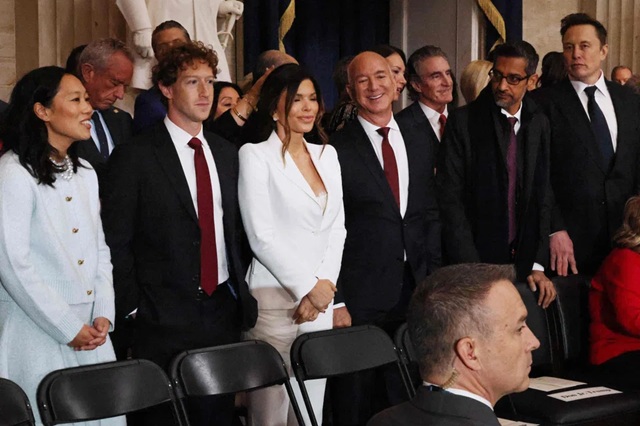
For decades, the race to space was defined by national rivalry. Today, it is increasingly shaped by two of the world’s richest men. The intensifying competition between Elon Musk and Jeff Bezos has entered a new phase after Musk unexpectedly shifted focus from Mars to the moon, placing his company SpaceX in direct strategic conflict with Bezos’s Blue Origin.
The move marks a significant departure from Musk’s long-stated ambition to colonize Mars and make humanity a “multiplanetary species.” Instead, he is now advocating the construction of what he calls a “self-growing city” on the lunar surface, complete with industrial infrastructure and artificial-intelligence data centers. The concept overlaps strikingly with Bezos’s long-held vision of using the moon as a manufacturing hub that could eventually support large-scale human settlement in space.
This convergence has set the stage for a 21st-century space race driven not by geopolitics alone, but by competing commercial strategies, personal legacies and technological philosophies. Where Cold War competition once pitted Washington against Moscow, the defining contest of this era may be Silicon Valley–style entrepreneurship backed by immense private wealth.
For years, Musk appeared to dominate the modern launch industry. SpaceX built a powerful position through reusable rockets, dramatically lowering the cost of sending payloads into orbit and establishing a vast satellite network in low-Earth orbit. The company’s towering next-generation rocket, Starship, was designed primarily with Mars in mind, envisioned as the vehicle that would one day ferry settlers across interplanetary space.
Yet Mars has proved far more technically and financially daunting than early projections suggested. Key engineering hurdles remain unresolved, including achieving consistent orbital performance and mastering the complex process of refueling spacecraft in space—an essential requirement for deep-space travel. Planetary alignment windows that allow relatively efficient journeys to Mars occur only about every 26 months, adding further constraints.
Against this backdrop, shifting to the moon offers a nearer-term objective with clearer commercial justification. Investors evaluating a potential public offering by SpaceX are more likely to support projects with achievable timelines than a decades-long dream of Martian colonization. The lunar surface, just three days away from Earth, provides a testing ground for technologies that could later be used farther afield while also enabling new industries such as resource extraction, manufacturing and energy generation.
Political winds in Washington have also nudged priorities moonward. The U.S. government, through NASA, has committed to returning astronauts to the lunar surface before the end of the decade, reviving ambitions reminiscent of the Apollo era. Aligning with those goals strengthens SpaceX’s chances of securing lucrative federal contracts and maintaining its leadership in launch services.
Musk himself has acknowledged pragmatic concerns behind the recalibration. Establishing a self-sustaining settlement on Mars, he suggested, could take more than 20 years and would remain vulnerable to disruptions in supply from Earth. A lunar base, by contrast, could be expanded far more quickly and might reach a level of autonomy within a decade, serving as both insurance for humanity and a springboard for deeper exploration.
Still, building on the moon presents formidable challenges. The environment is hostile: extreme temperature swings, relentless radiation exposure and abrasive lunar dust threaten both machinery and human health. Transporting the immense quantities of material required to construct habitats, power systems and industrial facilities would demand launch rates far beyond anything yet achieved. Musk has floated the idea of thousands of flights annually to deliver equipment and personnel, an ambition that would require unprecedented operational scale.
Bezos’s approach has historically been more methodical. Blue Origin has favored incremental development, emphasizing reliability and long-term planning over rapid iteration. The company’s culture, symbolized by its tortoise mascot, reflects Bezos’s belief that steady progress ultimately wins complex engineering races. That philosophy has sometimes drawn mockery from Musk, who built SpaceX’s reputation on speed and bold deadlines, but it may prove advantageous in the painstaking work of constructing lunar infrastructure.
Blue Origin is preparing its own cargo missions aimed at the moon and has redirected resources away from suborbital tourism ventures to concentrate on deep-space logistics. Bezos has consistently argued that the moon is the logical first step in expanding civilization beyond Earth, providing access to raw materials and a platform for heavy industry that could reduce environmental strain on the home planet.
The rivalry has increasingly played out in public, with social media exchanges and pointed remarks underscoring personal as well as strategic competition. Yet beneath the banter lies a deeper reality: both companies are attempting to solve the same monumental problem—how to move vast quantities of people and equipment beyond Earth in a sustainable way.
Industry analysts note that the two visions are not mutually exclusive. A thriving lunar economy could serve as a proving ground for technologies needed to reach Mars, blending Bezos’s gradualism with Musk’s long-term interplanetary ambitions. In that sense, the race may ultimately accelerate progress for both paths rather than determine a single winner.
What makes this moment distinctive is the scale of private influence over humanity’s future in space. Government agencies remain essential partners, but strategic direction increasingly flows from boardrooms and billionaire founders. Their resources allow for experimentation at speeds once impossible in publicly funded programs, while their competition generates urgency reminiscent of Cold War rivalries.
Whether the moon becomes a bustling industrial outpost or merely another stepping stone will depend on technologies still under development and markets yet to materialize. But one outcome already seems certain: the contest between Musk and Bezos has transformed lunar exploration from a symbolic return into a central arena of economic and technological ambition.
As rockets grow larger and visions bolder, the next chapter of space exploration may be written less in the language of national prestige and more in that of entrepreneurial rivalry—an era where the drive to build cities beyond Earth is powered as much by competition as by curiosity.