Morocco has declared that Western Sahara will remain under its sovereignty “until the end of time”, intensifying its confrontation with Algeria and the supporters of Sahrawi independence at the United Nations, just days after a diplomatic deadlock brought an end to the UN mission that had monitored the disputed territory for 35 years. The confrontation at the UN General Assembly exposed deep divisions among major powers over the future of the former Spanish colony, with the United States backing Morocco’s autonomy proposal and Russia and Algeria demanding that the Sahrawi people retain the right to determine their own future.
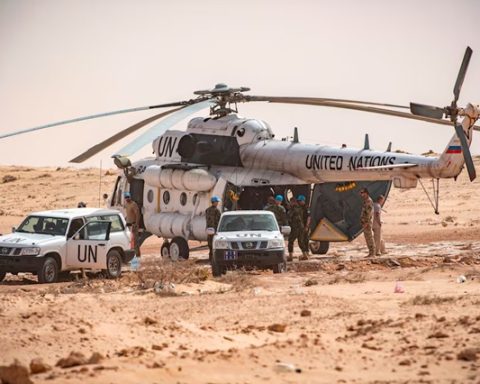
Omar Hilale, Morocco’s permanent representative to the United Nations, told the General Assembly on Tuesday that the longstanding debate over Western Sahara had effectively lost its purpose, insisting that the territory would remain Moroccan “until the end of time”. His declaration came ten days after Russia and the United States blocked each other’s competing positions in the Security Council, preventing the renewal of the United Nations Mission for the Referendum in Western Sahara (MINURSO), which had been deployed for 35 years.
Western Sahara has remained on the UN list of non-self-governing territories since 1963, when the organisation recognised its status as a territory awaiting decolonisation. Morocco’s latest position challenges that classification and reflects Rabat’s effort to secure wider international recognition of its sovereignty over the territory. Hilale directly accused Algeria of perpetuating the regional conflict and the humanitarian crisis affecting thousands of Sahrawis who have lived in refugee camps around Tindouf, in south-western Algeria, since 1975.
Washington openly aligned itself with Rabat during the General Assembly debate. Mike Waltz, the US ambassador to the United Nations, argued that Morocco’s autonomy plan remained the only viable basis for resolving the dispute, dismissing alternative positions as “illusory” and “impracticable”. He described Russia’s veto in the Security Council as “a step backwards”, reinforcing the American position that negotiations should proceed on the basis of the autonomy proposal advanced by Morocco.
The Security Council confrontation on 30 October had exposed the limits of that approach. A resolution drafted by the United States sought to establish Morocco’s autonomy plan as the framework for negotiations, a move Russia argued would exclude other proposals, particularly the option of independence through a referendum on self-determination advocated by the Polisario Front. Moscow attempted to secure a further one-year extension of MINURSO’s mandate but encountered a reciprocal US veto.
The resulting deadlock forced Russia to explain its decision before the General Assembly, opening a wider debate on an issue that had been blocked in the Security Council. Anna Evstigneeva, Russia’s deputy permanent representative to the UN, accused Washington of attempting to deprive the Sahrawi people of their “historical claims”. Algeria, a Russian ally, maintained that Western Sahara must remain a decolonisation issue in which its population could freely decide its political future.
Algerian diplomatic representative Amar Bendjama insisted that the United Nations should continue its mediation until a settlement was reached. Both Moscow and Algiers argued that the organisation should retain its role in facilitating a political solution rather than allowing the dispute to be settled through an internationally imposed framework that favours Morocco’s position.
The Polisario Front, which seeks independence for Western Sahara, responded to the latest developments by declaring a “state of general mobilisation”. Its leader, Brahim Gali, announced the decision on Tuesday afternoon. The movement had already ended the ceasefire with Morocco in 2020, following a Moroccan military intervention at the main border crossing between Mauritania and Western Sahara. The ceasefire had been in place since 1991.
Beyond the immediate diplomatic confrontation, Morocco faces a further challenge at the General Assembly, where it needs the support of a majority of the UN’s 193 member states to have Western Sahara removed from the list of non-self-governing territories. The list includes Gibraltar, a British overseas territory. Rabat’s Foreign Minister, Naser Burita, has pointed to the absence of veto powers in the General Assembly’s Fourth Committee, which deals with political and decolonisation matters, in contrast to the Security Council.
On 15 October, the General Assembly renewed Western Sahara’s inclusion on the list, with Morocco itself voting in favour. The decision incorporated a reference to Security Council Resolution 2797, which had endorsed Morocco’s autonomy plan a year earlier as the basis for negotiations. The resolution did not, however, remove the territory’s non-self-governing status.
There are few precedents for removing territories from the UN list. Puerto Rico was removed in 1953 following an initiative by the United States, while Hong Kong’s removal was negotiated between Britain and China in 1972. The three countries involved in those cases — the United States, the United Kingdom and China — are permanent members of the Security Council, each holding veto powers.
Spain, which belongs to the so-called Group of Friends of Western Sahara alongside the United States, Russia, France and the United Kingdom, has yet to state an explicit position on the termination of MINURSO. Foreign Minister José Manuel Albares recently described the Security Council’s failure to agree on renewing the mission as “not good news”, maintaining that any resolution of the Western Sahara dispute must remain within the United Nations framework.