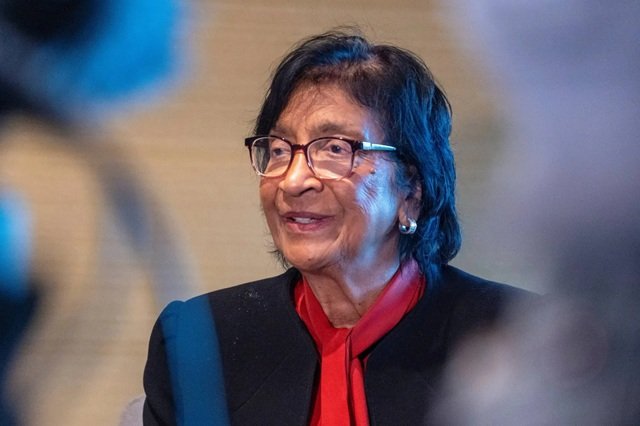
The recent award of the 2026 Nobel Peace Prize to South African jurist and former United Nations High Commissioner for Human Rights Navanethem Pillay, 85, drew global attention to Sri Lanka’s successful war against the separatist Liberation Tigers of Tamil Eelam (LTTE). Sri Lanka brought the war to an end a year after Pillay succeeded Louise Arbour (2004 to 2008) as UN Human Rights Chief.
Congratulating Pillay, the only UN Human Rights chief to win the Nobel Peace Prize, Dr. Jehan Perera, on behalf of the National Peace Council (NPC), issued a press release which was aptly headlined, citing the main obvious agenda of the NGO lobby – ‘Nobel Peace Prize to Navanethem Pillay is reminder to Sri Lanka of unfinished commitments’
Pillay currently serves as a temporary judge on the International Court of Justice (ICJ), presiding over the case where Myanmar is under investigation for perpetrating genocide.
The Global Tamil Forum (GTF), too, cheered, stating that for the Tamil people in Sri Lanka, Ms. Pillay’s contribution, during her tenure as United Nations High Commissioner for Human Rights, holds particular significance. The UK headquartered GTF stated: “At a time when the grave allegations of war crimes and crimes against humanity, committed in Sri Lanka, risked being forgotten or marginalised, she helped ensure that accountability remained firmly on the international agenda. Her call for an international investigation marked an important moment in the continuing struggle for truth and justice for the victims and survivors of the Sri Lankan conflict. Although meaningful justice remains elusive to this day, the international attention sustained through these efforts continues to offer hope to victims, survivors and their families.
The Tamil Guardian, too, applauded Pillay’s intervention in Sri Lanka. Did the Norwegian Nobel Committee meticulously examine Pillay’s role in Sri Lanka? Comprehensive examination of her role is of critical importance as Norway-led mostly one sided peace process here created mayhem.
Let us discuss the Office of the United Nations High Commissioner for Human Rights during the period Pillay held the top post, from 2008 to 2014. Her term commenced on 01 September, 2008, as the LTTE was resisting a multi-pronged ground offensive, targeting Kilinochchi, which the group considered as its administrative headquarters, after the loss of Jaffna peninsula, during the 1995/1996 period.
Pillay’s Office hadn’t been worried as the LTTE continued to boast it held the upper hand in the northern theatre of operations. The Tamil Diaspora, too, remained confident of the fighting prowess of the LTTE, though Mahinda Rajapaksa’s government sustained the offensive, while all self-appointed pundits said Sri Lankan security forces were incapable of defeating the LTTE, including some of our so-called expert columnists here, who were actually cheerleaders for the Western agenda. Pillay was obviously deceived. Geneva wasn’t really bothered about the situation on the ground in spite of the fighting formations making slow but steady progress.
Those who believed in the LTTE’s battlefield invincibility were jolted when the Army regained Kilinochchi on 02 January, 2009. The often repeated myth was shattered. The armed forces achieved the notable target two months short of two years after the launch of their Vanni campaign. The loss of Kilinochchi made the outcome of the Eelam war a foregone conclusion.
The government disregarded the LTTE’s repeated warnings that Colombo would be bombed if the Army attempted to regain Kilinochchi. The fall of Kilinochchi, just four months after Pillay’s new appointment, should have galvanized Geneva. Unfortunately, Geneva failed to act swiftly and decisively. Had Geneva, with the backing of Sri Lanka peace co-chairs, namely the US, Norway, Japan and EU, brought real pressure on the LTTE the final onslaught on the Vanni east front could have been averted. Thousands of lives could have been saved. But, Geneva pursued its own agenda, regardless of the LTTE resorting to gathering large-scale civilian human shields.
It would be pertinent to mention that Pillay herself conceded, in March, 2009, that the LTTE used civilians as human shields, shot those who left and forcibly recruited people, including children, to fight. But, in her capacity as the UN Human Rights chief, she stopped short of demanding the immediate release of civilians held as human shield. Perhaps, Pillay’s Indian Tamil origin discouraged her from making such a call. Those who applauded the Nobel Peace Prize for Pillay should examine their own response to the LTTE’s widespread use of civilian shields and children in combat operations during the January-May 19, 2009 period.
UN inaction
The UN obviously responded to the then developing situation in Sri Lanka on the presumption that the armed forces lacked the wherewithal to bring the war to a successful conclusion. Pillay and then UN Secretary General South Korean Ban-ki moon misjudged the situation in Sri Lanka.
Both appeared to have believed the LTTE myth, floated by the West, that in spite of heavy battlefield beatings, it had the military depth to halt the armed forces offensive. Reappraisal of UN operations here could easily establish Ban-ki moon and Pillay’s predecessor Louise Arbour never really sought to pressure the LTTE not to prolong the bloodshed by literally backing its crazy demands. In fact, the UN failed to realise that the liberation of the entire Eastern Province by the second week of July 2007 may pave the way for a determined government bid to regain the entire Vanni region.
The UN, obviously, failed to take into consideration the launch of the Vanni offensive in March 2007, months ahead of the conclusion of major operations in the Eastern theatre.
Seeing how the UN has been behaving in places like Gaza, West Bank, Lebanon and elsewhere, luckily for us Mahinda Rajapaksa stuck to his guns, but the West is now exacting revenge from that family through its proxies.
The UN secretly negotiated for the release of two UN workers held by the LTTE in the Vanni. The Colombo-based UN bigwigs kept the incident under wraps believing that the LTTE would eventually free them.
In spite of the UN Headquarters receiving information regarding the incident, an influential section of the Colombo-based diplomatic community strived to resolve the dispute without bringing it to the notice of the government. The UN office in Colombo should have brought the incident immediately to the notice of the government.
The LTTE accused Tamil UN staffers of helping Tamils flee the LTTE-held region. Civilians began fleeing the region amidst signs that fighting could be intensified.
The UN brought the detention of UN workers to the notice of the government after all its efforts failed to convince the LTTE. The LTTE is believed to have detained UN workers for about a month. We haven’t heard of the UN ever seeking punitive action against the LTTE. The responsibilities of the Office of the High Commissioner for Human Rights cannot be discussed without examining the overall UN response to the Sri Lanka war.
The UN turned a blind eye to the forcible recruitment of children by the LTTE. Ban Ki-moon or Pillay never bothered to revisit the agreement that had been finalised during President Chandrika Bandaranaike Kumaratunga’s tenure. The agreement worked out among the government, the UN, the ICRC and the LTTE was meant to stop the despicable practice of deploying child soldiers.
An unprecedented agreement
Had the UN taken meaningful measures to ensure the implementation of the agreement, the war wouldn’t have lasted so long. There had never been a similar agreement during the conflict here. Interestingly, none of those demanding accountability, on the part of the government of Sri Lanka, never bothered to push for the implementation of the unprecedented agreement, finalised by the then UNSG Kofi Atta Annan’s Special Representative, Olara Otunnu, in early May, 1998 (UN, LTTE to discuss modalities with strap line Pledge to stop using children in combat – The Island, May 11, 1998). Otunnu visited the Vanni, with the blessings of the then Foreign Minister Lakshman Kadirgamar, to discuss the arrangement with a British citizen, of Sri Lankan origin, Anton Balasingham, who was also the official Tiger Theoretician, and Thamilselvam.
At the conclusion of Otunnu’s weeklong visit, the UN mission, in Colombo, proudly declared that political advisor Balasingham, and Political Wing leader, Thamilselvam, had, on behalf of LTTE leader Velupillai Prabhakaran, assured an immediate stop to using children in combat operations.
A jubilant Otunnu declared, in Vavuniya, that the LTTE had agreed for the setting up of a mechanism to monitor commitments made to the UN (Tigers agree to end use of chidren below 18 in combat – The Island, May 9, 1998). Having succeeded Boutros Ghali as UN Chief, in 1997, Annan intervened in Sri Lanka though his predecessor did absolutely nothing to end the bloodshed in Sri Lanka. However, at the time of the disastrous Indian intervention here, Pérez de Cuéllar had been at the helm at the UN. Unfortunately, Annan failed to implement the agreement. Foreign Minister Kadirgamar quite rightly urged the LTTE to adhere to the agreement.
A skeptical Kadirgamar told the writer that it was the UN’s responsibility to ensure the implementation of the agreement. Kadirgamar asserted that it was nothing but propaganda as the LTTE couldn’t sustain its war effort without fresh cadres joining the depleted fighting formations (Transform commitments into action, Government urges LTTE – The Island, May 9, 1998). Otunnu had been the first foreign official to hold talks with the LTTE, with Sri Lanka’s blessings, since the Gandhi assassination, in May, 1991. Perhaps, the LTTE used the UN to boost its image in the wake of the US designating the group, in the previous year, as a Foreign Terrorist Organisation.
Salient points of the UN-LTTE agreement:
* The LTTE promised to immediately stop deployment of children under 18 years of age. The group also promised to end the recruitment of children, below the age of 17 years.
* The LTTE assured not to interfere with those war displaced families wanting to return to areas under government control. In addition, the LTTE promised to allow Muslims, driven out by them, in late 1990, to return to their villages. (The LTTE at gunpoint ordered the entire Muslim population to vacate the Northern Province in late Oct/Nov 1990).
* The UN also received an assurance from the LTTE that it wouldn’t interfere with the distribution of relief supplies among the war affected population, particularly those living in areas under its control.
* The LTTE pledged to adhere to the Convention of the Rights of the Child. The group promised to take measures to educate its fighting cadres, as well as other units as regards the Convention.
* The LTTE assured that it would review its military strategies as regards operations directed at civilians and other non-military targets.
The UN never acknowledged its failure to ensure the implementation of any of the commitments made by the LTTE. In fact, the LTTE continued to violate promises made to the UN until the military eradicated the conventional fighting capability of the group, in May, 2009. The LTTE lasted for 11 more years after having taken the UN for a ride. Wouldn’t it be appropriate to launch a thorough study on the conflict to ascertain the UN’s failure here?
CBK’s 1994/95 effort
The NPC used the award of Nobel Peace Prize to Navanethem Pillay to remind the world of Sri Lanka’s unfinished commitments. The NPC that had been in operation since February ’95 is aware of the escalation of fighting after the LTTE broke the ceasefire (cessation of hostilities) negotiated during Kumaratunga’s presidency. Having won the parliamentary polls, Kumaratunga held talks (Oct. 04 to April 1995) but the LTTE resumed attacks in the third week of April.
The global community didn’t come to Sri Lanka’s rescue. Multiple devastating attacks stunned the country. The LTTE sank two Shanghai ii class fast gunboats at the gunboat pier at the Navy dockyard, Trincomalee harbor, on 19 April, and brought down two Avros over Palaly air base a week later. Those who backed that peace effort simply moved away, leaving unprepared Sri Lanka to face an unprecedented new threat of heat seeking missiles. The LTTE intention was clear. It intended to cut off the Jaffna peninsula. In the absence of Sri Lanka losing the overland Main Supply Route (MSR) to the peninsula, denial of sea and air supply routes could have a devastating impact on the military deployed there.
Norway, which had been a major sponsor of the NPC, from the onset of its ‘operations’, was among the countries involved in Kumaratunga’s disastrous effort. The government and the LTTE agreed on the formation of four peace monitoring committees, headed by foreigners, following talks in Jaffna on 24 January, 1995. The ICRC arranged the meeting that led to the consensus on four committees consisting of five persons – two representatives each from the government and the LTTE and foreign heads. The ICRC politely declined to head one of the committees, while Norway (Audun Holm and Johan Gabrielson), Canada (retired Major General. C. Milner) and the Netherlands (retired Lt. Colonel Paul Henri Horsting) accepted the responsibility. When the LTTE resumed Eelam War 111, with the sinking of China-supplied fast gunboats and transport aircraft procured from the UK, foreign heads of so-called peace monitoring committees quietly left the country.
The LTTE never actually allowed the peace committees to function though their foreign heads were granted a rare opportunity to meet LTTE leader Velupillai Prabhakaran on 05 February, 1995, in Jaffna.
From the very beginning, the Kumaratunga peace bid was destined to fail. The LTTE caused obstacles. The international community tolerated. The British allowed the terrorist group’s International Secretariat to function from London, even after it assassinated former Indian Premier Rajiv Gandhi while he was campaigning in Tamil Nadu during the Indian general election of 1991.
Later, the LTTE demanded that there should be six peace monitoring committees. The government promptly agreed but failed to realise that the group was preparing to deliver a strategic blow. The LTTE maximized the opportunity to win concessions. It wanted the government to do away with restrictions on fuel, cement and iron while another major contentious issue was the troops deployed at Komar point-Pooneryn sector. Anyway, the resumption of war, in April, 1995, caught Kumaratunga’s government by surprise, after having blindly trusted the LTTE, and the so-called international community, led by the West.
But, Kumaratunga taught the LTTE an unforgettable lesson when the armed forces brought back the entire Jaffna peninsula, under government control, during operations conducted in 1995/96. In spite of a devastating attack on Elephant Pass, in 2000, after having evicted the Army from its bases south of Elephant Pass up to Kilinochchi, the LTTE could never re-capture Jaffna.
In Nov, 2008, the Jaffna-based fighting formations moved southwards of Muhamalai, two months after Pillay received the appointment as UN Human Rights chief. By then, the Task Force I (later elevated to 58 Division) had recaptured the Kandy-Jaffna A 9 road, stretch from Kilinochchi northwards to Elephant Pass ,where the Army suffered a humiliating defeat in 2000.
Under Pillay’s leadership, too, like her predecessors, the Office of Human Rights Commissioner essentially pursued an agenda hostile to Sri Lanka. It couldn’t stomach the LTTE’s impending defeat. Pillay conveniently failed to acknowledge that Sri Lanka went on the offensive after having exhausted all avenues to end the conflict through dialogue. During Pillay’s tenure as the UN Human Rights chief, the organisation pathetically failed to address accountability issues. Like her predecessors and successors, Pillay, too, never acknowledged that whichever party in power, the government couldn’t have succumbed to the LTTE’s tactics.
The UN in Colombo had been so involved with the LTTE and literally became part of its operation. The mission here refrained from alerting New York immediately of the abduction of UN workers, accused of helping Tamil civilians to enter government held area in 2007. This happened weeks after the newly raised 57 Division launched operations in March, 2007, west of Vavuniya, with the objective of taking Madhu. That division had been tasked to regain Kilinochchi. The Task Force I launched operations in Sept 2007.
The UN had ample time and opportunities to make a meaningful intervention. Instead of compelling the LTTE to give up terrorism, it mollycoddled the group. The UN never really questioned the LTTE regarding its relentless efforts to eliminate Tamil groups who previously carried weapons. Pillay pursued her predecessor Louise Arbour’s approach that allowed the LTTE to continue fighting. Western governments, civil society as well as the UN until the very end believed the LTTE could turnaround the battlefield status. It was not to be.
A brief missive sent by war time Norwegian Ambassador in Colombo, Tore Hattrem, to the then National List MP and presidential advisor Basil Rajapaksa revealed a halfhearted Norwegian bid to secure the release of civilians held by the LTTE. Pillay couldn’t have been unaware of this but she obviously turned a blind eye to the developing situation. Her March statement didn’t make any impact, by then, the government was hell-bent on destroying the LTTE, for once and for all.
The following is the text of the letter headlined Offer/proposal to the LTTE dated Feb. 16, 2009: “I refer to our telephone conversation today. The proposal to the LTTE on how to release the civilian population now trapped in the LTTE controlled area has been transmitted to the LTTE through several channels. So far there has been regrettably no response from the LTTE and it does not seem to be likely that the LTTE will agree to this in the near future.”
Norway never pushed the influential Tamil Diaspora, in Norway, to pressure the LTTE leadership to give up its meaningless resistance. Thanks to Wikileaks, the world knows the ICRC believed the Army could have finished off the LTTE much faster if it didn’t take the civilian factor into consideration on the Vanni east front.