


by Nil
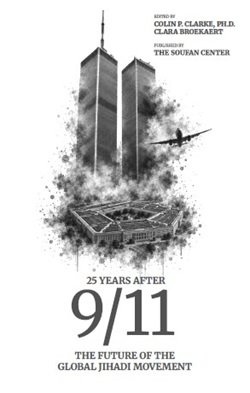
Twenty-five years after the planes struck New York and Washington, the most unsettling argument in 25 Years After 9/11: The Future of the Global Jihadi Movement is not that al-Qaeda or Islamic State has returned to the scale of 2001 or 2014. It is that the West may be losing the capacity to recognise what comes next. Edited by Colin P. Clarke and Clara Broekaert, this ambitious volume is less a commemoration than an institutional warning. Its central paradox is stark: the jihadi movement has become less central to Western strategic thinking at precisely the moment it has become more geographically dispersed, organisationally adaptive and technologically capable. The book’s most provocative proposition is therefore not that another 9/11 is imminent, but that the conditions for strategic surprise are being reconstructed. As the editors put it, “the distance between the perception of the threat and the threat as it operates is thus also the subject of this book” (p. 6). That sentence captures both the volume’s intellectual strength and its principal anxiety.
Ali Soufan’s preface establishes the moral and strategic tension that runs through the collection. The United States, he argues, has repeatedly “confused vengeance with security, impunity with strength, and callousness with patriotism” (p. 2). More damagingly, “America has inadvertently served Osama bin Laden’s ends more than its own” (p. 2). These are unusually severe judgements from a figure deeply associated with the post-9/11 counterterrorism enterprise, and they prevent the book from becoming a conventional celebration of two and a half decades of counterterrorism. Yet Soufan’s argument contains a revealing contradiction. The volume is simultaneously an indictment of America’s strategic excesses and an argument for retaining the institutional architecture built to fight the very threat that helped produce those excesses. The authors want neither the permanent war footing of the Bush era nor the strategic amnesia that may follow it. That is a defensible position, but it is also the book’s most difficult political problem: how does a state maintain vigilance without allowing vigilance itself to become an engine of overreach?
Brian Michael Jenkins and Daniel Byman provide perhaps the volume’s most convincing corrective to the mythology of the Global War on Terror. Jenkins recounts the transformation of an initially focused campaign against al-Qaeda into something vastly more ambitious, while Byman dissects the analytical errors that followed 9/11. His conclusion is admirably restrained: “the central lesson is not complacency but calibration” (p. 59). That formulation is important because it rejects two equally misleading narratives. The first is that the post-9/11 campaign was an unqualified disaster; the second is that military power and regime change solved the problem. Byman observes that “it is easier to destroy than create” (p. 57), a deceptively simple observation that exposes the fantasy underlying the invasions of Afghanistan and Iraq. Removing regimes proved considerably easier than constructing stable political orders in their place. Yet the book could push this argument further. Its criticism remains largely centred on American strategic competence rather than on the deeper political assumptions that made such interventions conceivable. The failure was not merely that Washington executed nation-building badly; it was also that policymakers repeatedly imagined that societies could be reordered from outside through military power.
The volume becomes more persuasive when it turns from American mistakes to the evolution of the jihadi movement itself. Soufan’s estimate that al-Qaeda has expanded from approximately 400 men under arms in 2001 to between 15,000 and 28,000 today, excluding another 12,000 to 18,000 Islamic State members and affiliates, is deliberately jarring (p. 2). But the editors are careful not to equate numerical growth with strategic victory. Their more sophisticated argument is that the movement’s strength lies in adaptation. “The movement has continued to adapt, expand, and, worryingly, has been able to absorb new capabilities and technologies” (p. 6). The crucial word is “adapt”. The book is at its best when it treats jihadism not as a fixed organisation awaiting decapitation but as a political ecosystem capable of mutation, localisation and recombination. Yet there is a danger here too. By repeatedly emphasising resilience, the volume risks creating the very threat inflation it warns against. If every adaptation is interpreted as evidence of resurgence, then decline, fragmentation and organisational weakness can become analytically invisible.
The Somalia chapter by Tricia Bacon offers the strongest empirical demonstration of why geography matters. Somalia’s transformation from what she calls a “backwater” into a focal point of global jihad is not presented simply as the movement’s migration from one theatre to another. Al-Shabaab has developed an institutional capacity that complicates the conventional distinction between terrorist organisation and governing authority. Bacon’s assertion that it “carries the al-Qaeda banner on its own terms as a self-sufficient affiliate” (p. 95) challenges the familiar franchise model in which affiliates are presumed to depend upon a central organisation. More striking still is her conclusion that “Al-Shabaab’s greatest asset is not military but political” (p. 91). This is one of the book’s most important observations because it exposes the limitations of a counterterrorism paradigm obsessed with killing commanders. If an insurgent organisation can tax, administer, intimidate and mediate disputes, its durability cannot be measured simply by its capacity to conduct spectacular attacks. Bacon’s warning that “airpower cannot substitute for the instruments that convert tactical pressure into strategic effect” (p. 91) is therefore as much a critique of counterterrorism thinking as it is a lesson about Somalia.
Amira Jadoon’s chapter broadens this argument by challenging the neat separation between terrorism and geopolitics. Her claim that the next strategic surprise in South Asia is likely to arise from “the interlinkages between interstate conflict and militant movements” is particularly consequential (p. 87). Her conclusion that analysis “requires analytical categories that treat state and militant behavior as endogenous to each other, rather than as separate tracks” (p. 107) points towards a genuine conceptual problem. The traditional counterterrorism framework isolates organisations, leadership structures and attack capabilities; contemporary conflict increasingly mixes states, proxies, insurgents, criminal networks and transnational ideological movements. The uncomfortable implication is that terrorism cannot always be understood independently of the political systems that sustain, exploit or inadvertently strengthen it. Yet this analytical expansion also carries risks. If almost every geopolitical rivalry becomes part of the terrorism problem, counterterrorism can once again become an all-purpose explanation for international disorder—the very conceptual inflation that the volume otherwise condemns.
Assaf Moghadam’s treatment of October 7 is similarly ambitious. His description of the attack as “a combined terrorist and guerrilla attack” (p. 140) challenges conventional categories of political violence and supports his larger contention that the distinctions between terrorism, insurgency and interstate conflict are becoming increasingly artificial. His recommendation that policy should focus on “how actors fight, rather than how we label them” (p. 11) is intellectually attractive. It also raises a difficult question about the political consequences of classification. Labels such as terrorist, insurgent, proxy and army are not merely academic categories; they determine legal status, diplomatic treatment and military response. The danger is that abandoning categories in favour of capabilities and behaviour may improve analytical accuracy while simultaneously weakening the normative distinctions that international law and counterterrorism policy depend upon. The book identifies the problem but does not entirely resolve it.
The chapters on technology deepen the argument about strategic surprise. The warning that “failure to accurately assess the protean nature of terrorist and other threats involving drones could open the United States and its partners up to significant surprise attacks” (p. 11) is less about drones themselves than about institutional imagination. This connects Don Rassler’s chapter directly to the volume’s central theme. The 9/11 Commission famously called the attacks a “failure of imagination”, but Rassler asks whether institutions have genuinely learned that lesson. His concern that counterterrorism has become increasingly compartmentalised is encapsulated by a practitioner who admits, “I am really surprised how siloed up we’ve become again” (p. 74). The irony is difficult to miss: an apparatus created to prevent the information failures of 2001 may be recreating some of the organisational conditions that preceded them.
Aaron Y. Zelin’s concluding chapter turns that irony into the book’s most politically provocative claim. “Budgets can be restored in a single appropriations cycle. Knowledge cannot” (p. 10), he argues. This is persuasive as an institutional warning, particularly because terrorism expertise takes years to cultivate. But Zelin’s argument occasionally approaches a self-reinforcing logic: because counterterrorism professionals fear that declining resources will produce future surprises, any reduction in resources becomes evidence of dangerous complacency. The more difficult question is how much counterterrorism capacity is enough, and how policymakers should balance that requirement against competing threats from China, Russia, organised crime, cyber conflict and other forms of political violence. The book calls for a “sustainable floor”, not another boom-and-bust cycle, but it is less precise about where that floor should actually sit.
That limitation does not diminish the volume’s larger achievement. 25 Years After 9/11 refuses the comforting conclusion that either jihadism has been defeated or that another catastrophe is inevitable. Instead, it presents a more uncomfortable proposition: terrorism can decline in strategic importance without disappearing as a security problem. The movement may be weaker in some respects, stronger in others, more fragmented yet more geographically extensive, less capable of another 9/11 but better positioned to exploit local conflicts and technological change. Its own resilience is therefore partly a product of Western success and Western distraction. The United States learned how to prevent large-scale attacks on its homeland, but it also spent enormous resources pursuing objectives that exceeded counterterrorism and generated consequences that helped militant movements.
The book’s deepest lesson is consequently not that the West should return to the post-9/11 mobilisation, but that it must resist the temptation to oscillate between obsession and neglect. As Byman puts it, “the United States cannot eliminate terrorism altogether” (p. 59). What it can do is prevent terrorism from becoming either an existential obsession or a forgotten threat. That is a harder political task than declaring war, invading countries or dismantling institutions. The tragedy of 9/11 was followed by strategic overreaction; the danger now, the volume argues, is strategic amnesia. Between those two failures lies the elusive principle of calibration. The book does not always achieve it itself, occasionally overstating the danger in its effort to warn against complacency. But its central challenge remains difficult to dismiss: an adversary does not have to become stronger than its enemy to become dangerous. Sometimes it merely has to wait until its enemy stops looking.










