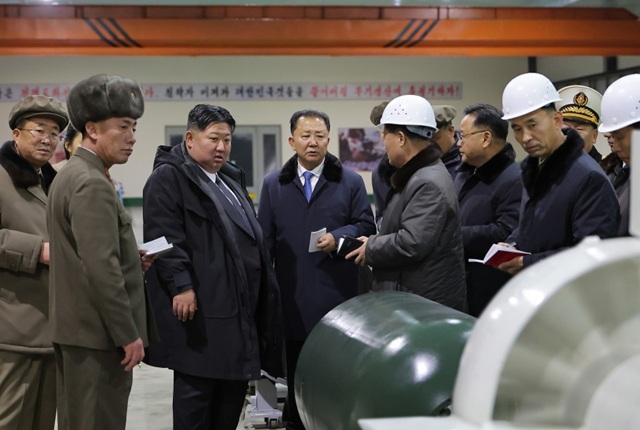
North Korean leader Kim Jong Un has overseen the construction of a nuclear-powered strategic guided missile submarine, underscoring Pyongyang’s determination to expand its nuclear deterrent at sea as regional security tensions intensify. The development was disclosed by the state-run Korean Central News Agency, or KCNA, which reported that Kim personally guided the submarine-building project during an on-site inspection.
According to KCNA, the vessel under construction is an 8,700-ton nuclear-powered submarine designed to carry strategic guided missiles, marking what the leadership describes as a major milestone in the modernization of the country’s navy. Kim was accompanied by senior officials from the warship-building sector as well as defense science research and production units, and he was briefed in detail on the progress of the project.
KCNA said the submarine is part of a broader plan approved at the 8th Congress of the Workers’ Party of Korea, which identified the development of a strategic nuclear attack submarine as one of five key tasks for strengthening national defense capabilities. Workers, scientists, and technicians were praised for advancing the project through what the report described as self-reliance and patriotic commitment.
During the visit, Kim emphasized the strategic importance of the submarine in implementing North Korea’s defense policy, which he characterized as defensive in nature but grounded in what he called the strongest offensive power. KCNA quoted him as saying that a “super-powerful offensive capability” serves as the most reliable shield for national security, reinforcing Pyongyang’s long-standing argument that its nuclear arsenal is meant to deter aggression rather than provoke it.
Kim also framed the expansion of nuclear forces as a historical duty, asserting that the current generation bears responsibility for strengthening what he described as the country’s nuclear shield and ensuring the irreversible security of the state. He said the completion of a new nuclear-powered submarine would represent an “epoch-making” change, demonstrating the level of war deterrence the Democratic People’s Republic of Korea has achieved.
The KCNA report linked the submarine project to broader geopolitical developments, including recent moves by South Korea and the United States. Kim criticized what he described as Washington’s approval of Seoul’s plans to develop nuclear-powered submarines, calling it an offensive act that violates North Korea’s maritime sovereignty and heightens instability on the Korean Peninsula. He said such actions justified accelerating the modernization and nuclear weaponization of North Korea’s naval forces.
Kim further noted that new attack destroyers and nuclear submarines currently under construction would significantly enhance the combat capabilities of the country’s fleets. He outlined plans to expand the scale and speed of building both surface and underwater warships and to equip them with a variety of offensive weapons systems, signaling a sustained push to strengthen naval power alongside land- and air-based nuclear forces.
KCNA reported that Kim also reviewed ongoing research into new underwater weapons systems and provided strategic guidance on reorganizing naval forces and establishing new units. He reaffirmed that North Korea’s security policy remains unchanged and warned that any attempt to violate the country’s strategic sovereignty would be met with what he described as merciless retaliation.