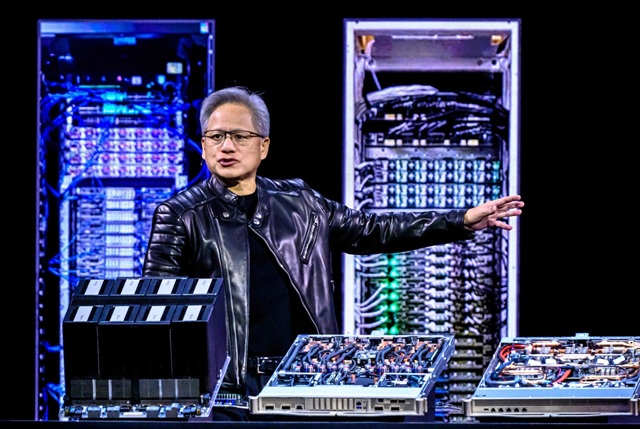
The artificial intelligence (AI) boom has drawn attention from tech giants and national champions eager to close the gap on Nvidia, the chipmaker that has become central to the AI revolution. Once relatively unknown to the public, Nvidia now boasts the world’s highest revenue in semiconductors, driven largely by sales of its graphics processing units (GPUs) — the processors that power AI models such as ChatGPT and its rivals.
Nvidia’s dominance stems from decades of experience in GPUs, which it began specializing in during the late 1990s, coinciding with the rise of cloud computing. Analysts have described the company as a “three-headed dragon”, offering not just chip design, but also an integrated infrastructure combining networking and software. “It can satisfy every level of need in the datacenter with world-class product,” said Jon Peddie of Jon Peddie Research.
Competitors remain far behind. American firm AMD, historically considered Nvidia’s closest rival, generates most of its revenue from CPUs — less powerful processors used in personal and business computers — and has limited ability to pivot resources toward GPUs, according to analysts. Meanwhile, major cloud providers have developed their own AI processors: Google’s Tensor Processing Unit (TPU) and Amazon Web Services’ Trainium, introduced in 2020. Combined, these account for more than 10% of the market and have surpassed AMD in certain performance metrics, including pricing, reliability, and capacity to meet large-scale demand. Google has also started offering its chips to third-party customers, though Amazon has not.
In China, companies such as Huawei, Baidu, and Alibaba are developing AI processors domestically, though they remain substitutes for Nvidia’s GPUs due to export restrictions and the technical challenges of local fabrication. Experts caution that China will require time to catch up, despite a large workforce and substantial government-backed investment.
For now, Nvidia’s position appears secure. “Nvidia underpins the vast majority of AI applications today,” said John Belton, analyst at Gabelli Funds. The company continues to innovate rapidly, with its upcoming Rubin GPU, expected in late 2026, projected to deliver 7.5 times the AI performance of its current flagship, Blackwell.
Analysts agree that while competitors are investing heavily, Nvidia’s combination of hardware, software, and ecosystem integration will make it difficult to dethrone the Santa Clara, California, company in the near term.