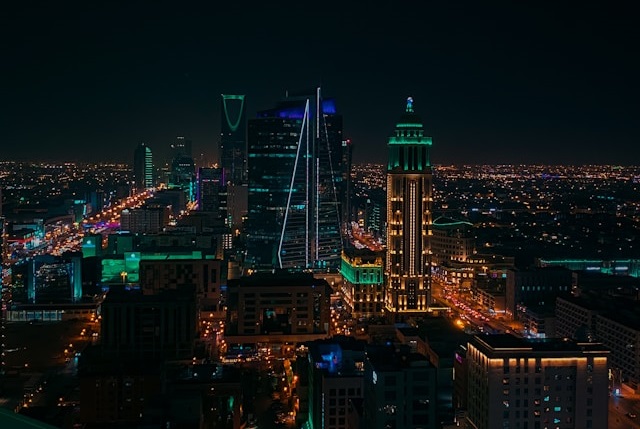
Riyadh’s King Abdullah Financial District (KAFD), long criticized as a gleaming but empty skyline, is finally coming to life as Saudi Arabia pushes ahead with ambitious plans to become a regional financial hub, according to the Financial Times.
First announced in 2006, the $10 billion development faced years of delays, leaving towering skyscrapers largely vacant. That is now changing as the kingdom’s $940 billion sovereign wealth fund, the Public Investment Fund, began moving staff into KAFD’s tallest building last year, and global firms such as HSBC and Accenture start taking up offices.
Observers describe the district as reminiscent of Canary Wharf in the late 1990s, a time when London’s docklands began to establish itself as a financial centre. Pedestrian-friendly spaces, high-end restaurants, and ongoing construction of skywalks are gradually transforming the district into a modern urban hub.
Saudi authorities have incentivized foreign companies to set up regional headquarters in the kingdom by linking it to access to government contracts. Since 2021, more than 600 firms have received licences to establish regional bases in Saudi Arabia. Banks including Goldman Sachs and Morgan Stanley have opened offices, though some financial institutions remain cautious due to the kingdom’s regulatory environment, which differs from Dubai’s International Finance Centre.
The Financial Times reports that officials hope recent judicial and regulatory reforms, combined with the kingdom’s large-scale economic diversification projects, will make Riyadh an attractive destination for global finance. Agreements between the Public Investment Fund and international asset managers such as BlackRock and Neuberger Berman aim to channel investment into Saudi Arabia, supporting up to $6 billion in projects and creating a Riyadh-based multi-asset investment platform.
Social reforms, including lifting the ban on women driving, and new infrastructure such as a futuristic metro station designed by Zaha Hadid, are also intended to attract international talent. However, challenges remain, including limited schools, housing, and lifestyle preferences, with many expats still favouring Dubai for its established financial ecosystem and more liberal environment.
While Dubai remains ahead in terms of financial hub status, Riyadh is rapidly closing the gap, leveraging its economic heft, sovereign wealth, and long-term planning to position itself as a rising regional centre for finance.