by Our Correspondent in New Delhi
Rashtriya Swayamsevak Sangh (RSS) chief Mohan Bhagwat has warned against political movements that he says exploit public grievances to generate hostility towards institutions, ideologies and individuals, alleging that global powers seeking to weaken India can take advantage of domestic divisions. Addressing the organisation’s annual Vijayadashami gathering in Nagpur on Tuesday, marking its 101st foundation day, Bhagwat called for vigilance against agitation that could undermine public confidence in the country’s systems, while asserting that there would be no “regime change” in India.
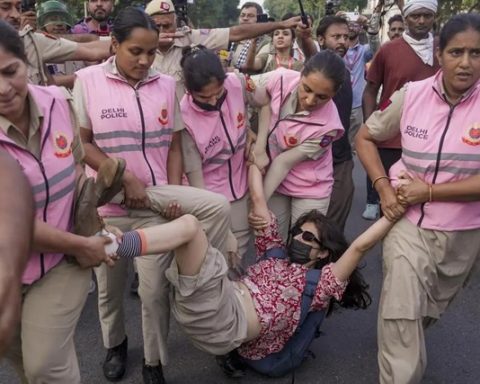
His remarks came as Opposition parties, students and young people led by the Cockroach Janta Party (CJP) were holding protests against Chief Election Commissioner Gyanesh Kumar and the controversy surrounding the Special Intensive Revision (SIR) of electoral rolls. Although Bhagwat did not identify every protest or movement he was referring to, his speech framed political mobilisation driven by antagonism as a potential vulnerability that external forces could exploit.
“When a movement becomes a tool of politics, driven by hostility and antagonism towards an individual, a group, or an ideology, forces seeking to undermine Bharat take advantage of the situation,” he said. He described the creation of mutual hostility, the amplification of grievances and the erosion of trust in national institutions as elements of a wider process that could produce discord, discontent, separatism and disorder.
“Global powers that wish to keep India subdued also occasionally play their part in this process,” Bhagwat said, suggesting that international interests could contribute to domestic instability. He also referred to protests and unrest in France, Albania, Bangladesh and Nepal, presenting them as examples of agitation associated with instability in different parts of the world. His speech did not provide specific evidence establishing foreign involvement in the Indian protests or detailing the alleged international coordination.
Bhagwat urged people to resist what he described as divisive tendencies and intellectual confusion, arguing that political and social disagreements should not become grounds for lasting hostility. “We must protect our mutual goodwill by remaining alert and safeguarding ourselves against the intellectual confusion created by such divisive tendencies,” he said. He called on Indians to avoid being provoked and to continue working towards the aspiration of making Bharat a “Vishwaguru”, or a guiding nation for the world.
National unity formed the central theme of his historical argument, particularly his interpretation of the role played by Vande Mataram during the movement against the proposed partition of Bengal under British rule. Bhagwat said the song had become a symbol of unity when Lord Curzon sought to divide Bengal along communal lines, separating Hindus and Muslims. He argued that opposition to the proposal had compelled the British government to withdraw it.
“When Lord Curzon sought to partition Bengal along communal lines, to drive apart Muslims from Hindus, the society firmly opposed the division of one land – one people on communal grounds,” he said. “It was during that period when Vande Mataram emerged as a symbol of that very unity and patriotism. The partition was defeated.”
He contrasted that episode with the partition of India in 1947, attributing the different outcome to the growth of communal and extremist thinking, political ambition and what he called appeasement. According to Bhagwat, people came to regard differences in appearance and identity as evidence that communities were fundamentally separate, weakening their sense of shared belonging.
“Driven by the obsession with separatism, combined with the lust for political dominance, and the pursuit of selfish interests, we gradually began to reject the very foundations that had held us together as one,” he said. “Ultimately, the country was partitioned.”
Bhagwat argued that partition had left India with enduring insecurity, distrust and conflict along its borders and within the country. He described Vande Mataram as a continuing source of national unity and said there should be no hesitation or objection to singing the national song in its entirety. His account presented national cohesion as dependent not only on political arrangements but also on the willingness of communities to recognise a common identity despite religious, linguistic and cultural differences.
The RSS chief also linked his argument about unity to the organisation’s understanding of Hindutva and India’s historical identity. He said the Preamble to the Constitution envisaged a society held together by emotional unity despite its diversity, but argued that India’s conduct had at times departed from that ideal. In his assessment, internal divisions and failures of collective responsibility had contributed to centuries of foreign subjugation.
“Through Herculean efforts and countless sacrifices, we have freed ourselves from those difficult times and have once again embarked upon the path of unity and progress,” he said.
Bhagwat presented India’s cultural traditions as a potential contribution to addressing international problems, arguing that the world’s difficulties stemmed partly from an incomplete understanding of life and an excessive emphasis on material interests. He criticised what he described as selfishness, consumerism and collective greed, linking them to exploitation, violence and religious extremism. He specifically cited the Islamic State of Iraq and Syria (ISIS), which he described as a new manifestation of terrorism in West Asia, and argued that international efforts to combat such violence would remain inadequate unless the conditions and interests sustaining cycles of terror were addressed.
He nevertheless acknowledged that India had lessons to learn from other countries, particularly in human effort and endeavour. The country, he said, should combine such learning with a clear understanding of its national identity, the preservation of unity and organised collective work. His stated objective was a prosperous and capable India whose development incorporated ethical principles, compassion, service and universal welfare.
The address also included a defence of the RSS against criticism arising from incidents with which Bhagwat said the organisation had no connection or association. He alleged that attempts were being made to undermine public confidence in the organisation’s intentions by citing undesirable or unexpected events. “The work of the Sangh is founded on pure, selfless, and virtuous love,” he said. He added that his recent visits abroad had sought to present what he considered a correct picture of India and the RSS to international audiences.
Bhagwat’s appeal for unity extended to social discrimination, poverty and the responsibilities of families and voluntary organisations. He argued that governments alone could not eliminate prejudice or deliver the social changes needed for national development. Discrimination, he said, had to be challenged through individual conduct, family life and community action, including the removal of caste-based, regional and linguistic prejudices.
He called for Hindu temples, cremation grounds and community water sources to remain open to all Hindus, and urged participation across communities in festivals and commemorations honouring historical figures. He also stressed the importance of education, social welfare, self-reliance and entrepreneurship, while arguing that public institutions and civil society should maintain dialogue to ensure that development policies reached the most disadvantaged.
The speech opened with tributes to Sant Ravidas, the 15th–16th-century saint revered among Dalit communities, and Swami Shraddhanand, the Arya Samaj leader associated with the Shuddhi reconversion movement. Bhagwat placed these references within a broader appeal for a disciplined and organised society, calling for the expansion of RSS activities across villages, streets and communities. He described the organisation, established in 1925, as committed to building a strong society rooted in what he termed the country’s national Hindu identity.