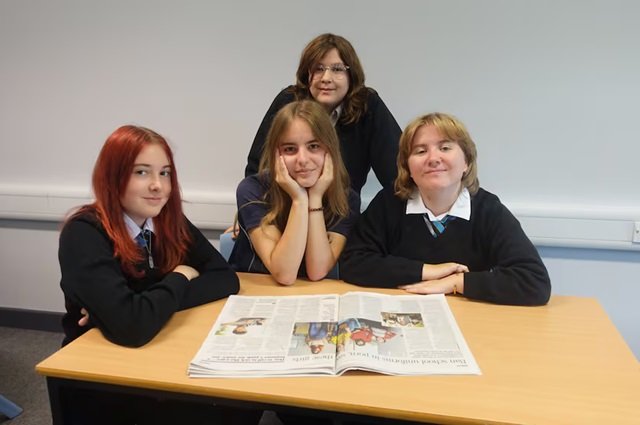
A group of 15 teenage girls in southeast England has taken its campaign against the sexualisation of school uniforms to the British Parliament, calling for legislation to prohibit their use in pornographic material and erotic costume marketing. Members of the Little Feminist Book Club at Cooper School in Oxfordshire have launched a petition, gathered more than 65,000 signatures and begun discussions with politicians across the political spectrum. Their campaign seeks to challenge the association between school clothing, designed to identify and protect children, and the commercial presentation of schoolgirls as sexualised figures.
The initiative, reported by the Spanish newspaper El País, is being led by students aged between 14 and 15, who have spent the past year researching the issue, approaching parliamentarians and contacting non-governmental organisations and academic institutions. Their central demand is to extend existing restrictions on pornography depicting people pretending to be under 16 to cover all minors under 18, while introducing a specific prohibition on the sexualised use of school uniforms.
“Why is what children wear to feel safe sexualised?” asks Kristan O’Flynn, the 51-year-old English teacher who runs the book club and supports the campaign. She argues that school uniforms are intended to protect children from being bullied over their clothing, help identify pupils during school trips and establish a shared sense of belonging. Associating them with erotic imagery, she says, undermines that purpose.
The campaign began after O’Flynn introduced the students to an earlier initiative by a feminist group at Sandbach High School in Cheshire, which petitioned Parliament in 2022 to remove school uniforms from sex shops. The Cooper School students decided to investigate the issue themselves, beginning their research in May last year. Their findings prompted them to launch their own petition in September and seek changes to existing legislation.
Rose, one of the campaign’s four student spokespeople, described the sexualisation of school uniforms as incompatible with the purpose of education. “The school uniform is intended to form a community in a safe environment, but that safe environment is destroyed the moment the uniform is fitted into a sexual category, with which no one under 18 should be associated,” she said in correspondence with El País.
The students have focused particularly on the Crime and Policing Act 2026, passed in April and brought into force in England and Wales on 6 November. Among its provisions, the legislation prohibits the possession and distribution of pornography in which a person pretends to be under 16. The campaigners argue that the restriction does not go far enough because it leaves children aged 16 and 17 outside the proposed protection. They want the law extended to cover everyone under 18, irrespective of the age of consent, and an additional amendment addressing the sexualised use of school uniforms.
O’Flynn acknowledges that legislation alone will not eliminate the problem or immediately change public attitudes. However, she argues that a legal prohibition would establish that the sexualisation of school uniforms is unacceptable. The campaign also seeks to challenge the commercial marketing of costumes and products that associate the terms “sexy” and “schoolgirl”.
The teacher points to online retail and social media searches as examples of how easily such associations appear. Searching for “school uniform” on Amazon, she says, can produce suggestions including “sexy schoolgirl” and “cosplay” before users have completed their search. She has also questioned why searching for “student” on X can produce pornographic material among the initial results. The campaigners argue that the issue extends beyond individual images to the language and commercial practices used to market sexualised representations of school-age children.
The students say that adults frequently react with surprise when they explain the campaign, often assuming that the problem has disappeared. Aylin, another member of the group, argues that the need for young people to campaign on the issue demonstrates that the sexualisation of children remains widespread and harmful.
The group has also collected accounts from women who say they experienced unwanted attention when wearing school uniforms. Some have told the students that they were shouted at more frequently in public while dressed in their school clothing. Mae, a club member, says that hearing these experiences has encouraged women to discuss incidents they had previously not recognised as part of a wider problem. She believes the campaign has helped people share their experiences and seek a sense of justice.
The students have already gained access to Parliament through an earlier campaign to improve the availability of menstrual products at their school. At a parliamentary event, they presented their latest initiative and attracted the attention of Scottish National Party MP Kirsty Blackman, who requested a meeting and promised to deliver their letter to First Minister Andy Burnham.
Their next discussions are expected to include Alex Davies-Jones, the Labour minister for victims, violence against women and girls at the Ministry of Justice, and Gabrielle Bertin, a Conservative member of the House of Lords who was instrumental in the recent amendments to pornography legislation. The campaigners are seeking to reach 100,000 signatures on their Change.org petition, which had already attracted more than 65,000.
The book club was established six years ago after a student asked O’Flynn whether she knew any other feminist writers. Its members have since moved from discussions about books and gender equality to campaigning directly for legislative reform. O’Flynn says her responsibility is to protect the students and ensure they do not feel that changing the law is theirs alone to achieve. “We will continue to argue and defend the case, but now we need the adults in power to step up,” she said.