“If you had been here on that day and at that hour, if you had seen the hell that opened up on Earth before our eyes, if you had even a glimpse of that, you would never, never entertain the crazy thought of another war. If there is another war, automatic bombs may explode everywhere and there will be no beautiful songs of distant Earth, no poems, no paintings, no music, no literature, no research. Only death.” ― Charles Pellegrino, The Last Train from Hiroshima: The Survivors Look Back
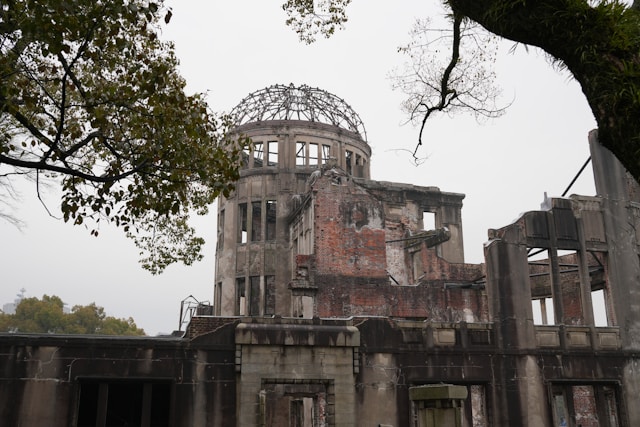
On the sixth and ninth days of August in the year 1945, the world stood witness to an act of destruction so profound that its reverberations have not ceased in the eight decades that have since passed. Hiroshima, on the sixth, and Nagasaki, on the ninth, became the unwilling laboratories in which humanity experimented with its own annihilation. These cities, their people, their landscapes, and their histories became fused with the mushroom clouds that rose above them—clouds that would forever serve as symbols not only of military dominance but of the fragility of human civilization. As we mark the eightieth anniversary of these events, the solemn remembrance is not merely a ceremonial nod to the dead but an imperative reflection on the living: what have we done with the lesson we were given in blood and fire? On a recent program marking the anniversary, The Amanpour Hour on August 9, 2025, the acclaimed filmmaker James Cameron discussed a book entitled The Ghosts of Hiroshima, authored by Charles Pellegrino, which was later adapted into a film. The title itself is an indictment—those ghosts are not merely the souls of the dead but the lingering presences of decisions made in rooms far away from the charred rubble, decisions that drew from a calculus of war where human lives became variables in equations of geopolitical supremacy.
Cameron, in his reflections, bridged the space between artistic representation and historical reality, underscoring that the atomic bombings were not only singular tragedies but also enduring narratives that must be retold if their lessons are to survive the erosion of memory. Alongside Cameron, Ernest J. Moniz, a nuclear scientist, spoke, saying the persistent myth of nuclear deterrence—the belief that the possession of nuclear weapons by rival powers guarantees peace because each fears the doctrine of Mutually Assured Destruction – should be treated with caution. In its succinct form, MAD asserts that no rational actor would initiate nuclear war knowing it would ensure its own destruction. Yet, as Moniz persuasively argued, this is a dangerously incomplete understanding of both human history and political psychology. Peace secured by fear is neither stable nor humane; it is a precarious balancing act on the edge of catastrophe.
What struck the viewer most profoundly, however, was the testimony of a Japanese citizen who survived both bombings—first in Hiroshima and then, after taking his young wife’s remains to her parental home in Nagasaki. His existence is a living contradiction to probability, an unassailable witness to the indiscriminate cruelty of nuclear warfare. The survivor’s account was not rendered in abstractions of military strategy or deterrence theory. It was the human voice of scorched earth, of rivers clogged with the dead, of the skin of children peeling away under the sun. No statistical abstraction or legal principle can replace the moral authority of such testimony, for it encapsulates the most essential truth about nuclear weapons: their logic belongs not to human ethics but to the machinery of annihilation. The haunting universality of this witness’s words reminds us that the law, in its effort to codify conduct in war, often runs far behind the facts of human suffering.
Legal Issues
From a legal standpoint, the atomic bombings remain among the most contested acts of the twentieth century. The International Court of Justice, in its 1996 Advisory Opinion on the Legality of the Threat or Use of Nuclear Weapons, stopped short of declaring them per se unlawful in all circumstances, but its hesitation was as telling as its conclusions. The Court acknowledged that international humanitarian law—particularly the principles of distinction, proportionality, and unnecessary suffering—must govern any use of force, yet it also conceded that in the extremis of self-defense, when the survival of a State is at stake, the legality of nuclear use could not be definitively resolved. The ambivalence of the Court’s language reflects the ambivalence of the world order itself: we know that the destruction visited upon Hiroshima and Nagasaki would be incompatible with humanitarian law if measured solely by the suffering caused, yet we have not been able to bind ourselves with a legal prohibition absolute enough to foreclose repetition.
This legal ambivalence has permitted the nuclear powers to wrap their arsenals in the cloak of deterrence. The belief in Mutually Assured Destruction as a guarantor of peace is, on closer inspection, less an axiom than a hope resting on an assumption of rationality. The historical record does not give comfort to such an assumption. States have engaged in wars over pride, ideology, misperception, and miscalculation—none of which can be ruled out in a nuclear age. Indeed, it is precisely in moments of heightened crisis, when rational calculation is most clouded by fear, that the possibility of nuclear escalation becomes real. The Cuban Missile Crisis of 1962 remains a chilling reminder that misreading an adversary’s intentions could have resulted in a catastrophe of planetary proportions.
From the standpoint of customary international law, the possession of nuclear weapons does not per se constitute a violation, but their use would almost invariably engage prohibitions against indiscriminate attacks and unnecessary suffering. The 1977 Additional Protocols to the Geneva Conventions codify these principles with clarity, yet they remain unratified by some nuclear-armed states, and even where ratified, the enforcement mechanisms are weak. Herein lies the paradox: international law is clear about the means and methods of warfare that cause superfluous injury or unnecessary suffering, yet the most destructive weapon ever devised remains in the legal grey zone, shielded by the political realities of power.
The Scary Part
In the present, the likelihood of nuclear warfare must be examined not only through the lens of strategic stability between the major powers but also through the proliferation of nuclear capabilities to states with volatile relationships. The statement by U.S. Vice President J.D. Vance that the nuclear rivalry between Pakistan and India “should not concern the U.S.” is emblematic of a troubling detachment from the global implications of regional nuclear dynamics. India and Pakistan, both nuclear-armed and bound in a history of conflict over Kashmir and other grievances, have fought multiple conventional wars since acquiring nuclear capability. The assumption that their possession of nuclear weapons ensures stability ignores the periodic flare-ups—such as the Kargil War of 1999—that brought them perilously close to escalation. The detonation of even a handful of tactical nuclear devices in such a theatre would not remain a contained “regional” matter; the humanitarian, environmental, and economic fallout would be global.
The commemoration of Hiroshima and Nagasaki’s 80th anniversary thus intersects with a sobering question: have we moved closer to the abolition of nuclear weapons or merely adjusted our tolerance to their existence? The Treaty on the Prohibition of Nuclear Weapons, adopted in 2017, represents a moral and legal aspiration to ban nuclear arms entirely, but it has been boycotted by all nuclear-armed states and their security allies. The defenders of deterrence argue that nuclear weapons have prevented large-scale wars between major powers since 1945. The critics respond that this is a correlation mistaken for causation; other factors—economic interdependence, shifting alliances, and changes in the nature of conflict—may explain the absence of such wars. The deterrence model also fails to account for the risk of accidental launch, cyber intrusion into command-and-control systems, or the breakdown of communication channels in a crisis.
James Cameron’s remarks on The Ghosts of Hiroshima serve as a reminder that beyond the abstractions of strategy and law lie the human dimension. The book, as described, chronicles not only the events of August 1945 but the lingering presence of the dead in the lives of the survivors. In Japanese culture, the concept of “hibakusha”—the atomic-bomb-affected people—carries both a personal and collective identity. It is not merely a status of victimhood but a responsibility to bear witness. The hibakusha embody an unbroken thread between the moment of destruction and the moral duty to prevent its recurrence. In international legal discourse, their testimony has been central to disarmament advocacy, as seen in Japan’s consistent sponsorship of UN resolutions calling for the elimination of nuclear weapons. Yet even their voices, weighty with lived horror, have not been sufficient to dislodge the entrenched interests of the nuclear states.
The commentator’s dismantling of the MAD myth on The Amanpour Hour was, in this sense, a continuation of the hibakusha’s work. By exposing the inherent fragility of deterrence, the commentator shifted the frame from “what has worked so far” to “what cannot be relied upon forever.” Deterrence assumes that leaders will always act rationally, that systems will always function flawlessly, and that crises will always be managed within thresholds of restraint. History, however, is replete with examples to the contrary: Archduke Franz Ferdinand’s assassination leading to World War I, the misinterpretation of exercises like NATO’s Able Archer in 1983, or the 1995 Norwegian rocket incident, where Russia’s early-warning systems mistook a scientific launch for a nuclear attack. In each case, catastrophe was averted by a margin measured in minutes or even seconds.
In light of these realities, the probability of nuclear war today may not be high in statistical terms, but its consequences are so catastrophic that even a low probability is unacceptable. The logic of international law, rooted in the protection of humanity from the worst excesses of war, demands that the potential for such destruction be reduced to zero. Yet, the architecture of arms control is fraying: the Intermediate-Range Nuclear Forces Treaty has collapsed; New START, the last remaining arms-control agreement between the U.S. and Russia, is under strain; and nuclear modernization programs are underway in multiple states, including China, which is rapidly expanding its arsenal. The shift from disarmament to modernisation marks a regression in the international community’s resolve.
My Take
Eighty years after Hiroshima and Nagasaki, the legal, moral, and strategic debates over nuclear weapons remain unsettled. The anniversaries force us to confront the uncomfortable truth that we have normalized the existence of these weapons even as we commemorate the suffering they cause. The survivor who endured both bombings stands as a singular rebuke to complacency; his life bridges the annihilation of two cities and the survival of humanity itself. James Cameron’s cinematic and narrative engagement, the commentator’s deconstruction of deterrence mythology, and the legal reflections on humanitarian law all converge on one imperative: remembrance must not be passive. To remember is to act, and to act in the nuclear age is to work toward the complete delegitimization of weapons that make all law, all morality, and all civilization irrelevant in the instant of their use.
It is perhaps fitting to conclude by recalling that law, in its most elevated form, is not a mere instrument of governance but a moral language. International law speaks through treaties, customary norms, and judicial pronouncements, but its authority ultimately derives from our shared recognition that some acts are so destructive of human dignity that they must be outlawed absolutely. Hiroshima and Nagasaki were not just Japanese tragedies; they were human tragedies. On their 80th anniversary, we are called to recommit—not only in words but in law and policy—to ensuring that no city, no people, and no generation will ever again join the ranks of those ghosts.
the present, the likelihood of nuclear warfare must be examined not only through the lens of strategic stability between the major powers but also through the proliferation of nuclear capabilities to states with volatile relationships. The statement by U.S. Senator J.D. Vance that the nuclear rivalry between Pakistan and India “should not concern the U.S.” is emblematic of a troubling detachment from the global implications of regional nuclear dynamics. India and Pakistan, both nuclear-armed and bound in a history of conflict over Kashmir and other grievances, have fought multiple conventional wars since acquiring nuclear capability. The assumption that their possession of nuclear weapons ensures stability ignores the periodic flare-ups—such as the Kargil War of 1999—that brought them perilously close to escalation. The detonation of even a handful of tactical nuclear devices in such a theatre would not remain a contained “regional” matter; the humanitarian, environmental, and economic fallout would be global.
From the standpoint of customary international law, the possession of nuclear weapons does not per se constitute a violation, but their use would almost invariably engage prohibitions against indiscriminate attacks and unnecessary suffering. The 1977 Additional Protocols to the Geneva Conventions codify these principles with clarity, yet they remain unratified by some nuclear-armed states, and even where ratified, the enforcement mechanisms are weak. The 1996 ICJ opinion, while an authoritative statement of the law’s reach, did not supply the decisive prohibition that campaigners sought, leaving open a narrow legal pathway for nuclear justification in existential crises. In effect, it gave the world a jurisprudential paradox: nuclear weapons are fundamentally at odds with humanitarian law, yet their absolute illegality is not declared.
The commemoration of Hiroshima and Nagasaki’s 80th anniversary thus intersects with a sobering question: have we moved closer to the abolition of nuclear weapons or merely adjusted our tolerance to their existence? The Treaty on the Prohibition of Nuclear Weapons, adopted in 2017, represents a moral and legal aspiration to ban nuclear arms entirely, but it has been boycotted by all nuclear-armed states and their security allies. The defenders of deterrence argue that nuclear weapons have prevented large-scale wars between major powers since 1945. The critics respond that this is a correlation mistaken for causation; other factors—economic interdependence, shifting alliances, and changes in the nature of conflict—may explain the absence of such wars. The deterrence model also fails to account for the risk of accidental launch, cyber intrusion into command-and-control systems, or the breakdown of communication channels in a crisis.
Against this backdrop, J.D. Vance’s dismissal of India–Pakistan nuclear tensions as a non-issue for the U.S. reflects a narrow conception of national interest. The doctrine of erga omnes obligations in international law—duties owed towards the international community as a whole—suggests that nuclear stability is not a matter of bilateral or regional concern alone. The prevention of nuclear war is a global public good, akin to the maintenance of the ozone layer or the mitigation of climate change. To treat it as a parochial matter between two states is to ignore both the transboundary nature of nuclear fallout and the normative commitment under the UN Charter to
Seventy-nine years on, the bells that toll in Hiroshima’s Peace Memorial Park and the solemn gatherings in Nagasaki echo far beyond Japan. They are not solely for the repose of the souls lost, nor merely for the survivors—the hibakusha—who still carry the physical and psychological scars. They are for the entire human family, calling upon us to interrogate the choices we make in the name of national security, deterrence, and geopolitical advantage. The hibakusha’s voices—often frail yet unwavering—remind us that memory is not passive recollection; it is an active moral obligation. Their testimonies describe not only the blinding flash and the infernal firestorms, but also the decades of radiation illness, social stigma, and intergenerational trauma. To listen to them without committing ourselves to preventing a repetition would be a betrayal of history itself.
These anniversaries force us to confront an enduring paradox. The very states that profess a desire for peace and stability are often the ones that maintain, modernize, and even expand nuclear arsenals. This paradox is amplified by the persistent invocation of nuclear deterrence theory—the claim that such weapons prevent war by their very existence. Yet Hiroshima and Nagasaki are irrefutable counterpoints: weapons that exist will eventually be used, whether by calculation, accident, or desperation. The anniversaries thus confront us with a choice: to perpetuate the logic that produced those mushroom clouds, or to embrace a different logic rooted in restraint, empathy, and shared human security.
International law has, over the decades, evolved to grapple with the humanitarian consequences of armed conflict, culminating in instruments such as the Geneva Conventions and the Treaty on the Prohibition of Nuclear Weapons. Yet law without will is mere parchment. The moral force behind such treaties derives from their resonance with lived human experience—exactly what the hibakusha embody. They transform abstract legal principles into living truths: that indiscriminate destruction violates the most elemental norms of humanity; that no military necessity can justify weapons whose effects are uncontrollable in time and space; that survival is not enough—dignity, too, must be preserved.
From a teleological perspective, the anniversaries urge us to transcend the sterile calculus of strategic balance and to move toward what philosophers like Hans Jonas might call an “ethic of responsibility”—an ethic mindful not only of the present generation but of those yet unborn. This responsibility does not rest solely with states. It is diffused across civil society, educators, scientists, diplomats, and ordinary citizens. The Talmudic injunction tikkun olam—to repair the world—finds poignant application here, for the world shattered in August 1945 has yet to be fully mended.
The anniversaries also draw into the discourse the legal and moral tensions between sovereignty and humanity. Just as the Nuremberg Trials established that individuals could not hide behind state orders to escape accountability, so too must the nuclear age accept that certain actions, even when clothed in the rhetoric of state security, are incompatible with the survival of civilisation. The law, in this context, is not a dry instrument of regulation but a living covenant with humanity itself—a covenant repeatedly tested by those who see law as an inconvenience rather than a restraint.
In remembering Hiroshima and Nagasaki, we do not stand still in grief. We stand in the crossroads of choice. We may choose to consign their memory to ceremonial wreaths and platitudes, or we may choose to let their memory animate a movement toward disarmament, dialogue, and the dismantling of doctrines that sanctify annihilation. The anniversaries are thus not ends in themselves, but moral summonses—urgent, unrelenting, and universal.
When the bells toll again next August, let them not be elegies alone. Let them be the measured heartbeat of a humanity that has learned, at last, that security bought at the price of annihilation is no security at all; that peace sustained by terror is a fragile peace; and that our highest calling is not the mastery of the atom, but the mastery of ourselves.