


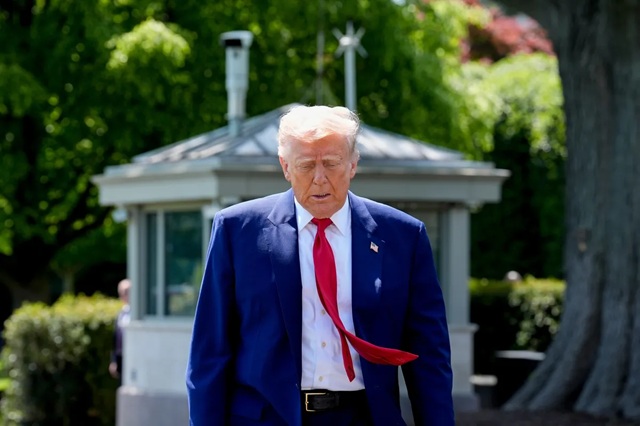
U.S. President Donald Trump has suggested he’s open to reducing steep tariffs on Chinese goods, raising hopes for a potential easing of tensions in the long-running U.S.-China trade war ahead of high-stakes talks in Geneva this weekend.
In a post on his Truth Social platform, Trump floated the idea of reducing current tariffs — which stand at 145% — to 80%, framing it as a possible move to re-engage with Beijing. “80% Tariff on China seems right! Up to Scott B,” he wrote, referencing U.S. Treasury Secretary Scott Bessent, who will lead the American delegation.
Trump’s remarks come as Bessent and U.S. Trade Representative Jamieson Greer prepare to meet Chinese Vice-Premier He Lifeng in Geneva. The talks are expected to focus on ways to roll back the mutually imposed tariffs that have weighed heavily on global trade and market confidence.
Chinese Export Surge Strengthens Beijing’s Hand
Adding a layer of complexity to the negotiations, fresh data from China’s customs authority shows that the country’s exports rose 8.1% in April year-on-year, despite heavy U.S. tariffs. Analysts attribute the increase to Beijing’s efforts to reroute trade through Southeast Asia and Europe, demonstrating resilience in the face of American economic pressure.
This export boost gives China a stronger position going into Geneva, especially as Washington’s tariffs — originally framed as a “liberation day” move in April — have not delivered the economic leverage the Trump administration hoped for.
While the initial announcement of Trump’s tariffs rattled global markets, triggering selloffs, financial indices have since stabilized. However, the S&P 500 is down 0.5% this week, showing investor uncertainty ahead of the weekend’s talks.
Negotiating Posture or Policy Shift?
Trump’s call to ease tariffs appears to be more a strategic maneuver than a firm policy pivot. Sources familiar with the discussions say the 80% figure is likely a negotiating tactic designed to create leverage at the Geneva table rather than a finalized target.
Still, the gesture signals that both sides may be inching toward compromise. China’s commerce ministry noted that it would approach the talks “based on thorough consideration of global expectations, China’s own interests, and calls from U.S. businesses and consumers.”
Beijing, which previously demanded that Washington reduce tariffs as a precondition for negotiations, has also softened its stance — perhaps reflecting growing economic pressures and a desire to stabilize trade relations.
Skepticism Over a Breakthrough
Despite the optimism surrounding Trump’s comments, many experts are doubtful that a major breakthrough is imminent. Libby Cantrill, head of public policy at investment firm Pimco, cautioned that while a temporary softening of tariffs might occur, “the chances of a durable substantive deal coming out of these weekend talks is very low.”
Cantrill noted that trade deals often take 18 months to negotiate and up to two years to fully implement. “The U.S.-China relationship has only deteriorated since Trump’s first term,” she added.
Indeed, a more structural de-escalation appears elusive, especially as both sides continue to exchange symbolic gestures rather than substantive concessions.
Domestic and Global Reactions
Trump’s Friday post followed a separate agreement to offer tariff relief to the UK — his first concrete deal since reigniting the global trade confrontation in early April. That deal, and the floating of lower tariffs for China, appear aimed at creating momentum ahead of Saturday’s Geneva session.
At the same time, the U.S. Federal Reserve has warned that the tariffs are increasing inflationary pressures and policy uncertainty — adding further urgency to finding a resolution.
Privately, many diplomats and trade officials have expressed frustration at the slow pace of negotiations with Washington, citing a lack of clear demands from the Trump administration. “Many Trade Deals in the hopper, all good (GREAT!) ones!” Trump declared on social media — but few details have emerged.











