


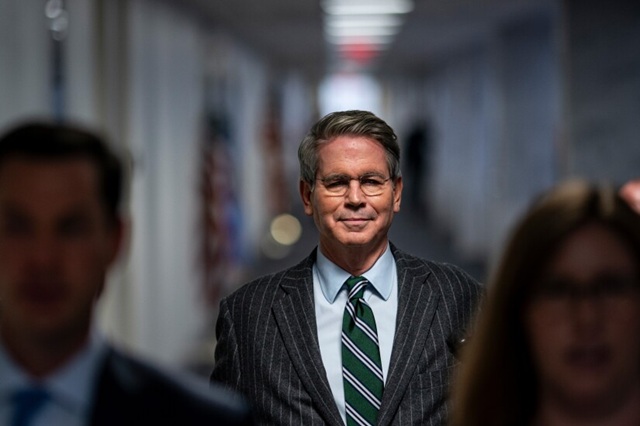
U.S. President Donald Trump’s tariff policy is designed to bring manufacturing jobs back to American soil, Treasury Secretary Scott Bessent said in an exclusive interview with Nikkei.
Speaking 200 days into the second Trump administration, Bessent described the president’s economic program as a “three-legged stool” built on tax reform, trade policy, and deregulation. He noted that tax reform had been completed “in record time” with the passage of the so-called “One Big Beautiful Bill” on July 4, and predicted that trade policy adjustments would be largely finalized by the end of October.
Bessent said the shift toward tariffs is meant to rebalance decades of trade deficits that have eroded U.S. manufacturing. “We had free trade. We also want fair trade,” he said, adding that tariffs would act as a “melting ice cube” that would diminish as domestic production grows.
Japan, which he called America’s “most important ally in Asia,” plays a central role in this strategy. Bessent said the Japan-U.S. “Golden Industrial Partnership” would deepen economic and security ties. He also acknowledged progress on an agreement to lower U.S. auto tariffs from 27.5% to 15%, though implementation timing remains uncertain.
On China, Bessent described the country as “the most imbalanced economy in the history of the modern world” and criticized its state-backed overproduction, particularly in electric vehicles. He said excessive Chinese production poses risks not only to the U.S., but also to Asian economies like Japan and South Korea.
Addressing monetary policy, Bessent reaffirmed the Treasury’s annual reviews for currency manipulation and said he supports the Bank of Japan’s focus on inflation and growth rather than currency targeting. Regarding the U.S. dollar, he stressed that “a strong dollar” refers to policies that maintain its reserve currency status, not simply exchange rate levels.
Bessent also defended the administration’s fiscal strategy, claiming that permanent tax provisions from the 2017 reforms were coupled with the largest spending cuts in U.S. history to curb deficits.
Looking ahead, he emphasized the importance of reviewing trade agreements to ensure compliance and reiterated Trump’s view that tariffs can be leveraged as a foreign policy tool — citing calls for India to halt imports of Russian oil as one example.
Having visited Japan more than 50 times since 1990, Bessent recalled the country’s economic boom years, when even the land of the Imperial Palace was famously valued higher than the entire state of California.











