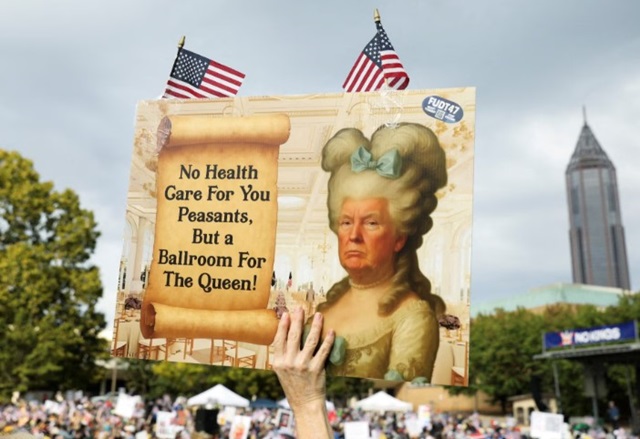
Massive “No Kings” protests across the USA a few days back, opposing Trump’s policies and style of functioning, have not come as a surprise to discerning observers around the world. The scale of the protest was such that it was also organized in a few other countries outside the USA. Some observers point out that such a protest was inevitable. What is particularly surprising is that the President dismissed it as the handiwork of leftists—whatever that term may mean. In any case, it is clear that Trump does not seem to recognize that people from various walks of life participated in the protest, making it a representative gathering.
Normally, a newly elected President would be given some time—around twelve months or so—to fulfill his promises. However, in the case of the Trump administration, strong protests against his methods and policies have emerged within just a few months of his assuming office. Many critics say that President Trump has not read the writing on the wall.
During his pre-election campaign for a second term, Trump raised two key issues: the influx of illegal immigrants to the USA and the poor state of the American economy. His campaign on these issues, and his promise to address them, captured the imagination of voters, resulting in his comfortable victory.
The issue of illegal migration is a long-standing subject of debate in the USA. A large number of Americans and American families rely on the services of illegal migrants, fully aware that they are not legal entities. Many believe that these migrants contribute significantly to the American economy, fulfilling the need for unskilled and semi-skilled labor.
In his efforts to address illegal migration, President Trump has shifted the goalposts by tightening visa rules for students and job seekers from other countries. This policy has caused concern among American universities and employers in various sectors, as visa restrictions may lead to shortages of both students and workers.
Illegal migrants are already part of the U.S. population. With a population density of just 38 per square kilometer, the country can certainly accommodate more people legally. A more pragmatic approach would have been to offer citizenship to illegal migrants, subject to verification of credentials, and then tighten fresh migration entry as needed. Instead, the draconian measures currently in place are likely to create more problems.
The “America First” policy propagated by President Trump is appealing on paper and is a strong subject for debate. However, in a complex world with high interdependence between countries, a self-centered policy that ignores the repercussions or reactions of other nations is likely to be counterproductive.
The primary strategy for implementing “America First” has been to impose high import tariffs on goods from almost every country. The expectation is that restricting imports will incentivize investors to create new industrial capacity and boost the domestic services sector.
The reality is that America imports many products due to inadequate domestic manufacturing capacity. Considering manpower, production costs, and other factors, building competitive domestic capacity in several sectors is not always feasible. American investors and consumers understand this.
By imposing unilateral tariffs, President Trump has undermined multilateralism and the consensus-based regulations of the World Trade Organization. The history books may describe this approach as “tariff terrorism.”
The likely outcome of Trump’s tariff policy is that, after an initial shock, American consumers will continue to buy imported products, but at higher prices. Domestic producers may also raise prices to capitalize on the situation, leaving consumers as the ultimate losers.
There are other issues where Trump has taken arbitrary decisions without achieving public consensus. While the implications of his anti-migration and tariff policies are clear, other subtle actions have created deep concern among the people.
It would benefit the future of the USA if Trump recognized the genuine concerns behind these protests. The protesters are as invested in the welfare of the country as President Trump and his supporters.