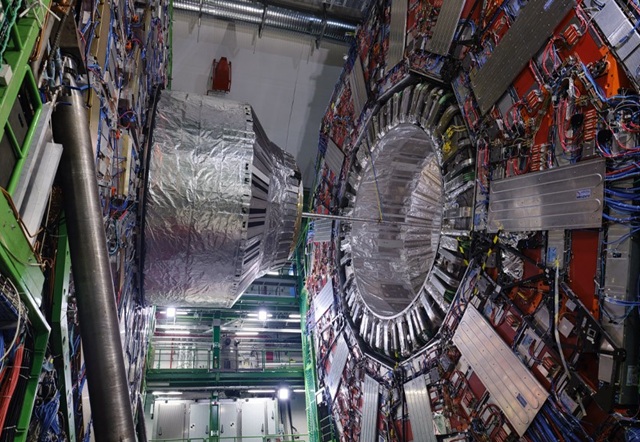
The European physics laboratory CERN is planning to build the most powerful particle accelerator the world has ever seen—a megacollider that would dwarf its current flagship facility, the Large Hadron Collider (LHC). However, this monumental project has become a battleground for the future of particle physics, with growing concerns over its feasibility, cost, and long-term scientific benefits.
The Future Circular Collider (FCC), envisioned to open in 2070, would stretch across a 91-kilometer tunnel—more than three times the size of the LHC—and would operate at energies eight times greater than those achievable by the current collider. The FCC is expected to cost a staggering $30 billion, and it is hoped that it will unlock new particles and insights into some of the biggest mysteries in physics, including the elusive nature of dark matter. The new collider would focus on breaking new ground in the Standard Model of particle physics, which has so far been unable to explain dark matter or provide clarity on some of the fundamental forces of the universe.
To achieve this, CERN plans a two-stage process. The first phase, starting in 2045, would involve a “Higgs factory,” a simpler machine designed to produce and study Higgs bosons. The second phase would ramp up the scale of the collider to its full potential, ultimately leading to a proton collider capable of discovering new, massive particles. The project has been endorsed by many, including CERN’s Director-General Fabiola Gianotti, who described the FCC as “the most powerful instrument ever built to study the laws of nature at the most fundamental level.”
However, not all physicists are convinced. Critics, including particle physicist Halina Abramowicz, have expressed concerns about the project’s long timeline, its enormous cost, and the risk of sidelining alternative approaches. The debate is intensifying as the scientific community continues to grapple with whether dedicating resources to such an expensive, long-term project is the best approach to advancing the field. Many researchers question if the FCC is the right tool for addressing unresolved issues in particle physics, especially given that some theories suggest that future discoveries could emerge from alternative designs, like a linear collider.
The controversy surrounding the FCC was highlighted in an article published by Nature, which conducted extensive interviews with more than two dozen researchers, many of whom raised concerns about the lack of adequate consultation with the global physics community before backing such an ambitious plan. Critics argue that CERN’s leadership has focused too heavily on the FCC, without fully considering other collider models or accelerator technologies that could achieve similar outcomes at a fraction of the cost.
CERN’s financial situation also complicates the situation. Germany has already signaled that it will not increase its budget contribution, while the possibility of competition from other countries, such as China, which is considering its own massive collider project, looms large. If member states cannot come together to secure funding, the entire project could face an uncertain future.
The FCC is far from a done deal. In December, CERN’s governing body, the CERN Council, will receive a strategy working group’s report on the collider. The decision made could determine the future of European particle physics for generations to come.
Beyond the technical challenges, the funding dilemmas also reflect deeper concerns about the future of scientific collaboration and global priorities. Some physicists worry that, if the FCC is delayed or scrapped, it could fracture the international community of researchers, many of whom have worked together at CERN for decades.
In the face of these uncertainties, the scientific community continues to look for ways to explore the fundamental laws of nature, whether through the development of new colliders or other methods. As the clock ticks toward a final decision, the stakes could not be higher for CERN, for particle physics, and for the next generation of scientists.