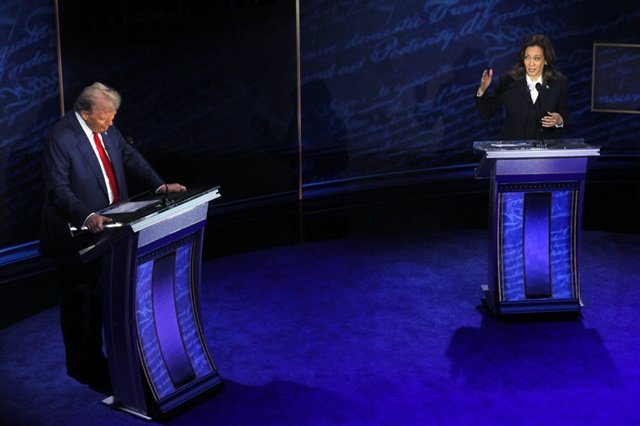
The 2024 presidential race took a heated turn as former President Donald Trump and Vice President Kamala Harris faced off in their first debate, held at the National Constitution Center in Philadelphia. The debate, broadcast by ABC News, began with a handshake between the two candidates but quickly revealed the deep ideological divides that define their campaigns.
Economy and Fracking
The economy was among the first topics addressed. Vice President Harris criticized Trump’s economic policies, arguing that his focus on tax cuts for the wealthy ignored the broader needs of the American economy. She also linked Trump’s presidency to economic instability, saying, “Trump left us with the worst economy, the worst health problem, and the worst attack on democracy since the Civil War.”
Harris emphasized her support for a balanced energy policy, making it clear that she was not opposed to fracking, a key issue in energy-rich states. “I made it very clear in 2020, I will not ban fracking,” Harris said, highlighting her role in the Inflation Reduction Act, which supported new fracking leases while promoting sustainable energy investments.
Trump pushed back, denying any involvement with Project 2025, a conservative initiative aimed at reshaping the federal government. “I have nothing to do with Project 2025. I haven’t read it, I don’t want to read it,” Trump said, distancing himself from the controversial proposal.
Technology Race: China vs. US
The conversation then shifted to America’s technological leadership, particularly in relation to China. Harris criticized Trump’s handling of technology exports during his administration, accusing him of allowing key technologies to be transferred to China. She argued for increased investment in American innovation, particularly in microchip production, as vital to maintaining a competitive edge.
Trump rebutted by claiming that the U.S. had stopped creating microchips during his tenure and that the responsibility for any technological transfers lay with Taiwan, not his administration.
Immigration and Border Policy
Immigration policy, always a flashpoint, took a dramatic turn when Trump painted a grim picture of the effects of immigration on American communities. He claimed that immigrants are “taking over towns and buildings” and contributing to rising crime rates. In a particularly controversial statement, he added, “They’re eating the dogs, the people that came in, they’re eating the cats.”
Harris, in response, defended the Biden-Harris administration’s immigration policies, emphasizing the importance of humane and fair treatment of immigrants, and sharply rejected Trump’s inflammatory remarks.
Foreign Policy and Israel
The candidates also sparred over foreign policy, particularly concerning Israel. Harris reaffirmed her commitment to Israel’s defense, especially in the face of potential threats from Iran. “I will always give Israel the ability to defend itself,” she said.
Trump issued a dire warning about the future of Israel under a Harris administration, stating, “If she’s president, I believe that Israel will not exist within two years.”
On the war in Ukraine, Harris accused Trump of emboldening Russian President Vladimir Putin, suggesting that if Trump had remained in office, Putin would have captured Kiev by now. Trump, for his part, called for an immediate end to the war, insisting he could broker a peace deal quickly if elected.
Roe v. Wade and Abortion Rights
One of the most contentious moments of the night came during the discussion of abortion. Trump took credit for the Supreme Court’s decision to overturn Roe v. Wade but made it clear that he would not support a national abortion ban if reelected, stating, “It’s a lie. I’m not signing a ban.” He emphasized his belief that the issue should be decided by individual states.
Harris, on the other hand, reaffirmed her strong support for reproductive rights, promising to sign legislation to enshrine federal protections for abortion if given the opportunity.
When Trump claimed that Democrats supported “the execution” of babies after birth, moderator Linsey Davis quickly corrected him, noting that no such law exists in the U.S.
Looking Ahead
The debate showcased the sharp contrasts between Trump and Harris, setting the tone for a highly polarized election season. With issues ranging from immigration to foreign policy and reproductive rights, both candidates offered starkly different visions for the future of the country.
As the debate wrapped up, Harris indicated that the next debate would likely take place in October, further intensifying the battle for the White House. Harris-Walz campaign Chair Jen O’Malley Dillon summed up the event, stating, “Under the bright lights, the American people got to see the choice they will face this fall: between moving forward with Kamala Harris or going backward with Trump.”