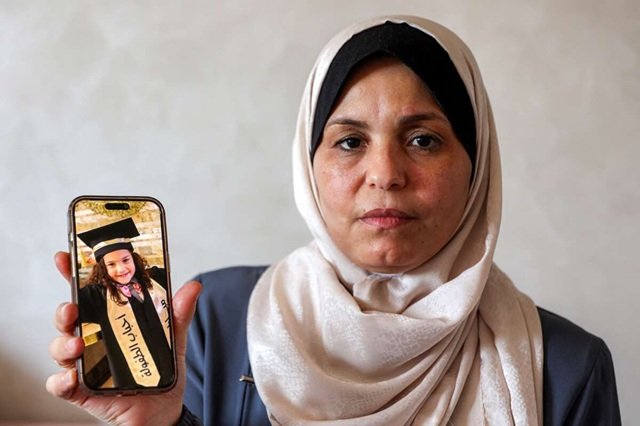
Five-year-old Hind Rajab Hamada was killed in Gaza on 29 January 2024 after her family fled attacks by the Israeli army in the northern Gaza Strip. Her uncle, his wife, their four children and Hind were travelling in a small black Kia when the vehicle came under fire. Researchers at Forensic Architecture at the University of London later reconstructed the incident and concluded that soldiers fired 335 bullets at the car.
What followed was documented by the Palestinian Red Crescent Society (PRCS), creating an unusually detailed record of the final moments of the children trapped inside the vehicle. Hind’s 15-year-old cousin, Layan Hamada, who was the only other member of the family still alive, called the emergency services. The recording, later released by the PRCS, captures her screaming: “They are shooting at us. The tank is right next to me. We are in the car, the tank is right next to us.”
More gunfire can be heard on the recording. Layan eventually stops responding to rescuers. Hind then speaks. “Come and get me. Will you come and get me? I’m so scared, please come!” she says. Hind was subsequently killed, as were two Palestinian paramedics who attempted to reach the children. The bodies of Hind, Layan, their relatives and the rescuers could not be recovered until weeks after the incident.
The case, documented through the emergency call and subsequent research, has since become an international symbol of the suffering of Palestinian civilians during the Gaza war. Pro-Palestinian protesters occupying a building at Columbia University in New York City named it “Hind’s Hall”. US rapper Macklemore dedicated a song to the child, while Tunisian director Kaouther Ben Hania’s documentary film The Voice of Hind Rajab was nominated for an Oscar.
In July 2024, United Nations experts warned for the first time that Israel could have committed a war crime in the case of Hind. In September that year, two Belgian-Lebanese activists established the Hind Rajab Foundation and filed a complaint with the International Criminal Court alleging war crimes, crimes against humanity and genocide against 24 named Israeli soldiers and commanders.
Now, more than two years after the killing, Israel’s own military prosecution system has opened a criminal investigation. But the scope of that investigation is narrower than the circumstances surrounding Hind’s death might suggest.
At the end of August, the military investigative committee FFAM announced that two incidents from the Gaza war would be investigated. One concerns the March 2025 shooting of an aid convoy in the Tel al-Sultan area, in which 15 Palestinian paramedics were killed. The other concerns the deaths of Hind, her cousin and the two Palestinian rescuers.
According to the statement, however, Israel’s Military Advocate General has opened an investigation only into why the PRCS ambulance travelling to rescue Hind and her cousin was fired upon. The investigation does not, at this stage, address why the family’s vehicle was fired upon in the first place.
These are the first cases in the war in which the military prosecution has determined that there is reasonable suspicion of criminal misconduct. An unnamed Israeli army official confirmed to Die Zeit that the suspicion concerns the coordination of the ambulance. The official said there was “significant suspicion” of a criminal offence relating to the shooting of the ambulance, while it remained unclear whether the shooting of the car itself would also be investigated.
FFAM said it was continuing to examine “dozens of cases” and that there was “no intention to discontinue this activity in the foreseeable future”.
Both FFAM and the Military Advocate General’s Office are authorities within the Israeli army. The military prosecution has itself come under domestic political pressure. Last autumn, former Military Advocate General Jifat Tomer-Yerushalmi resigned after accepting responsibility for the public release of a video showing several Israeli soldiers abusing a Palestinian detainee at the Sde Teiman military prison.
Tomer-Yerushalmi had brought charges against five reservists over the incident. But after her successor, Itai Ofir, was appointed in March this year, he announced that the charges would be dropped. Tomer-Yerushalmi herself faces proceedings over the disclosure of the video. Israeli Prime Minister Benjamin Netanyahu, against whom the International Criminal Court has issued an arrest warrant over alleged war crimes and crimes against humanity, praised Ofir’s decision at the time and criticised the prosecution for having taken “too long”.
The decision to investigate the Hind Rajab case has nevertheless intensified scrutiny of Israel’s military justice system. International law experts have questioned whether domestic investigations could precede or complicate an independent investigation by the International Criminal Court.
Shannon Bosch, a law professor at Edith Cowan University in Perth, Australia, told Die Zeit that if Israeli military personnel became suspects before the ICC, Israel would have its strongest arguments if its own authorities were investigating the same individuals for substantially the same conduct. The ICC generally becomes involved when national justice systems fail to act. But, Bosch said, partial investigations are not sufficient: they must specifically concern the individuals and conduct under examination by the ICC.
That means the evidence gathered, the duration of the investigations and their independence and impartiality could all become significant. Evidence that suspects were being protected, or that investigations were being unreasonably delayed, could indicate that Israel was not genuinely seeking accountability.
Israeli human rights organisation Yesh Din has also expressed caution. Its director, Ziv Stahl, told Die Zeit that the organisation did not have access to the complete details of the cases and therefore could not assess how likely the investigations were to result in charges.
Yesh Din’s previous data, however, provides a broader point of reference. Its research into investigations concerning the conduct of Israeli forces in Gaza in 2019 and 2020 found that the overwhelming majority of complaints were closed without a criminal investigation being opened, while only a limited proportion of the investigations that were opened resulted in charges.
For Hind Rajab’s surviving family, the question is therefore not simply whether an investigation has begun, but whether it can deliver transparent accountability. If the investigation into her case ends without charges, it could strengthen the argument for international intervention rather than settle it.
Hind’s mother, Wesam Hamada, has already made clear what she wants. “I don’t want a secret military investigation. I want an independent, transparent investigation and real accountability for everyone responsible,” she told CNN.
For now, the Israeli military has opened an investigation into part of a case that has come to symbolise the killing of a five-year-old child in Gaza. Whether that investigation expands beyond the ambulance that came too late — and whether it ultimately establishes responsibility for what happened to Hind and her family — remains unresolved.