


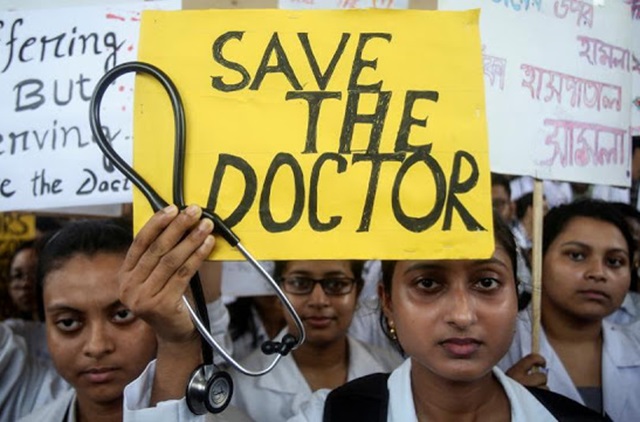
India is yet to recover from the severe shock it received when a young female doctor was brutally raped and murdered by a drunkard in the middle of the night at a hospital in Kolkata while she was on duty.
Even as a police inquiry took place and doctors all over India protested this tragic incident, recent attacks on two doctors in two separate hospitals on consecutive days in Chennai have left people wondering what has gone wrong and whether there is any fundamental cause for such incidents.
While the motives behind the attack on the young lady doctor in Kolkata and the two doctors in Chennai differ, there are fundamental common factors that cannot be ignored.
The shared factor is an apparent lack of fear of the law among criminals and aggressors, who act with impunity. Clearly, the government bears some responsibility for this situation, which could be justifiably termed a crisis in law and order. This also suggests that a violent streak exists in some segments of society, largely unchecked. This may stem from the fact that some ministers, top officials, and political leaders have failed to exhibit high standards in their behavior and statements, contributing to an unhealthy societal atmosphere. The media also shares some responsibility, often focusing more on negative events than positive developments in society.
While these are general conditions, a particular question arises: why have doctors been increasingly attacked in hospitals? This no longer seems to be a rare occurrence.
It has been reported that the attack on an oncology doctor in a Chennai hospital occurred because the son of a cancer patient was reportedly dissatisfied with the care his mother received and was distressed by what he perceived as the doctor’s indifferent attitude.
While the attacker was undoubtedly wrong and should be severely punished, the medical community might also benefit from a degree of introspection. Patients, especially those suffering from severe and terminal illnesses, often feel stressed and may become agitated, sometimes mistakenly believing that the treatment is inadequate. While most doctors are overworked and stressed, the stress felt by patients can be much more severe.
The Medical Council has recognized this and has advised doctors to be patient with patients, answer their questions to calm them down, and maintain a friendly and sympathetic attitude. However, not all doctors exhibit this behavior and may at times show impatience when dealing with patients.
A patient recently recounted an incident where, while hospitalized with a hemorrhagic condition, he expressed concerns about a pethidine injection the doctor wanted to administer, fearing possible side effects. The doctor, however, became irritated, reportedly telling the patient, “I am not a blue-collar fool,” before walking away. This type of behavior is precisely what doctors should avoid.
In another attack in a Chennai hospital, a mentally ill patient attacked a doctor during treatment. The patient was with the doctor unaccompanied, which raises questions about the patient’s level of mental instability and why he wasn’t accompanied by an escort. The doctor might have taken extra precautions while dealing with such a patient under stress.
Doctors in Chennai responded to these attacks with a one-day strike, demanding enhanced security measures in hospitals and calling on the government to ensure their safety. This demand is entirely appropriate.
At the same time, doctors should bear in mind that, while their profession is highly stressful and requires them to deal with stressed patients regularly, they must maintain an empathetic approach. Just as police officers cannot complain about dealing with criminals, doctors cannot expect that stressed patients will always behave calmly. It is part of a doctor’s responsibility to address both the physical and mental states of their patients.









This is a timely article focussing the problems of Doctors as well as patients. Having chosen a profession Doctors can not complain about the stress. Every job while having its advantages will have the stress factor also. But tgis can not be an excuse for maltreatment of patients. They have every right to know everything about their illness.
It also doesnot mean patients can attack Doctors, manhandle them to transfer their stress on others.
Doctors should be trained properly to handle stressful situations.
Doctors are next to God. They save lives. It would be a heinous act to attack on Doctors for some silly reasons. The patient has alternative solutions of complaining to the heigher ups in the hierarchy. So mant other solutions are also there.
As rightly said some of the media which concentrates on negative values now a days is to some extent responsible for this. Attacks are considered as acts of heroism. In addition support from some vested interests like politicians has made it very difficult to differentiate the real problem.
Ultimately every one should excercise restraint avoiding unwanted scuffles.
True.Doctors are by and large polite.But I know two doctors who are short-tempered.But they are so good that people go to them!