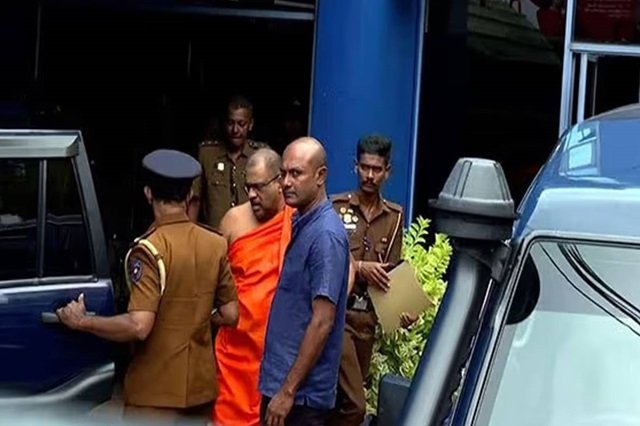
Yesterday, a close friend of mine and a close friend of Fair Comment was taken into custody. He is not a criminal. He was not evading the law. He is guilty of nothing except this: a few days ago, the Supreme Court of Sri Lanka, not some lower court, not some magistrate hunting for relevance, decided to unmake a decision made by the President of this nation seven years ago, and in unmaking it, decided to unmake the man himself.
Today we speak about my friend, Galagoda Aththe Gnanasara Hamuduru.
How did a Buddhist monk, a man in robes, find himself in this situation? Two decades ago, this man took a path he believed served his Sasana and his nation. In that path, he made enemies. He made costly mistakes. He positioned himself in a place where safety meant nothing and duty meant everything. He believed that the Tathagata Vahanse, the Buddhist order, his country, his community, came before his own security. That choice defined him then. It defines the charges against him now.
My friendship with him was confidential. Even those closest to me did not know how regularly we spoke, what we debated, how we disagreed. For a man with a history as cryptic as his, the closeness between us was unusual. Today I break that seal because the man who has been taken is now defenseless and voiceless. Because the lies being told about him demand that someone who knows him speak the truth. Because that truth matters to this Republic.
In January 2016, at Homagama Magistrate’s Court, during proceedings on Prageeth Ekneligoda’s disappearance, Gnanasara Thero made statements the Court of Appeal later found contemptuous. The record is clear. The conviction stands. The court sentenced him to six years. He served nine months. Then, in May 2019, President Maithripala Sirisena granted him a pardon.
That pardon did not emerge from the shadows. It did not come at the Thero’s request. It was not purchased. It was not cajoled into existence. It did not arrive under duress. The President himself met the Thero in prison at the collective urging of the Mahanayake Thero of the Malwathu Chapter, the Mahanayake Thero of the Asgiri Chapter, the Mahanayake of the Kotte Chapter, and the Diyawadana Nilame of the Sri Dalada Maligawa. The Prison Department reported. The Attorney General’s office produced a written analysis. The President reviewed and approved on the public record.
There is no allegation of a bribe. There is no allegation of inducement. There is no allegation that the Thero or anyone acting for him communicated improperly with the state. The pardon was procured by nobody. It was granted by the head of state upon the highest religious and institutional authorities of this nation expressing their collective view that the man deserved release.
That was May 2019. He walked free. He lived in his temple. He tended his duties. He did what a monk does.
Then, on September 10th, 2026, three judges decided that none of that had ever happened. That the pardon was void from the moment it was signed. That the seven years, three months and eighteen days Gnanasara Thero spent as a free man in the world, serving his Sasana, managing his temple, living as a human being, had been obliterated from the eyes of the law. The Court found the pardon arbitrary. The Court found it ultra vires. The Court found it void ab initio. Void ab initio means it never existed. Never existed means the law now pretends those seven years were a dream.
The judges who did this were Janak De Silva, Sobhitha Rajakaruna and Sampath Abayakoon.
Their problem with the pardon is purely procedural. The President did not personally write down his reasons. The President did not sign a warrant in his own hand. The Victims Act was not complied with because Sandya Ekneligoda was not served notice of the pardon. The President, the Court found, acted mechanically.
Let me be direct: every word of this analysis is correct as law. It is also a perversion of justice.
A president who commits a procedural error should not have that error visited upon a man who signed nothing, drafted nothing, requested nothing, and had no knowledge of any procedural defect in the process that freed him. The Thero is not the drafting attorney. He is not the will-beneficiary. He is not the architect of the state process. He is the subject of a pardon, and the pardon was granted. For seven years the state of Sri Lanka treated him as free. For seven years the law recognized him as free. For seven years he lived as a free man. Now, retroactively, the Court has declared the whole thing a nullity. Now the Thero must surrender back to Welikada Prison to serve the balance of a sentence a president lawfully commuted.
This is the pound of flesh. But the Court has demanded the pound of flesh and the drop of blood as well.
Now to the lie. Last week, the Thero became ill. His doctor advised him to rest. He went to Lenagiri Aranya Senasanaya, a forest hermitage in Pitigala, to put his affairs in order for his elderly mother. He was in his robes. He was managing his temple. He was preparing to submit himself to court on Monday, as any law-abiding citizen would. He was not in hiding.
I say this as someone in daily contact with him in these last days. I say this to every journalist, every commentator, every keyboard warrior who has written that the Thero was caught hiding like a criminal fleeing justice. You are lying.
He and I have joked many times that if he wanted to truly disappear, he would never be found. I believe that to be true. I know his friends. I know his well-wishers. I know the network that would shelter him and never surrender him. I bear witness that the Thero has the capacity and the friends to vanish completely if he chose. That he did not choose this path tells you everything about the man he is. He wanted to ensure his mother’s welfare. He wanted her bills paid. He wanted continuity in his temple. He wanted to face the Court as a man in robes, not a fugitive. That is the Thero. Not the fiction your media is selling.
I charge every Buddhist in this nation of a grave dereliction. You benefited from this man’s voice. You benefited from his willingness to take positions that were costly to himself. You watched while the Thero machinery moved. You used it. You were silent when you could have spoken. Now, from your comfort, from your keyboards, from your dinner tables, you are insulting him. You are belittling him. You are disparaging a man to whom you would never speak in those terms if you faced him. Shame on you. Shame on you all.
To the state machinery that coordinated this arrest: On September 30th, police protection was withdrawn from his temple under the Assistance to and Protection of Victims of Crime and Witnesses Act. Three days later, the CCD moved in. You lowered his defenses before you came for him. That sequence is noted and will be remembered.
I will do everything within my legal power to pursue every avenue available to the Thero for clemency, for pardon, for remission, for revision of this judgment. I will cross every T and dot every I. My lawyers will be instructed. This case will be fought. I speak only for myself in this.
I will also say this clearly: if the Republic can applaud a terrorist turned president, if the Republic can remain silent while those who orchestrated mass murder walk free, then the Republic can certainly keep silent about a Buddhist monk whose only crime was to speak for his Sasana. If you have nothing good to say about the Thero, I suggest you say nothing at all.
Just before he hung up for the last time, he said this to me. And I write it now in Sinhala, his words and his language:
‘රත්තරන්, මැරෙන්න කලින් දවසක් දෙකක් ඔබතුමා එක්ක ගත කරන්න ඕනෙ’
I finish this article on a Sunday. I finish it in anger. I finish it in clarity.
This is not an article vetted by Fair Comment’s legal counsel. This is not a statement that has passed through our editorial process. This is a personal statement by a friend defending a man I count among my very small circle of true friends. Our friendship demands this testimony. Our friendship deserves this.