Nearly five years into Russia’s war against Ukraine, Vladimir Putin faces mounting military and economic pressures. Russian forces are reportedly suffering approximately 30,000 casualties a month, while the war consumes an estimated 40 per cent of the federal budget. Ukraine has also demonstrated its ability to strike strategically important Russian infrastructure, including a bridge serving as a vital supply route for Russian forces. Yet, at a moment when Moscow faces substantial challenges on the battlefield, the Kremlin continues to enjoy an unexpected political advantage: the presence of Donald Trump in the White House.
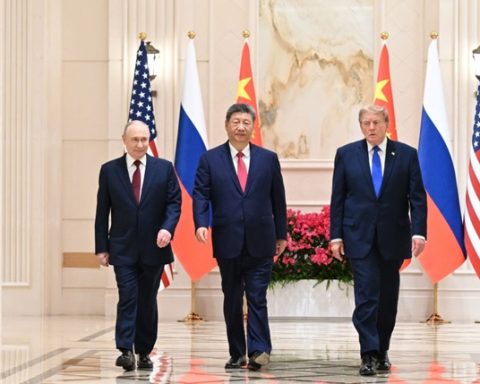
An Observer UK commentary argues that Trump’s conduct towards Putin has provided Russia with diplomatic and strategic benefits that would be difficult to imagine in a conventional account of American foreign policy. During a recent one-to-one meeting in China, Trump reportedly greeted the Russian president warmly and engaged him in private discussions. Putin subsequently said the meeting had gone “even better than expected”. Hours later, Trump contacted European leaders from Air Force One and, according to five sources who briefed Politico, urged them to abandon a proposed €70bn (£60bn) assistance package for Ukraine.
The sequence of events has intensified concerns about the direction of American policy towards the war. At a time when European governments are considering how to sustain Ukraine’s military and financial capacity, pressure from Washington to withdraw a major assistance package could weaken the international support available to Kyiv. The Observer UK commentary presents this as part of a wider pattern in which Trump’s diplomatic engagement with Putin has repeatedly produced outcomes favourable to Russian interests, regardless of whether the American president has any direct relationship with Russian intelligence.
The argument is not entirely new. During a Senate Foreign Relations Committee hearing last year, Oregon representative Jeff Merkley suggested that Trump’s conduct was consistent with what might be expected if an American president were acting as a Russian asset. Merkley identified five decisions that, in his assessment, had benefited Putin: repeating the Russian claim that Ukraine initiated the war, ruling out Ukrainian membership of Nato, suspending American weapons shipments to Kyiv, and publicly humiliating Ukrainian President Volodymyr Zelensky during a White House press conference, alongside other policy concessions.
These developments have contributed to questions about the reliability of the United States as a security partner. The commentary argues that Trump’s approach has offered Moscow opportunities to weaken Western unity while placing additional pressure on Ukraine. However, it also points to developments that have complicated the Kremlin’s expectations. Ukraine has continued resisting Russian military operations, while Trump’s Republican Party has suffered a major defeat in the US midterm elections. The political consequences have prompted a countdown towards the final two years of his presidency, after which the Kremlin may lose the advantage of having an American leader whose policies have repeatedly aligned with Russian interests.
Questions about Trump’s relationship with Moscow extend beyond his current presidency. Books including Catherine Belton’s Putin’s People and Craig Unger’s American Kompromat examine the financial relationships between Trump-linked business interests and Russian individuals with alleged connections to intelligence networks. The commentary revisits several episodes from Trump’s business career that have attracted scrutiny.
In 1990, Trump reportedly acknowledged debts of $5bn and described his personal financial position as being worth minus $900m, following substantial expenditure on the Trump Taj Mahal hotel and casino in Atlantic City. Two years later, the casino was reporting record profits, partly attributed to wealthy Russian gamblers. Among them was an individual suspected of organised crime connections who was under FBI surveillance and reportedly visited the establishment 19 times in two months during 1993.
Further questions emerged in 2004, when Felix Sater, a Russian-born associate of Trump, allegedly offered property licensing arrangements at a time when Trump’s casino and hotel division was filing for bankruptcy. These episodes have featured in accounts examining the financial relationships that connected Trump and individuals from Russia over several decades.
His 2013 visit to Moscow to host the Miss Universe competition generated another controversy. Rumours subsequently emerged that he had been compromised through covert filming involving sex workers in his hotel room, an allegation Trump has consistently denied. Unger and former Russian agent Yuri Shvets have also claimed that the KGB began cultivating Trump well before the Soviet Union collapsed in 1991. These remain claims advanced by the authors and individuals concerned, rather than established proof that Trump was recruited by Russian intelligence.
Shvets has pointed to Trump’s first visit to Moscow in 1987, following which Trump purchased full-page advertisements in three American newspapers advocating that the United States reduce its financial burdens by requiring allies to pay more for their military protection. Shvets suggested that the argument could have been forwarded by the KGB. The commentary places this episode within a broader examination of the similarities between Trump’s foreign policy positions and longstanding Russian strategic interests.
Trump’s first presidency provided further grounds for scrutiny. Shortly after his election victory, members of Russia’s State Duma reportedly celebrated by chanting, “Yes, we did.” His subsequent positions included suggesting that the United States might recognise Russia’s occupation of Crimea, withdrawing the remaining American troops from Syria, advocating Russia’s return to the G8 and accepting Putin’s assurances over the CIA’s assessment concerning Russian interference in the 2016 American election.
Dmitry Peskov, Putin’s official spokesperson, was in New York attending a chess tournament on election night in 2016. Reflecting on the two leaders, he remarked that their approaches to foreign policy were remarkably close. A decade later, Peskov remains in office, while the questions surrounding the relationship between the two presidents have become increasingly consequential.
The latest diplomatic engagement has also triggered political resistance in Washington. On Friday, Virginia Democratic senator Tim Kaine introduced a resolution seeking explanations about whether White House policies had helped Russia sustain its war effort. His initiative followed Trump’s appearance in Shenzhen and renewed criticism of the administration’s relationship with Moscow.
Trump subsequently defended his personal relationship with Putin, arguing that connections between national leaders were essential to achieving peace. However, he declined to say whether he considered the Russian president a friend of the United States. Secretary of State Marco Rubio supported the importance of personal diplomacy, saying that relationships between heads of state were invaluable.
The defence has done little to silence criticism. Democratic congressman Don Beyer, a former US ambassador to Switzerland and Liechtenstein, condemned Trump’s appearance alongside authoritarian leaders as damaging to American credibility. He accused the president of aligning himself with governments responsible for repression, disappearances and human rights abuses, arguing that such conduct undermined American values, international partnerships and the country’s global leadership.
The central issue raised by the Observer UK commentary is therefore larger than the personal relationship between Trump and Putin. It concerns the strategic consequences of American decisions for Ukraine, European security and the credibility of Washington’s commitments to its allies. Whether Trump’s approach reflects personal diplomacy, political calculation or a deeper alignment of strategic interests, its practical consequences are being measured in the continuing war and the increasingly uncertain future of Western support for Ukraine.