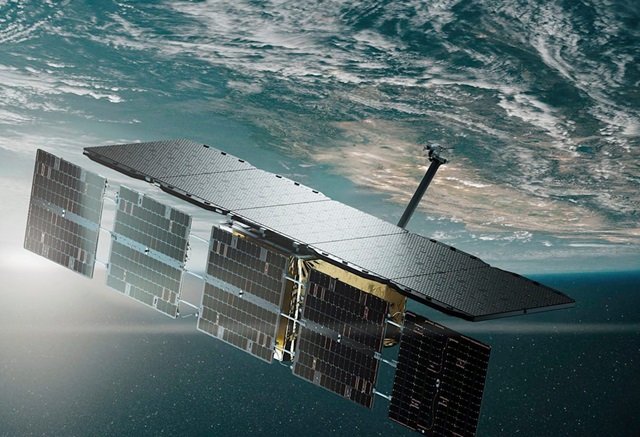
A Russian satellite’s approach to within a few hundred metres of a Finnish company’s spacecraft has exposed a growing security challenge confronting Europe: the militarisation of orbit is no longer a distant strategic concern but an operational reality. For Rafal Modrzewski, co-founder of satellite manufacturer Iceye, the incident involving the company’s X36 satellite is evidence that European governments must accelerate their ability to monitor, defend and operate critical infrastructure in space.
In an interview with German news magazine Der Spiegel, Modrzewski described the Russian spacecraft’s approach in October as comparable to a driver deliberately moving dangerously close to another vehicle. The X36 was approached to within several hundred metres, an unusually close encounter in an environment where even space debris can trigger precautionary manoeuvres. The International Space Station, he noted, already takes evasive action when debris comes within 50 kilometres.
Iceye has not reported damage to X36. Modrzewski said the satellite remains part of the company’s operational fleet and continues to provide services to customers. He declined to speculate about why it had been approached. However, he clarified that the spacecraft is registered in the United States and belongs to Iceye’s American subsidiary, meaning it should be regarded as an American space object.
The distinction is significant in an increasingly contested orbital environment, where satellites are no longer merely commercial assets or scientific instruments. They provide intelligence, communications and surveillance capabilities that have direct consequences for national security and military operations. Modrzewski was unequivocal about the wider implications of the encounter. “There is war in space; that is the reality,” he told Der Spiegel, warning that the threats already exist and are unlikely to disappear.
His assessment is also a criticism of Europe’s approach to technological and military preparedness. According to Modrzewski, European governments underestimate the speed at which defence technology develops. A five-year period, which policymakers might consider a reasonable timeframe for preparing a response to a new security threat, is an extraordinarily long interval in today’s technological environment. Waiting for established procedures and lengthy procurement programmes to deliver capabilities could leave European countries exposed.
He identified two immediate deficiencies. Europe first needs a more effective capacity to monitor activity in orbit. At present, he argued, the continent lacks a unified and sufficiently capable space-surveillance system. Iceye did not discover the approach to X36 through a European monitoring network, highlighting the limitations of existing arrangements. Secondly, Europe needs the ability to respond to hostile or potentially threatening activity. Modrzewski said the Russian satellite involved was specifically designed for missions of this nature, rather than being an ordinary meteorological spacecraft. He argued that European countries should develop comparable capabilities instead of restricting their response to political discussions.
The transformation of Iceye itself illustrates how rapidly commercial satellite technology is becoming intertwined with defence requirements. Founded in 2014 by Modrzewski and Finnish engineer Pekka Laurila, the company initially concentrated on mapping Arctic Ocean ice. Its technology has since attracted government and military customers, including Ukraine, while its commercial operations have expanded into supplying satellite data and complete spacecraft.
Modrzewski said government contracts now account for approximately 90 per cent of Iceye’s revenue. He prefers to describe these customers as government clients rather than exclusively defence customers, arguing that governments can deploy the satellite systems they purchase for different purposes. Nevertheless, the company’s contribution to Ukraine’s war effort demonstrates the strategic importance of its technology.
Iceye’s satellites provide frequently updated intelligence that can support both strategic and tactical decisions. According to Modrzewski, the information can help ground forces monitor opposing troop movements and prepare defensive positions. The same imagery can also support the planning of military operations and adjustments to strategy during an attack. He acknowledged that the technology can serve both defensive and offensive purposes, although he declined to discuss specific Ukrainian military operations.
The company’s growing exposure to defence activities has also prompted extensive security precautions. Modrzewski said Iceye maintains underground bunker facilities for certain exercises, distributes its production operations across different locations and has introduced personal security measures. He described these arrangements as necessary responses to the company’s operating environment.
Germany has become an important part of Iceye’s expansion strategy. The company has established a joint venture with defence manufacturer Rheinmetall, called Rheinmetall Iceye Space Solutions GmbH, to develop and operate a radar-satellite constellation for the German armed forces. The initial programme, known as Spock-1, involves reconnaissance satellites. Iceye supplies the underlying technology, while Rheinmetall contributes industrial capabilities and access to the wider defence sector. Modrzewski explained that German government requirements favour majority German ownership when a company is building and operating a satellite constellation on behalf of the Bundeswehr.
The partnership reflects a broader shift towards integrated military systems. Modrzewski argued that future battlefields will not operate through separate platforms such as satellites, tanks, ships and soldiers functioning independently. Instead, these capabilities will be connected through an integrated system in which information can move rapidly between surveillance assets and military units. He said the Spock-1 system was delivered to the customer successfully in less than 12 months, ahead of schedule. The objective is to reduce the interval between identifying a target and acting on the information from approximately 30 minutes to minutes or even seconds.
Iceye is also planning a separate satellite communications network with Nokia for Ukraine. Unlike Starlink, which serves both military and commercial users, the proposed system is intended exclusively for governments requiring secure communications for national security or disaster-response operations. The company expects its first satellites to become available in 2028, initially providing communications during limited time windows. The complete constellation is scheduled for 2029 and is expected to comprise approximately 50 to 60 satellites, depending on customer requirements.
Modrzewski said the project would complement the European Union’s IRIS² communications programme rather than compete directly with it. Iceye’s proposed network would provide broadband connectivity in areas beyond the reach of terrestrial infrastructure while offering governments secure and sovereign communications. The company also intends to present its solution for Germany’s Satcom Bw 4 programme, despite the presence of other industrial consortia seeking the contract. Modrzewski suggested that Iceye’s ability to manufacture satellites rapidly could become an advantage in a programme requiring hundreds of spacecraft.
The company’s ambitions extend beyond satellite manufacturing and communications to launch infrastructure. Iceye is seeking to acquire Italian rocket manufacturer Avio, with the stated objective of gaining greater control over the complete satellite supply chain. Although it currently purchases launches from providers in Japan, the United States and Europe, including SpaceX, it remains dependent on external companies to transport its satellites into orbit. Acquiring Avio could provide rocket-engineering expertise and eventually enable the development of launch vehicles tailored to Iceye’s requirements.
The expansion is backed by substantial investment. Iceye recently raised €450 million, bringing its reported valuation to €10 billion. Modrzewski said European investors retain a majority stake, while American investors own approximately 30 per cent. He also claimed that the company is profitable, generates around €500 million in annual revenue and expects that figure to reach €1 billion next year.
For Europe, the significance of Iceye’s expansion extends beyond the fortunes of one technology company. The encounter involving X36, the development of military satellite constellations and the pursuit of independent launch capabilities point to a security environment in which control of space infrastructure is becoming inseparable from national defence. Modrzewski’s warning to Der Spiegel is that Europe cannot afford to treat that transformation as a future problem. The confrontation has already begun.