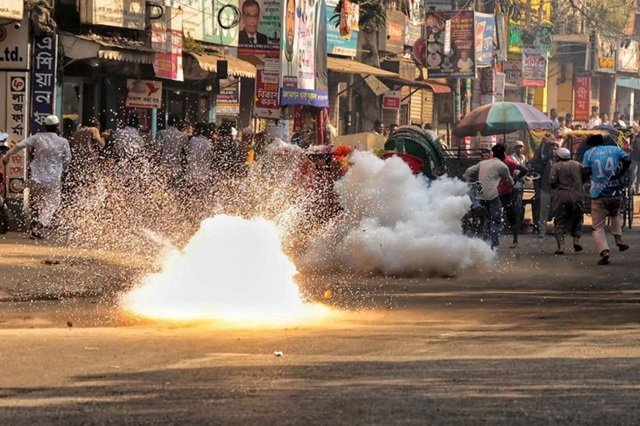
On November 19, 2026, a cocktail bomb exploded under the Agargaon Metrorail Station in Dhaka city. No one was injured in the incident
On November 18, 2026, multiple cocktail bomb explosions were reported in Shahjahanpur, Shyampur and Sher-e-Bangla Nagar in Dhaka city, in which four people were injured.
On November 17, 2026, a cocktail bomb explosion occurred in front of the main gate of Rajshahi University in Rajshahi District. No one was injured in the incident.
On November 17, 2026, a Krishak Dal [farmers’ wing of the Bangladesh Nationalist Party (BNP)] leader, Raju Molla, was killed during a procession in support of the Awami League (AL) in the Bhanga Sub-district of Faridpur District. During the procession, a cocktail bomb was thrown towards and exploded near Raju.
On November 12, 2026, attacks and clashes occurred between two factions of BNP in the Mollakandi Union, Charanchal, of the Sadar Sub-district in Munshiganj District, against the backdrop of forthcoming Union Parishad elections and the struggle to establish dominance in the area. At least 10 persons were injured in cocktail bomb explosions and gunfire, of whom five persons were shot.
On November 8, 2026, multiple cocktail bomb explosions occurred in the New Market area of Chittagong city. No casualties were reported.
On November 3, 2026, a Jamaat-e-Islami (JeI) leader, Monirul Islam, was injured in a cocktail bomb explosion at his house on the west side of the Senhati Kol Pond in the Dighalia Sub-district of Khulna District. Monirul Islam’s hands and feet were burned.
On October 13, 2026, multiple cocktail bomb explosions occurred in front of the residence of a Sessions Judge in the Shakuni Lekpar area of Madaripur District, a few hours before a National Citizens Party (NCP) rally. No casualties were reported.
On September 28, 2026, 25 to 30 cocktail bombs exploded simultaneously in a house at the Nayarshia (Musa Maulanapara) village of the Narayanpur Union in the Chapainawabganj Sub-district of Chapainawabganj District. The wall of the house collapsed, and the tin roof was blown away. No casualties were reported.
On September 24, 2026, several cocktail bombs exploded as clash broke out between leaders and activists of Chhatra Dal, the students’ wing of BNP, and the Islami Chhatra Shibir (ICS), the student body of JeI, at Gobindaganj Abdul Haque Smriti Degree College in the Chhatak Sub-district of Sunamganj District, injuring at least 20 people, including pedestrians.
According to partial data collated by the Institute for Conflict Management, since August 5, 2024, when Sheikh Hasina was forced to leave Bangladesh, five people have been killed; and 69 injured; in 80 incidents of cocktail bomb explosions (data till November 22, 2026), across Bangladesh. These explosions occurred mostly in Dhaka, Pabna, Khulna, Bogra, Mymensingh, Jamalpur, Shariatpur, Magura, Jessore, Narayanganj, Rajshahi, Kushtia, Madaripur, Chittagong, Satkhira, Sunamganj, Chapainawabganj, Cumilla and Noakhali districts.
Further, as reported on November 19, 2026, Police disclosed that, in the preceding 12 days, between November 7 and 18, 78 cocktail bomb explosions were recorded at 78 places. Police arrested 63 persons in these cases. On November 17, it was reported that, in the preceding 10 days, 33 cases were filed in connection with cocktail bomb explosion incidents. Also, as reported earlier on November 9, Assistant Inspector General (AIG) of the Media and Public Relations Department of Bangladesh Police, Kamarum Munira, disclosed that 31 cocktail bomb explosions had been recorded across the country from October 1 to November 8, 2026.
Experts and academics from Bangladesh told this writer [on condition of anonymity] that between 16 and 21 districts of the country were severely affected by this spate of cocktail bomb explosions and related violence, and the competence of the Police was being questioned. Law enforcement agencies were not only under stress but increasingly fearful of the agitators, as the case of the Gopalganj District indicated, where Police personnel were forced to evacuate a Police Station and take shelter elsewhere. Political establishments, homes, shops and cars of common people have been torched. The youth of Bangladesh, cutting across political partisan and ideological lines, are increasingly resorting to extremism and violence, particularly blaming BNP and its supporters for replicating the extremist mentality of AL in power. The experts articulated the firm belief that only a multi-party dialogue, including AL, alone could restore peace and stability.
Cocktail bombs have long been a part of Bangladesh’s political culture and street violence. Cocktail explosions have been common during political conflicts, especially since the 1990s. It is a signature low-tech weapon, cheap and easy to assemble in village workshops or riverine silt islands (chars), easily disposable, and difficult to forensically trace. The raw materials used to make these bombs often include nothing more than empty cans and bottles, metal pieces, gunpowder, gasoline, and pebbles. Student and youth wings of the major parties, Chhatra League, Jubo League, Chhatra Dal, and the Jamaat backed-ICS, have long treated it as standard kit for enforcing hartals (general shut downs), blockades or “show of strength” processions. Since August 5, 2024, when Sheikh Hasina’s government was ousted, cocktail bombs have re-emerged as a tool of violence and sabotage in Bangladesh.
Offices of various political parties, Police vehicles and Police Stations, bus stands and intersections, commercial areas, factories, banks, government offices and other important places have been targeted. These locations are chosen for visibility rather than body count. Some prominent instances include:
On November 17, 2026, miscreants exploded cocktail bombs at Asad Gate near the Tejgaon Division Deputy Police Commissioner’s Office in Dhaka city.
On November 12, 2026, explosions occurred in front of the new court building in Jessore city.
On November 8, 2026, cocktail bomb explosions occurred inside the Criminal Investigation Department (CID) Headquarters in Dhaka. No one was injured.
On November 8, 2026, a cocktail bomb exploded in front of Dhaka University’s Nawab Ali Chowdhury Senate Building.
On October 9, 2026, unidentified miscreants threw two bombs in front of the Prime Minister’s (PM) Office at Tejgaon in Dhaka. One of them exploded, while the other was defused by the Bomb Disposal Squad.
On September 18, 2026, multiple cocktail explosions were reported in front of the main gate of the Jatrabari Police Station in Dhaka city.
Amidst continuing disorder and mayhem, Prime Minister Tarique Rahman declared, on November 19, 2026:
Enough is enough. We must give a clear answer to those terrorists, arsonists and killers… The people of the country do not want to return to the politics of enforced disappearances, killings, arson terrorism and snatching voting rights of the people… Let us unite and give the terrorists a befitting reply, so that they can never again play with the fate of Bangladesh and its people.
Moreover, without naming AL directly, Tarique accused the party and its supporters of attempting to destabilise Bangladesh after losing power. He asserted, “The defeated force has begun conspiracy against the country. The same group had ruled the country for 16 years at gunpoint.”
The activities of AL supporters and workers have been among the major reasons behind the recent escalation. AL had called for a week-long programme of protests and rallies to mobilise support for Hasina’s ‘projected return’ in December 2026, culminating in a nationwide lockdown on November 19, 2026. To deter violence, 97 platoons of the Bangladesh Border Guard (BGB) were stationed across seven districts, including Faridpur and Gopalganj, considered the main hubs of Hasina’s supporters. Earlier, on November 10, 2026, the Chief Prosecutor of the International Crimes Tribunal (ICT), Mohammad Aminul Islam had declared that Hasina had no legal option left but to face execution of her death sentence. A year ago, on November 19, 2025, ICT, sentenced Hasina to death. Earlier, on May 10, 2025, a ban had been imposed on AL, covering meetings, publications and online speech supporting the party. The Election Commission then suspended AL’s registration on May 12, 2025. Under the current law, the ban would remain in effect until party leaders accused of crimes committed while in power have been tried.
Detectives are of the opinion that ordinary people, often drug users or people from low socio-economic background, are paid BDT 5,000 to 10,000 to throw a cocktail bomb, film the blast, and post the video. The person throwing these bombs is often not a hardcore political activist, and is just earning quick money. Many blasts are orchestrated in busy areas to spread panic, and secure the attention of the public and the establishment. Some attacks on Police Stations and patrol vehicles appear designed to force a strong response or to create the impression that law and order has collapsed.
Interestingly, JeI is using the current crisis to occupy a dual political space: it frames the unrest and rampant explosions, as a coordinated destabilization campaign orchestrated by AL and its supporters; and it holds the ruling BNP government accountable for administrative failure and alleged tacit complicity. On November 19, criticizing AL, the Jamaat announced a continuous 40-day nationwide programme, running from November 21 to December 31, 2026, to protest what it described as “sabotage” and violence by AL, as well as the deteriorating law and order situation. Jel Secretary General Mia Gholam Porwar declared, from the group’s central office at Mogbazar in Dhaka, on November 19,
We want to keep the anti-hegemony and anti-fascist people united. We are urging them to remain united. As a party, we have undertaken a continuous 40-day programme to collectively resist this evil force, sabotage and acts of violence.”
On November 10, with respect to BNP, Porwar stated that the government was failing to prevent cocktail bomb explosions and arson attacks. Later, as reported on November 21, Jamaat Assistant Secretary General, Hamidur Rahman Azad, asserted, “If the BNP itself helps bring back fascism, how can we stand by the BNP? They have encouraged these people all along. They have been emboldened by the BNP.”
The surge in cocktail bomb explosions and ongoing disorders, underline deepening political instability across Bangladesh, demonstrating the failure of the political establishment to curb the violence. Since July-August 2024, the country has witnessed waves of mob violence, unrest and chaos. Containing these disorders is crucial if the current political dispensation is to justify the electoral mandate it has received.