Editorial
The people of Manipur have once again been shattered by an atrocity that exposes the grotesque failure of both state and central governments in protecting the lives of its citizens. Six civilians, including women and children, were abducted and gruesomely murdered by Kuki militants in Jiribam district—a horrific crime that sent shockwaves across the region, igniting waves of protest, strikes, and sheer outrage. Three of the victims were discovered floating in the Jiri River, while the remaining bodies were found days later and dumped in a mortuary. This vile act, while shocking, is just another stark reminder of the systemic violence that has festered in the region for decades, exacerbated by the government’s sustained inaction and its oppressive reliance on draconian measures like the Armed Forces Special Powers Act (AFSPA).
The failure of the state to address the root causes of this bloodshed is glaring. The Kuki militants, while undeniably responsible for these heinous acts, are not the sole culprits in this ongoing tragedy. The true guilt lies squarely with a government that has forsaken its responsibility to protect its citizens, choosing instead to rely on authoritarian tactics that have perpetuated suffering rather than alleviating it. The imposition of AFSPA, originally enacted in 1958 as a measure against insurgency, has become an insidious instrument of oppression—entrenching violence, fostering fear, and enabling unchecked abuses of power by security forces. Its very presence on the ground has not only failed to protect innocent lives but has emboldened violence across the region.
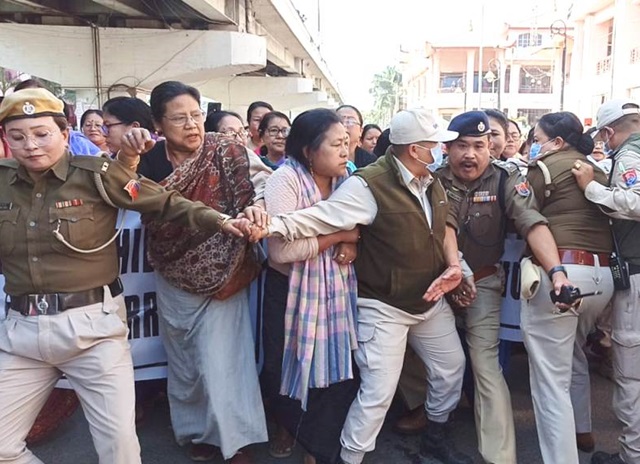
The brutal killings of Yurembam Rani Devi (60), Laishram Chingkheinganba Singh (2.5 years old), L. Heitombi (25), Telem Thoibi (31), Telem Thajamanbi (8), and Laishram Langamba (8 months old) on November 11, 2024, were not just a grotesque act of terror; they are the latest, most tragic chapter in the continuing saga of government neglect. The abductions were followed by a callous delay in rescue efforts, while the government sat idly by, and the victims’ bodies were later discovered in the most grotesque of circumstances. Harrowing reports of sexual assault and brutal execution paint a chilling picture of the horrors that these innocent civilians endured. As local protests, led by the women of Jiribam, erupted with such intensity that roads were blocked and businesses shut down, one could not help but feel the deep sense of abandonment that the people of Manipur feel. For them, this is not just another tragic loss; it is a damning indictment of the government’s deep indifference to their suffering.
The fury in Manipur is palpable. It is not just the violence itself that infuriates people—it is the relentless apathy of the government. The local community’s sense of betrayal is profound. H. Priyananda Singh, convenor of the Jiri United Committee, condemned the killings as “cowardly” and “barbaric,” rightly calling out the state’s failure to act swiftly and decisively. Instead of a rescue operation, there was bureaucratic lethargy, a hallmark of a government that is far too comfortable in its complacency. What should have been an urgent mission to save lives became a story of delays, passivity, and neglect. This is not a case of a government trying but failing—it is a case of a government deliberately refusing to act, perpetuating a narrative of oppression rather than healing. Modi’s government, which has displayed an authoritarian streak in handling internal conflicts, has ignored the grievances of the people of Manipur for far too long. Its lack of genuine engagement with the population, coupled with an over-reliance on militarised responses, has only deepened the divide between the state and its citizens.
The most damning element of this crisis is the continued reliance on AFSPA, a law that has not only failed to quell violence but has instead fuelled it. Originally intended as a counter-insurgency tool, AFSPA has, over time, become a carte blanche for the military to commit human rights violations with impunity. Under this law, security forces have been accused of extrajudicial killings, sexual violence, and torture—atrocities that have gone unchecked for years. The case of Irom Sharmila, who spent over a decade on hunger strike demanding the repeal of AFSPA, remains one of the most powerful symbols of resistance against a law that has wreaked havoc on the lives of ordinary people. Yet, despite widespread condemnation, AFSPA persists—not because it has worked, but because it allows the government to maintain control over a region in crisis, regardless of the human cost. It is a political tool, not a security one, used to assert dominance rather than peace.
The re-imposition of AFSPA in parts of Imphal Valley only highlights the futility of this approach. History has repeatedly shown that militarisation does not bring peace; it deepens divisions, hardens hearts, and perpetuates violence. The tragic deaths in Jiribam are a bitter reminder of this cycle, as both the Meitei and Kuki communities are caught in the crossfire of a brutal conflict that the government has consistently failed to address. The very law that was supposed to bring order to a fractured society has instead entrenched fear, resentment, and suffering. It is a vicious cycle that the government has perpetuated in the name of national security, while, in reality, it is the people of Manipur who are paying the ultimate price.
AFSPA has never been about peace. It has always been about control. Its continued application is an affront to the people of Manipur, who have long demanded an end to the law and its abuses. The truth is that AFSPA has never been about quelling insurgency—it has always been about silencing dissent. The government’s failure to listen to the voices of the people, especially the women who have borne the brunt of this violence, is a glaring example of how state power is used to oppress rather than protect. The cries of mothers who have lost their children to violence and injustice go unheard, their pleas for a peaceful resolution dismissed in favour of military might. In the wake of these recent deaths, it has become increasingly clear that the government’s response is more about silencing resistance than addressing the root causes of the violence.
The Modi government’s approach to Manipur has been nothing short of catastrophic. The decision to continue enforcing AFSPA in the region—despite its proven failure—reflects a dangerous political myopia. Rather than addressing the root causes of conflict, the BJP has opted for authoritarian measures that alienate local populations and exacerbate tensions. The government’s silence in the face of mounting human rights violations speaks volumes about its true priorities. Modi’s reluctance to take decisive action in response to the suffering of the people of Manipur reveals a government more interested in maintaining its power than in ensuring justice. This silence is not just negligence—it is complicity in the ongoing bloodshed.
The real issue in Manipur is not the Kuki militants or the insurgency—it is the systemic failure of the government to address the underlying political and ethnic issues that fuel this violence. Manipur’s tragedy is not just one of localised conflict; it is a national crisis that speaks to the very soul of India’s democracy. The people of Manipur are not mere subjects in a national security experiment—they are citizens who deserve justice, autonomy, and a future free from the terror of violence. If the Modi government genuinely cares about the people of Manipur, it must stop relying on failed tactics like AFSPA, engage in real dialogue, and seek justice for the victims of this massacre.
Until this happens, Manipur will continue to bleed. Its people will remain trapped in an endless cycle of violence, suffering, and government apathy. The question is: how much longer will they, as a nation, allow this to continue? The blood of innocent civilians is now staining the conscience of a government that has failed to act, and it is high time we demanded that the cycle of violence be broken before more lives are lost.