by Sachin Sri
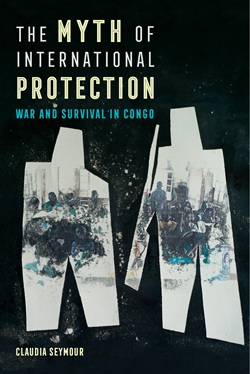
Claudia Seymour’s The Myth of International Protection: War and Survival in Congo is a searing indictment of the international community’s pretensions of humanitarianism, a harrowing ethnography that exposes the chasm between the lofty rhetoric of intervention and the brutal realities of survival in conflict zones. With an unrelenting gaze, Seymour dismantles the comforting illusions of “international protection” and reveals a world where the mechanisms of aid and intervention often exacerbate, rather than alleviate, human suffering.
The Mirage of Humanitarianism
Seymour’s thesis is as unsettling as it is incisive: the international aid apparatus, far from being a panacea, is often complicit in perpetuating the very conditions it seeks to ameliorate. “In Congo,” she writes, “protection is not a guarantee but a performance, a spectacle designed to reassure donors and sustain bureaucracies” (p. 52). This assertion forms the crux of the book, which is a devastating critique of the structures and actors that dominate humanitarian interventions in the Democratic Republic of Congo (DRC).
Through vivid ethnographic accounts, Seymour illustrates how international organisations prioritize optics over outcomes, focusing on quantifiable metrics—such as the number of displaced persons reached or workshops conducted—while neglecting the deeper, systemic issues that perpetuate violence and poverty. Her depiction of the “UN’s blue helmets” as “spectral presences, more adept at navigating bureaucracy than protecting lives” (p. 78) is emblematic of her unflinching critique.
Survivors as Actors, Not Victims
One of Seymour’s most powerful interventions is her refusal to reduce Congolese survivors to mere victims. Instead, she presents them as agents navigating a labyrinth of violence, deprivation, and betrayal with remarkable resilience and ingenuity. She recounts, for instance, the story of Byamungu, a farmer turned militia member, who oscillates between roles of perpetrator and protector in his quest to secure a future for his family. “In Byamungu,” Seymour writes, “the binaries of victim and villain collapse, revealing the impossible choices forced upon those at the margins of war” (p. 134).
This nuanced portrayal of Congolese agency is a welcome antidote to the paternalistic narratives that often dominate discussions of African conflicts. Seymour’s writing refuses to infantilize her subjects; instead, it foregrounds their humanity in all its complexity, contradictions, and courage.
The Violence of Labels
A recurring theme in The Myth of International Protection is the pernicious role of labels—“child soldier,” “refugee,” “combatant”—in shaping and constraining the lives of those caught in conflict. Seymour argues that these labels, far from offering clarity, serve to obscure the messy realities of war and survival. “A child soldier in one context,” she observes, “may be a breadwinner, a protector, or even a victim of coercion in another” (p. 89).
By interrogating these labels, Seymour exposes the reductive frameworks through which international actors view Congo’s conflicts. Her critique extends to the “protection” offered by international organisations, which often hinges on such reductive categorizations. She recounts, for example, the plight of displaced women who are denied aid because they do not fit the prescribed image of “vulnerability” required to qualify for assistance. “Protection,” she concludes, “is contingent upon performance, and those who cannot or will not perform their suffering are rendered invisible” (p. 176).
The Economy of Violence
Seymour’s exploration of the economy of violence in the DRC is another standout feature of the book. She delves into the intricate web of actors—from local militias to multinational corporations—who profit from the perpetual instability of the region. Her analysis of the coltan trade, for instance, is both chilling and illuminating. “Every smartphone,” she writes, “bears the trace of Congolese suffering, a digital residue of exploitation and blood” (p. 201).
What makes this analysis particularly compelling is Seymour’s refusal to exonerate any party. Western consumers, multinational corporations, and Congolese elites are all implicated in the perpetuation of violence. This even-handed critique underscores the global dimensions of Congo’s plight, challenging readers to confront their own complicity in these distant atrocities.
A Challenge to Anthropological Orthodoxy
As a work of anthropology, The Myth of International Protection is as much a critique of the discipline itself as it is an exploration of its subject matter. Seymour challenges the field’s traditional focus on detached observation, arguing that such an approach often reinforces the power imbalances it seeks to critique. “To document violence without challenging its structures,” she asserts, “is to become complicit in its perpetuation” (p. 223).
This call for engaged anthropology is both timely and urgent. Seymour’s work serves as a powerful reminder that scholarship is never neutral, and that the act of witnessing must be accompanied by a commitment to justice. Her own positionality as a researcher is woven into the narrative, lending the book an ethical clarity that is as refreshing as it is rare.
Ethical Dilemmas and Uncomfortable Questions
Seymour’s book is replete with ethical dilemmas that challenge both the reader and the humanitarian sector. Should aid organisations negotiate with militias to secure access to vulnerable populations? Is it ethical to provide aid that may inadvertently sustain corrupt regimes? And perhaps most provocatively: can international protection ever truly exist in a world defined by inequality and exploitation?
These questions are not merely rhetorical; they demand answers. Seymour’s refusal to offer easy solutions is one of the book’s great strengths, forcing readers to grapple with the complexities of humanitarian intervention. Yet, this very refusal may frustrate those looking for actionable insights. The Myth of International Protection is not a handbook for reform but a clarion call for a fundamental rethinking of the systems and ideologies that underpin international aid.
Conclusion: A Masterpiece of Critical Scholarship
The Myth of International Protection is a devastating, unflinching, and profoundly necessary book. Seymour’s prose, at once lyrical and incisive, captures the full spectrum of human experience in Congo—from the depths of despair to the heights of resilience. Her critique of international aid is both scathing and constructive, offering a blueprint for a more honest and equitable approach to humanitarian intervention.
This is not an easy book to read. Its pages are filled with stories of unimaginable suffering, and its conclusions are often disheartening. Yet, it is precisely this discomfort that makes the book so important. By forcing us to confront the failures of the systems we rely on, Seymour challenges us to imagine a better, more just world.
In the end, The Myth of International Protection is not merely a critique of international aid; it is a meditation on the nature of power, agency, and survival. It is a book that demands to be read, debated, and acted upon. For, as Seymour so powerfully reminds us, “The greatest myth of all is that protection can exist without justice” (p. 287).