
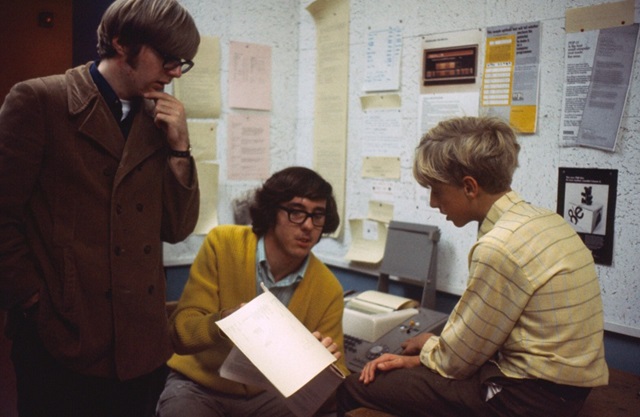
In the spring of 1975, 19-year-old Bill Gates was a student at Harvard University. But when he wasn’t experimenting with acid or playing high-stakes poker, he spent every spare hour in Harvard’s highly restricted computer lab, furiously writing code with his friend Paul Allen. As he recalls in an extract from his new memoir Source Code, they were creating what eventually became the first Microsoft software and made them both billionaires. But such was their fervour for programming and disdain for the strict rules of the laboratory, Gates soon found himself in deep trouble…
______________
“I want to see you in my office tomorrow at ten. I’m in Room 20,” the associate director said when I picked up the phone in my dorm room. It was the middle of reading period, May 14 to be exact, and I was studying for finals. I instantly knew I was being summoned to Harvard’s Aiken computer laboratory to talk about my heavy computer use.
The next morning, the associate director confronted me without any preamble. Why was I spending so much time at the centre? What was I working on? Who was I bringing into the centre? I told him I wrote a version of Basic computer code for a microcomputer, collaborating with my friends Paul Allen and Monte Davidoff.
To anyone who was regularly using the centre, nothing I said would be new. I was always open with everyone in the lab about what we were doing. The associate director seemed to already know the answers to a lot of his questions. The centre had recently introduced an accounting program to track how much time each person was using the computer. He placed a piece of paper in front of me showing the results from my user account.
I had racked up 711 hours in the month of February and another 674 hours in March. Given that there are barely that many hours in a month, that seemed like a lot to him. He was flabbergasted that when he did the maths, 711 hours meant that Bill Gates and his “associates,” as he called Monte and Paul, were using the centre an average of eight and a half hours each day of the 28 days in February. How was that possible?
I wasn’t sure he understood that it was common practice to leave the terminal unattended for several hours while the computer crunched through a job on its own. At times we were using two or three terminals simultaneously, so I was sure the hours were double or even triple the time we actually spent at the centre.
Maybe that didn’t matter. Beyond computer time, at issue was the fact that I brought unauthorised people — Paul and Monte — into the lab and that we worked on a commercial project. He explained that the government would be concerned that commercial work was performed under the lab’s defence department contract.
As he looked at me across his desk, I’m sure he saw an undisciplined undergraduate, mistakenly given access to his centre, who sneaked his two accomplices into Harvard’s secure computer room where the three worked on some mystery product late at night to avoid detection.
In this scenario, if the generals at the Department of Defence ever uncovered this scheme, they would have no choice but to cut off the generous funding they provided to Harvard’s cutting-edge Aiken Computation Laboratory.
That outcome seemed far-fetched to me. I guess I showed it. My lack of contrition in the moment seems to have bothered him. In notes I recently found in my Harvard records, he wrote, “He [me] did not understand the ramifications of his activities and seemed totally unimpressed when I explained them to him.” Other notes in my record have him commenting that I was “a wise-ass”. Perhaps I was. My ability back then to filter my reactions wasn’t very highly developed.
It seemed like a decision had been made. “I want to remind you that you’re speaking before a witness,” he said at one point, indicating that his administrative assistant was sitting at her desk nearby. Witness? Am I in some legal peril? I said I would reimburse the centre for the time I used the computer and added that I’d put the version of Basic written at Harvard in the public domain where anyone could access it.
He told me to hand over my key to the Aiken centre. He then deactivated my account in front of me. He said he was going to immediately inform the administrative board. The administrative board? That meant the dean and a committee of administrators and faculty members would hear my case. Two days later I learnt what was at stake.
My senior tutor explained that in the worst case, the board could expel me from Harvard and if they found my actions particularly grievous, they would expunge my record, which meant all but erasing the fact I had ever attended the university. Gulp.
I didn’t call my parents often back then — once every three weeks or so. I hadn’t shared very much with them about what I was doing with Paul and Basic. Now, in one call, they learnt everything. As always, my dad went right to the key questions: Were the rules of the lab written down and communicated to you? How does the school distinguish your use of the computer from professors who use university resources for their commercial work?
Will you get to see the testimony of others? At some point he called the school and asked similar questions. My dad wasn’t the type to ever play the bad cop, but given his temperament — measured, logical, succinct and not prone to small talk — he could be intimidating all the same. I’m sure whoever he spoke with was left with the impression that he was watching closely.
Whether explicit or not, I’m sure his message was, “Whatever your verdict, your process had better be fair.” After all these years, I don’t remember the details of my parents’ involvement in my Aiken mess. I know my father flew to Boston to see me and assess the severity of the situation. I know that he was worried that Harvard might run roughshod over me.
And I know that the prospect that I might get kicked out of Harvard deeply distressed my mom. She worried about me. And I’m sure she worried too about our reputation as a family in our community. To have a son drop out of college would be shocking. To be kicked out, even worse. I felt the weight of all this as I sat at my typewriter and over the course of one long night wrote a letter to the administrative board.
The document — I still have a copy — was a defence of my actions, an apology, a critique of Aiken, a narrative of our project and a snapshot of an industry on the verge of revolution. I wrote that the advent of the microprocessor by 1974 meant that suddenly computers could be “made smaller than a matchbox”. I included that “Paul Allen is a firm believer that microcomputers are the wave of the future” and of our interest in trying to be part of that wave.
When I was done writing, I read the ten pages to my parents over the phone. My father suggested I should be more conciliatory. On his advice, I concluded my letter: “I apologise for my mistakes. I feel I showed serious misjudgment in relation to the selling of the Basic. I believe I can continue to be an asset to the Harvard community, and I ask that you not put a blot on my record that will hamper my pursuits in the future.”
One week later, I was in my dorm room studying for final exams when my senior tutor called. The ad board had just met over my case. They voted to “admonish” me for improper and unauthorised use of the lab. What does that mean? He explained: I got off easier than he thought I would. No punishment.
Of the three areas of concern — computer time, building a commercial product and bringing unauthorised people into the lab — they found only that I violated the third. I should have sought approval before bringing Paul and Monte into Aiken. I was lucky that the board realised the lab had been very loosely run and had virtually no set rules.
I’m not sure why I don’t have better recall of my parents’ worries during my Aiken problems. I was very independent and also less in tune back then with other people’s emotional states than I am now. I do know that I felt at the time that since I caused the problem, it was up to me to get out of it.
One record from that period I have is a Christmas letter from my grandmother Gami. As expected, she took a firm, principled view of my mess. Her thoughts, I’m certain, reflected those of my parents:
I’m sure you recognise you have a wonderful talent and we’re all proud of your creativity and diligence in pursuing each idea. Be sure you stand on the highest ethical standard. Bend over backward to look at each facet of your endeavour from every angle. Perhaps I am concerned because I feel temptations are so great to let up a little here and a little there, forgetting our whole goal is being jeopardised.
Your experience at Harvard, although you were somewhat exonerated, is still a warning to be above board in every step you take. Having seen lives destroyed because the individual thought the end justified the means, should keep us on our toes. I want you to be alert. Let your work be so correct that in no way can it be construed as improper. You’re a great young man — I’m for you and I love you.
See you soon, Gami
The tension over my use of Aiken was rooted in the way computing had always been up to this point: a scarce, protected resource. Computers were still expensive and access to one required some special connection or accreditation, a key to a room, or if you were lucky, enlightened teachers at your high school.
Yet though no one could fully grasp it at the time, everything was about to change. That scarcity was about to give way to plenty, and computers would very quickly be available to millions of people. The Basic program we wrote that caused such a stir would play a central role, as would the work of thousands of other people.
Suddenly the notion that a teenager could create something of value on a computer would go from far-fetched to commonplace. And the cost of computing would fall so fast that it would be nearly free.
My last LSD trip (almost)
Paul and his girlfriend, Rita, had arrived in Boston in August, renting an apartment in the suburbs about a 40-minute drive from Harvard. By the fall, Paul was adjusting to life as a salaried employee at Honeywell, writing small pieces of large programs. My college friends already knew Paul as a larger-than-life character from my stories. Now Paul kept the mystique alive in person.
With his beard and his girlfriend, his guitar and his broad knowledge, Paul fit the role of cool older brother. And as always, he was my goad — and a bit of a corrupter.
One weekend in October, I drove with a few friends to visit Paul and celebrate Rita’s birthday. Paul had some LSD that we all dropped while watching Kung Fu. Patient Rita stayed sober, our chaperone on the chance things got weird.
At night we checked out the woods around the house, stopping a long time at every tree to look at the fall colours. I watched a friend trace his finger in the dewdrops on the trunk of Paul’s car, writing Ǝ, the symbol in logic problems meaning “there exists”.
He wrote another one next to the first: Ǝ Ǝ. The two backwards Es together, side by side, to him, to us, held some profound meaning. “Bill, see this. Existence exists,” he said as we stared at the dewy car trunk. It was one of those moments that seem perfectly cosmic at the time and purely silly once the acid wears off.
At the height of the evening, a curious train of logic passed through my mind. On a computer you can delete a file and even wipe out all of your stored data. Since the brain is just a sophisticated computer, I thought, “Hey, maybe I can command my brain to zero out all my memories.” But then I got worried that testing that notion might actually set it irrevocably into motion. Better not even think about it!
Taking a shower the next day, I ran through an inventory of my cherished memories, relieved to find that everything was intact. That would be one of the last times I would do LSD.