by Our Correspondent in Colombo
Former Sri Lankan president Ranil Wickremesinghe has called for stronger cooperation among Theravada Buddhist countries, arguing that Sri Lanka’s historical role in the development and spread of the tradition provides a foundation for closer regional ties.
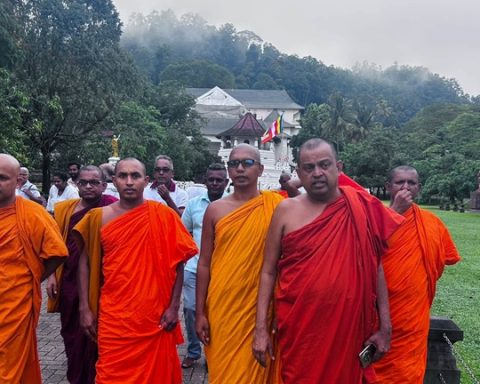
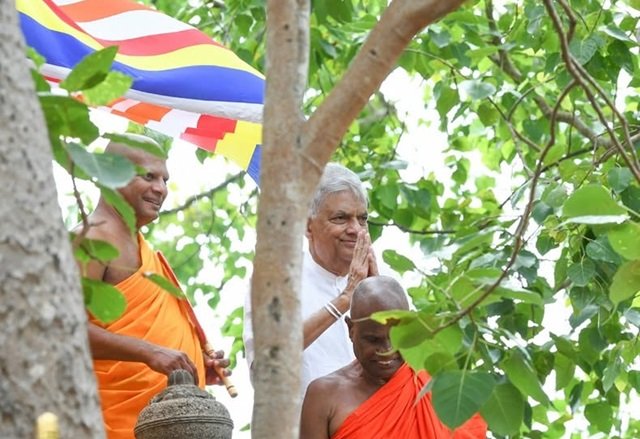
Speaking at the unveiling of the pinnacle of the Mihindu Maha Seya at Mihintale on the 18th, Wickremesinghe described Anuradhapura as a sacred centre for Buddhists across the region, rather than a religious heritage site belonging exclusively to Sri Lanka. He linked the country’s historical importance to the spread of Theravada Buddhism into Southeast Asia, the movement of monks between kingdoms and the restoration of Buddhist monastic traditions through exchanges with Thailand.
“The beginning of Theravada Buddhism was here when Reverend Arahat Mahinda arrived in Sri Lanka, bringing the instructions of the great Emperor Ashoka,” he said, referring to the introduction of Buddhism to the island following the Third Buddhist Council at Pataliputra.
Wickremesinghe said Buddhism was accepted by King Devanampiya Tissa, under whose patronage the Mahavihara was established to accommodate monks who entered the monastic order. The institution subsequently became a major centre of Theravada Buddhist learning, alongside the religious establishments of the Anuradhapura region. He said it was among the earliest centres where Buddhist teachings were studied in Pali and where the Tripitaka was eventually committed to writing on ola leaves.
Although different Buddhist sects existed in Sri Lanka, Wickremesinghe said they were eventually brought together under the Mahavihara tradition during the reign of King Parakramabahu I. The country’s religious institutions subsequently developed connections with Buddhist communities beyond the island, particularly in mainland Southeast Asia.
He recalled that Polonnaruwa was the capital during an important period of these exchanges, while Trincomalee served as a principal port. Monks associated with the Mahavihara tradition operated from centres including Dimbulagala, which Wickremesinghe identified as an important place of learning and religious activity.
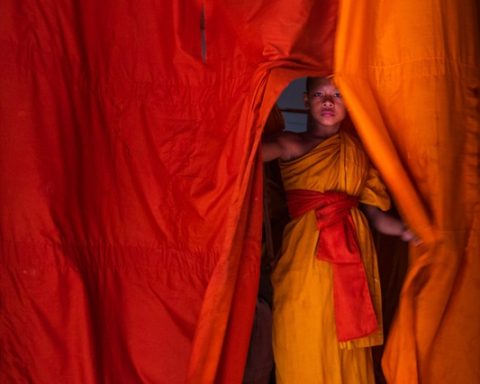
According to his account, Thai and Cambodian monks travelled to Sri Lanka to study Theravada Buddhism, while Sri Lankan monks helped establish and strengthen the tradition elsewhere in the region. He cited Nakhon Si Thammarat in present-day Thailand as an early destination for the transmission of Buddhism from Sri Lanka, followed by the Sukhothai kingdom, where monks from the island, including the monk Mahaswami, contributed to religious developments.
Wickremesinghe also referred to connections with Angkor, where the ruling kingdom followed Mahayana Buddhism before a shift towards Theravada. His remarks placed these developments within a broader history of exchanges between religious institutions and political authorities across Southeast Asia, although he did not provide further details about the chronology of the changes.
He identified Sukhothai as an important centre in the evolution of regional Buddhist practice, saying that Thai Buddhism moved from Sanskrit towards Pali there. He also referred to developments in Myanmar and the continuing presence of Theravada Buddhism in Cambodia and Laos, describing these countries as part of a shared religious region.
The former president connected this historical relationship to his longstanding call for a Theravada economic framework. He said Sri Lanka had begun pursuing closer economic cooperation with Thailand through a free trade agreement, presenting economic engagement as another means of strengthening relations among countries linked by their Buddhist heritage.
Wickremesinghe also recalled periods when Sri Lanka’s Buddhist monastic order faced disruption. He said wars involving the Portuguese contributed to a decline in the availability of ordained monks, prompting efforts to restore the tradition through links with Thailand. An ordination ceremony at Kelaniya during the reign of King Parakramabahu VI was among the historical developments he mentioned before turning to later efforts to revive the monastic community.
He said Sri Lankan representatives subsequently travelled to Ayutthaya to obtain assistance in bringing monks from Thailand to re-establish ordination on the island. He associated this process with the beginnings of the Siam Nikaya, followed by the establishment of the Amarapura and Ramanna Nikayas.
Wickremesinghe also credited Thailand’s King Rama V with supporting Buddhist causes during the period when Anagarika Dharmapala campaigned on behalf of Buddhism. He said the Thai monarch provided financial assistance, helping sustain Buddhist hopes during the 19th and early 20th centuries. The episode, he argued, demonstrated the depth of the relationship between the two countries beyond the movement of monks and religious teachings.
Describing Anuradhapura as a shared spiritual centre, Wickremesinghe compared its significance for Buddhists with that of the Vatican for Catholics, Jerusalem for Christians and Jews, and Mecca for Muslims. He also referred to sacred Hindu sites, stressing that Anuradhapura’s importance extended beyond Sri Lanka’s national boundaries.
“This is a sacred place of the Buddhist and it’s in Sri Lanka,” he said, calling on people across the region to recognise their common religious inheritance.
He further addressed the relationship between Buddhism and modern constitutional government, saying Sri Lanka and Thailand protected freedom of religion while giving Buddhism a distinct constitutional position. He cited Article 9 of Sri Lanka’s Constitution, which accords Buddhism the foremost place and requires the state to protect and foster the Buddha Sasana, while maintaining the rights of other religions.
In discussing Thailand, he referred to constitutional provisions concerning the protection of Buddhism and the requirement that the king be Buddhist. He also said Cambodia combined religious freedom with constitutional protection for Buddhism. His remarks presented these arrangements as examples of how countries in the region maintained their Buddhist traditions within modern state structures.
The ceremony at Mihintale, associated with the arrival of Arahat Mahinda and the introduction of Buddhism to Sri Lanka, concluded with Wickremesinghe acknowledging the contribution of Thailand to the Mihindu Maha Seya project. He thanked the Thai people and the deputy prime minister for bringing the pinnacle to Sri Lanka and expressed the hope that the merit associated with the offering would be bestowed on Thailand’s king and people.