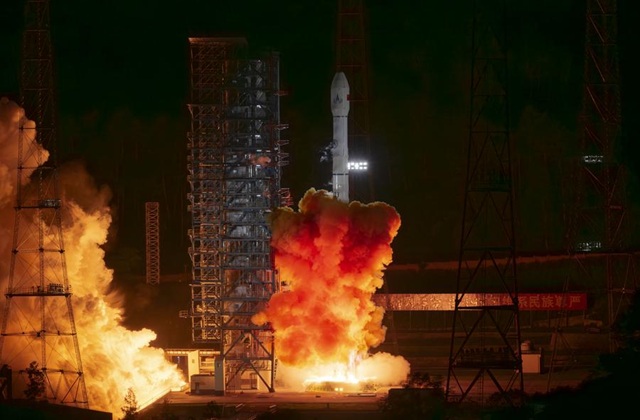
China successfully launched its first asteroid sample-return mission, Tianwen-2, in the early hours of May 29, marking a significant stride in the country’s quest to uncover the secrets of the solar system’s origins. Blasting off aboard a Long March-3B carrier rocket from the Xichang Satellite Launch Center in Sichuan Province at 1:31 a.m. Beijing Time, the Tianwen-2 spacecraft is embarking on a decade-long journey that promises to reshape humanity’s understanding of asteroids, comets, and the early solar system.
The mission’s initial objective is to retrieve samples from near-Earth asteroid 2016HO3, a quasi-satellite of Earth that remains in a stable orbit, appearing to loop around our planet while following the Sun. The probe is expected to reach the asteroid after a year of deep-space travel, mid-course corrections, and precise maneuvers. Once within 30,000 kilometers of its target, the spacecraft will enter a complex phase of circling and hovering to identify the optimal sampling site—no small feat considering the asteroid’s extremely weak gravity and rapid rotation.
After securing a sample, the spacecraft will return the material to Earth by the end of 2027, using a detachable capsule for reentry. Following that, the main probe will venture even farther into space to investigate the enigmatic main-belt comet 311P, located between Mars and Jupiter. This dual-phase mission underscores China’s growing capabilities in space science and high-risk, long-duration autonomous missions.
According to Shan Zhongde, head of the China National Space Administration (CNSA), Tianwen-2 marks “a significant step in China’s new journey of interplanetary exploration,” reflecting both scientific ambition and technological prowess. The mission carries not only scientific instruments such as spectrometers, radar, and magnetometers, but also a deeper cultural significance—its name is derived from “Tianwen” or “Questions to Heaven,” a classical Chinese poem by Qu Yuan, symbolizing humanity’s eternal pursuit of cosmic truth.
Asteroids like 2016HO3 are often described as “cosmic fossils,” preserving primordial material from the solar system’s infancy. Scientists hope the samples will provide insights into the chemical and mineral makeup of early celestial bodies, potentially shedding light on how water and organic compounds may have arrived on Earth. As Liu Jianjun, deputy chief designer of the mission, noted, such findings could even inform our understanding of life’s origins.
The second phase of the mission is equally compelling. Main-belt comet 311P defies conventional astronomical classification—its periodic ejection of material resembles a comet, but its location in the asteroid belt raises questions about its composition and origin. By closely studying 311P, scientists hope to determine whether such comets formed in situ or migrated from the outer solar system, challenging long-held theories of planetary formation.
Technologically, Tianwen-2 is a tour de force. It must perform autonomous navigation, sample collection on unstable terrain, and precise timing over vast distances—up to 500 million kilometers from Earth in the case of 311P. Engineers have developed flexible, lightweight solar panels for extended deep-space power supply and incorporated a suite of backup systems to handle the unknowns, from surface density to asteroid shape. As Chen Chunliang of the China Aerospace Science and Technology Corporation explained, “We’ve engineered multiple contingency strategies to tackle the formidable challenges of operating in near-zero gravity and under extreme uncertainty.”
The mission’s success would place China in the elite ranks of spacefaring nations capable of returning samples from deep space—an achievement so far only realized by the United States and Japan. It also signals a maturing space program ready to tackle the most ambitious questions in planetary science, extending China’s reach far beyond lunar and Martian exploration.
In the words of CNSA, all Tianwen missions are dedicated to the “spirit of seeking the truth.” With Tianwen-2 now en route to answer some of the most profound questions about our place in the cosmos, China’s cosmic quest enters a bold new chapter.