
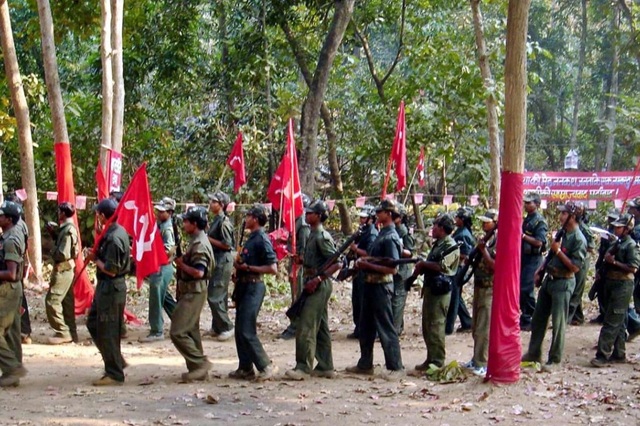
On June 14, an Assistant Sub-Inspector (ASI), Satwan Singh (34), of the Jharkhand-based 134 Central Reserve Police Force (CRPF) battalion was killed in an Improvised Explosive Device (IED) blast along the Odisha-Jharkhand border during a joint combing operation against the Communist Party of India-Maoist (CPI-Maoist) in the Banko Forest under K. Balang Police Station limits of Rourkela in the Sundargarh District of Odisha. The blast site remains tense, especially as it comes in the wake of the banned CPI-Maoist operatives hijacking a truck and looting industrial explosives from the same Banko Forest on May 27.
In a disturbing development, on May 27, 2025, the Maoists looted five tonnes of explosives from a truck transporting licensed commercial explosives to a stone quarry in Banko. While 3.8 tonnes of the stolen explosives were subsequently recovered, 1.2 tonnes remained in the possession of the Maoists. Speaking on the explosives’ heist, Odisha Director General of Police (DGP) Y.B. Khurania, while affirming the involvement of armed Maoist ultras in the daylight heist of this huge quantity of explosives by hijacking a vehicle from the Banko Mines area under the K. Balanga Police limits of Sundargarh District, noted,
Upon receipt of the information, the Odisha Police, Jharkhand Police and Central Reserve Police Force (CRPF) jointly launched search operation in Saranda Jungle. The joint operation which started on May 27th night is still on. Around 3.8 tonnes of explosives, out of the looted explosives weighing around 5 tonnes, have so far been recovered. The joint operation by Odisha police, Jharkhand Police and CRPF is still on to recover the remaining amount of explosive.
On June 9, 2025, Akash Rao Giripunje (42), Additional Superintendent of Police (ASP), was killed in an IED blast suspected to have been planted by cadres of the CPI-Maoist in a quarry at Dondra village in the Konta area of Sukma District in the Bastar Division of Chhattisgarh. Two other Police personnel on foot patrol duty were also injured in the blast. The incident took place when ASP Giripunje, along with other officers including the Town Inspector (TI) and Sub Inspector (SI), were patrolling an area on foot where Maoists had set a JCB machine on fire. When ASP Giripunje and the team reached the location of the fire, Giripunje stepped on the IED, triggering an explosion. Bastar Range Inspector General of Police (IGP) Sundarraj Pattilingam disclosed that the blast was triggered by a pressure IED on the Konta-Errabore Road when a team led by Giripunje was patrolling the area to prevent any incident ahead of the 10 June Bharat Bandh (general shutdown strike) call given by the CPI-Maoist to protest the deaths of several of its senior cadres, including ‘general secretary’ Nambala Keshava Rao alias Basavaraju (70), in encounters on May 21.
On May 21, 2025, a District Reserve Guard (DRG) jawan, Ramesh Hemla, was killed in an IED blast suspected to have been planted by the CPI-Maoist when the forces were returning after completing a combing operation in Bijapur District. The blast took place hours after Security Force (SF) personnel gunned down 27 Maoists, including the top leader Basavaraju, in a major operation in the Abujhmad region. Ramesh Hemla accidentally stepped on an IED and died on the spot in the explosion.
On May 7, 2025, three junior commandos of the Greyhounds, the elite anti-Naxal [Left Wing Extremism, LWE] force of the Telangana Police, were killed, and an Assistant Assault Commander (AAC) of the elite force was injured in a landmine blast triggered by CPI-Maoist cadres, while the commandos were on a routine area domination exercise in the Wazeedu–Perur Forest zone. The explosion occurred near the Veerabhadravaram-Tadapala hillocks near Penugolu village in the Wazeedu Mandal (administrative sub division) of the Mulugu District of Telangana. The deceased commandos were identified as Vadla Sridhar, N. Pavan Kalyan and T. Sandeep. The AAC, Ch. Ranadheer, sustained firearm injuries in the attack that took place in the forested area close to the volatile Telangana-Chhattisgarh border. The Greyhounds unit, which was part of a patrol team including Mulugu Police, launched a search operation in the forest area to unearth IEDs planted by Maoists and defuse them. Police disclosed that the search operation was launched in the wake of the statement purportedly given by the Maoists stating that they had planted bombs in the area, warning locals against movement. “One of the mines was triggered by Maoists resulting in the fatalities. The Maoists also opened fire at the commandos after the mine was triggered,” a Police source disclosed.
In these recent incidents, SFs participating in area dominance exercises have been targeted by the Maoists using explosives [IEDs and landmines]. In certain instances, civilians have often fallen prey to these traps, as they venture out to the forest to collect wood or graze their cattle. In some of the incidents in the past, the Maoists have also been killed or injured in the exchange of fire that followed the initial shock of the explosion triggered by them.
According to partial data documented by the South Asia Terrorism Portal (SATP), at least 32 incidents of Maoist-linked explosions have been recorded, resulting in 22 fatalities (five civilians and 17 SF personnel) and injuries to 33 (seven civilians and 26 SF personnel), since the beginning of 2025 (data till June 15). During the corresponding period of 2024, 23 such incidents resulting in 20 fatalities (five civilians, two SF personnel and 13 Maoists) were recorded, with injuries to another 20 persons (four civilians and 16 SF personnel). Through 2024, a total of 42 incidents of explosion were recorded, with 30 fatalities (nine civilians, eight SF personnel and 13 Maoists), and injuries to 42 persons (seven civilians and 35 SF personnel).
A total of 1,677 incidents of explosion have been engineered by LWEs, resulting in 1,934 fatalities (545 civilians, 1,216 SF personnel, 133 Maoists and 40 deaths which remained unspecified) and injuries to 2,383 persons (735 civilians, 1,453 SF personnel, 138 Maoists, and 57 in the unspecified category), since March 6, 2000, when SATP started documenting data on LWE-linked violence across the country. A maximum of 187 incidents of such explosions was recorded in 2009, resulting in 182 fatalities (36 civilians, 128 SF personnel and 18 Maoists) and injuries to 301 (64 civilians, 145 SF personnel, 81 Maoists and 11 unspecified). 2010 was the worst year in terms of fatalities, with 388 killed (200 civilians, 177 SF personnel, two Maoists and nine unspecified) and another 295 injured (208 civilians, 71 SF personnel, one Maoist and 15 unspecified), in 149 incidents of explosion.
The deadliest IED attack to target SFs was carried out on April 6, 2010, in which at least 75 Central Reserve Police Force (CRPF) personnel and a State Police trooper were killed in an ambush at Chintalnad in the Dantewada District of Chhattisgarh, when the Maoists first detonated an anti-landmine vehicle before firing indiscriminately on the CRPF troops.
The geographic distribution of IED attacks indicates that the highest number of such incidents have occurred in Chhattisgarh, with 502 incidents (749 fatalities and 767 injured); followed by Jharkhand, with 386 incidents (384 fatalities and 547 injured); Andhra Pradesh, with 237 incidents (162 fatalities and 262 injured); Bihar, with 232 incidents (187 fatalities and 248 injured); Odisha, with 189 incidents (126 fatalities and 170 injured); West Bengal, with 64 incidents (222 fatalities and 268 injured); Maharashtra, with 45 incidents (90 fatalities and 112 injured); Telangana, with 15 incidents (four fatalities and eight injured); and two incidents each in Uttar Pradesh, with three fatalities and one injured, Karnataka, with six fatalities, and Kerala, with one fatality. Madhya Pradesh reported one incident with no fatalities.
The Maoists employ an explosives arsenal comprising landmines, claymore mines, grenades, sticky bombs, pressure cooker bombs, crude rocket launchers, gelatine sticks, mortars and a range of IEDs to administer a first shock before engaging SFs with small arms fire, while the latter are engaged in area domination, cordon-and-search, combing, search, long-range patrolling, ambush-cum-patrolling and other operations. The use of IEDs also helps the Maoists avoid direct confrontation on the ground. IEDs are hidden underground or in bushes, on national highways and important state roads, as well as near SF camps/posts. IEDs have been among the most potent tools deployed by the Maoists, and are often very difficult to locate, resulting in higher SF casualties, without any loss of their own cadres.
The lethality of IED attacks was demonstrated in the beginning of the current year, on January 6, 2025, when eight security personnel of the DRG and a driver were killed in Bijapur District, when CPI-Maoist cadres used an IED to blow up their vehicle. The SFs were returning from an operation when the IED blew up their Scorpio SUV at Kutru in the Bastar region at around 2.15 PM [IST].
Meanwhile, according to an April 14, 2025, report, the National Investigation Agency (NIA) alerted the Central Paramilitary Forces as well as State Police in Bihar, Chhattisgarh and Jharkhand about hidden IEDs in different locations of the three States. The development took place following the interrogation of several suspects involved in Maoist activities. On April 8, 2025, NIA recovered two IEDs with three kilograms each, concealed underground between two rocks in the Kari Pahadi area of the Bhusiya Forest region of Lutuwa in the Gaya District of Bihar. Speaking to ETV Bharat, security expert Brigadier (Retired) B.K. Khanna observed that IEDs had become a challenge for the SFs as their components are easily available in the market and the devices can be prepared within hours by an expert. Brigadier Khanna added, “They (Maoists) can plant IEDs targeting the security forces [SFs] in selected locations in advance. This is posing a significant risk to security operations against the Maoist cadre hiding in deep forests.”
Taking actions against the Maoists’ explosives campaign, NIA Hyderabad, on May 30, 2025, formally took over the investigation into three cases registered by the Telangana police, related to the planting of IEDs in the Karregutta region, located on the Telangana-Chhattisgarh border. The Karregutta area is a heavily mined and LWE insurgency-prone zone. The cases, originally registered by various Police Stations in Mulugu District, were handed over to NIA on May 23, 2025, following directives from the Union Ministry of Home Affairs (UMHA) citing national security concerns and the need to investigate a wider Maoist conspiracy.
On March 21, 2025, NIA charge-sheeted two arrested accused in a 2024 case of purchase and supply of explosives by the banned organisation CPI-Maoist in Chhattisgarh. The anti-terror agency, in its chargesheet filed before the NIA Special Court, Jagdalpur, named Mantosh Mandal and Sela Nagarjun alias S. Nagarjun, both residents of Patnampara, District Sukma, Chhattisgarh, under various sections of the Explosive Substances Act and the Unlawful Activities Prevention Act (UAPA). The two men were identified as supporters/overground workers (OGWs) of CPI-Maoist and were found to have been actively involved in the online purchase of explosives and other items for the proscribed outfit. They were found to be in unlawful possession of such material, meant for supply to CPI-Maoist members in the Jagargunda area of Sukma District, for the preparation of IEDs for use against SFs.
According to the SATP database, SFs recovered arms and ammunition from the Maoists on 116 occasions during the current year, as on June 15, 2025, to foil rebel plans. Since March 6, 2000, a total of 5,179 occasions of the recovery of arms from the Maoists have been documented across the country.
The Maoist insurgency across the country has been successfully contained to a certain extent, with strong action by Central and State Police Forces on the ground, to meet the deadline of March 2026 set by the UMHA, for the complete elimination of the rebel threat. The Maoists are now fighting for their survival with rapidly depleting cadre strength, and explosives are increasingly their weapon of choice, inflicting continuous losses on SF cadres, as well as civilians. As SF operations meet with increasing success, penetrating deep into erstwhile areas of Maoist domination, they will be met with increasing Maoist efforts to target their movement with concealed explosive devices. If the consequent loss of life is to be minimized, following Standard Operation Procedures. (SOPs) and evolving counters to the Maoists’ IED and mine campaigns become urgent imperatives.