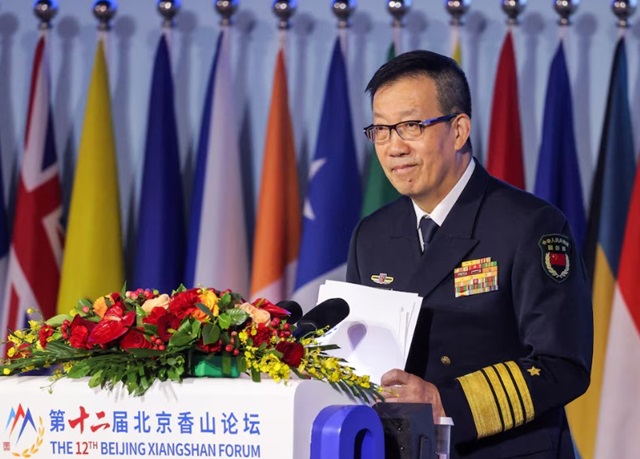
China’s defense minister on Thursday highlighted Beijing’s efforts to reshape global governance, warning against an increasingly divided world “defined by the rule of the jungle,” while asserting that the country’s robust military would act as a stabilizing force.
Speaking at the opening of the Beijing Xiangshan Forum on security, Dong Jun said the world faced a crossroads overshadowed by Cold War thinking, hegemony, and protectionism, urging dialogue over confrontation.
“External military interference, seeking spheres of influence, and coercing others to take sides will bring the international community into chaos,” Dong told the gathering of about 1,800 officials, military personnel, and scholars from 100 countries, in remarks Reuters attended.
Dong’s comments, widely seen as veiled criticism of the United States, were more hawkish than his address at last year’s forum. He stressed that “an obsession with absolute superiority in military strength and a ‘might is right’ approach will lead to a divided world defined by the rule of the jungle and disorder.”
Despite his warnings, Dong positioned China’s military as a force for peace, echoing President Xi Jinping’s recent speeches against “hegemonism and power politics” and following Beijing’s recent large military parade that showcased new weapons.
Addressing Taiwan, Dong said the island’s “return to China is an integral part of the postwar international order” and pledged that the People’s Liberation Army (PLA) would prevent any separatist attempts or external military interference. China claims Taiwan as its territory and has not renounced the use of force, while Taiwan’s government rejects Beijing’s sovereignty claims, insisting that its people will decide their own future.
Singapore’s Defence Minister Chan Chun Sing supported Dong’s warning, noting that an erosion of shared values could trigger “a similar vicious cycle” of economic upheaval and radical politics reminiscent of the period leading up to World War Two.
The forum comes amid heightened tension between China and the United States and its allies over East Asia flashpoints, including Taiwan and the South China Sea, as well as ongoing economic rivalries under President Donald Trump. U.S. and Chinese officials recently reached a deal in Madrid to place TikTok under U.S.-controlled ownership, signaling progress in defusing a long-running trade dispute.
While U.S. Defense Secretary Pete Hegseth held a direct call with Dong last week and a Xi-Trump phone conversation is expected, analysts told Reuters that there is no clear indication yet of deeper military-to-military engagement, with Western nations sending mostly low-level representatives to observe China’s military developments.
“I just don’t think that China understands the United States is no longer going to purchase a defense relationship by being accommodating,” said Chad Sbragia, a former Pentagon official, on the sidelines of the forum.