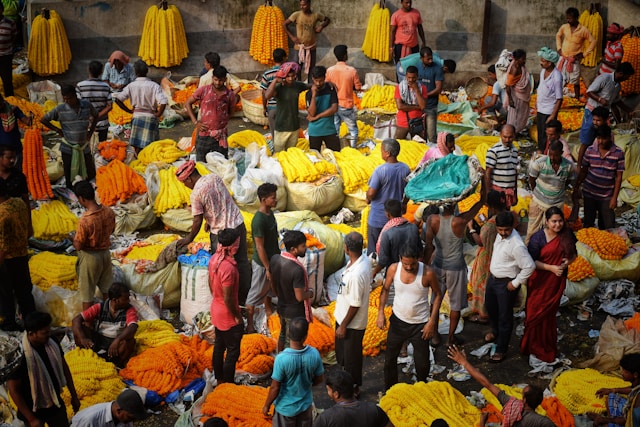
India has now emerged as the most populous country in the world, surpassing China. The present population is estimated to be between 1.45 and 1.5 billion, and it seems to be “progressing” toward 1.8 billion by the year 2050, or perhaps even earlier. Such a level of population can appropriately be described as unacceptable, or even as a population explosion.
It is surprising, however, that no serious alarm has been raised in India about this growth trend. On the contrary, some sections of society claim that such a population level is a strength for the country, often referring to the misleading term “demographic strength.”
To appreciate the seriousness of this issue, India’s population density can be compared with that of large developed countries. The land area of the United States is 9.8 million square kilometers—nearly three times larger than India’s 3.3 million square kilometers—yet its population density is only 38 people per square kilometer, compared to India’s 492. In China, the land area is 9.6 million square kilometers, again nearly three times larger than India, but its population density is just 151 people per square kilometer. China successfully curbed population growth through the one-child policy and has since adopted a more flexible approach to stabilize its population. Russia, with an area of 17.1 million square kilometers, has a population density of only 8.5 people per square kilometer. These comparative figures make it clear that India’s present population density is unparalleled in history. No government anywhere in the world has had to manage such a vast population within such limited land.
According to the Sample Registration Survey (2023), India’s crude birth rate (CBR)—the number of births per thousand people annually—declined by 0.7 points, from 19.1 to 18.4. For the first time, the total fertility rate (TFR) fell to 1.9. However, these declines are not uniform across the country. In Bihar, the CBR stands at 25.8, while in Tamil Nadu it is only 12. Bihar also reports the highest TFR among the larger states at 2.8. Meanwhile, average life expectancy has increased steadily, reaching 73 years in 2023 compared to just 35 years in 1950, largely due to medical advancements. This means that despite falling fertility rates, India’s overall population will continue to rise for decades.
Some advocates of high population argue that efforts to downsize should stop. They claim that declining CBR and TFR, combined with longer life expectancy, will lead to an aging population and a shrinking workforce. They cite examples of Japan and Russia, where low fertility has created concerns about an older population, and of China, which has relaxed its one-child rule and now encourages larger families. On the surface, such arguments may seem reasonable.
However, these views ignore India’s extraordinarily high population density and the country’s limited carrying capacity. They fail to consider factors such as widespread poverty, unequal distribution of income and opportunities, and the already severe unemployment crisis. The reality is that India cannot afford unchecked population growth. A proper cost–benefit analysis shows clearly that curbing population growth will bring far greater benefits than allowing it to rise endlessly.
Joblessness is a particularly serious consequence of overpopulation. Social peace and communal harmony can be sustained only if working-age people have adequate opportunities. It is a well-known fact that “an idle mind is the devil’s workshop.” Yet it is impossible to provide sufficient employment for India’s vast workforce at such high density. The problem is aggravated by technological changes: automation, robotics, and artificial intelligence are already reducing job opportunities in factories, offices, and commercial centers. Agriculture, which still employs a large share of Indians, is also being mechanized, with drones now used to spray fertilizers and pesticides—further reducing the need for human labor.
The Government of India has been struggling with unemployment for decades, and no administration has been able to provide enough jobs for the majority of the working-age population. As a result, many young people remain unemployed or underemployed, leading to growing social tensions. In response, governments often attempt to “buy peace” by providing subsidies and freebies. While politically expedient, this strategy is financially unsustainable and ultimately counterproductive.
In simple terms, India today is “overflowing” with people. This is one reason why so many Indians migrate abroad in search of opportunities, which in turn fuels anti-immigration sentiment in many developed countries. The backlash is visible in protests across the United Kingdom and elsewhere. India’s growing population is increasingly criticized for contributing to global migration pressures. In addition, Indian companies are being accused of “body shopping”—exporting manpower along with goods and services.
When India gained independence in 1947, its population was about 350 million. In just 75 years, it has soared to nearly 1.5 billion. Yet some poorly informed state leaders still encourage families to have three or more children, while certain religious and regional groups promote larger families to expand their influence. Such irresponsible positions only worsen the crisis. At the same time, the central government has done little to actively campaign for population control, offering only token support.
The urgent need is for a clear, pragmatic, and determined population policy. The target should be to reduce the population to about 1 billion and stabilize it at that level. If India achieves this, it could indeed become an economic superpower, thanks to its agricultural potential, mineral wealth, and skilled manpower. But without downsizing its population, these advantages will be negated by the crushing weight of numbers.