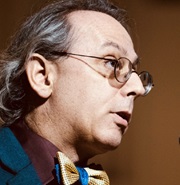

Some teachers retire. Some stay on too long. And then there is Austin Sarat.
This weekend I traveled to Amherst College for a celebration of Austin’s fifty years in the Amherst classroom. Before he even reached the podium, he was already teaching — calling on people across the room, questions flying like sparks: Is the death penalty defensible? What is justice? The room broke into laughter and unease, the old classroom energy alive again.
Watching him, I thought back to my own first encounter with Austin as a nervous sophomore interviewing for his course The Fate of Law. His questions then were the same as now — sharp, relentless, impossible — and they changed the way I think, and perhaps the way I live.
I am not alone. Nearly a hundred of Austin’s students and colleagues traveled from around the world to celebrate his 50th year as a professor at Amherst. Watching him, I was reminded of why. Austin’s method — one former student dubbed it the “Saratocratic method” — terrifies his students, and they adore him for it. Once, walking across campus after class, confused and exhausted from his relentless questions, I finally protested: “Well, you tell me, what do you think?” He smiled: “I get to ask the questions.”
Austin’s dedication was total. Once, during my senior year, he found me shivering outside his office at five in the morning. I was paralyzed trying to begin my thesis. He sat me in front of his computer and told me simply to write, as he pretended to be busy putting books away.
Months later, I received Austin’s comments on the first draft of my thesis. He asked whether I wanted the good news or the bad news first. I chose the bad news. His feedback was merciless and exacting — and somehow the most inspiring words I had ever heard. Thirty minutes later he was done and told me to go out and get to work. I had the temerity to ask: “What about the good news?” He smiled: “The good news is,” he paused in thought, “is that’s all the bad news.”
As I listened to Austin speak and interact with so many former students, one theme emerged. What animates him is love — not the sentimental kind, but the demanding love that believes students can think for themselves. He cares about his students enough to respect them and push them, and also to stay in the struggle with them.
Watching Austin yesterday and thinking back to my time as his student, I realized that what he teaches isn’t law, or even justice. It is a profound love for the world itself. Hannah Arendt called such love amor mundi.
Arendt saw education as born not from love of our students, but from a love of the world. Only those, she wrote, who “love the world enough to assume responsibility for it,” can truly teach. The educator must believe the world is worthy of respect, even with its faults. In this sense, education is conservative: it conserves the world as it has been given. But education is also revolutionary; the teacher must realize that education itself is part of that world — and that it is through the young that the world will change.
To teach the world as it is, one must first love it. A teacher must not despise the world or see it as merely oppressive, evil, or deceitful. Yes, the teacher can recognize the world’s limitations and faults. But he or she must nevertheless love the world with all its imperfections, and thus lead the student into the world as something inspired and beautiful. To teach Plato, you must love Plato. To teach geology, you must love rocks. While critical thinking is an important skill, what teachers teach, rather, is enthusiasm and a love of learning. The great teachers are the lovers of learning. What they teach, above all, is the experience of discovery. And they do so by learning themselves.
Education is to be distinguished from knowledge transmission. It must also be distinguished from credentialing. And finally, education is not the same as indoctrinating students with values or beliefs. Education is about opening students to the fact of what is — to the world as it is. It is then up to the student, the young, to judge whether the world they have inherited is loveable and worthy of retention, or whether it must be changed. The teacher is not responsible for changing the world; rather, the teacher nurtures new citizens capable of judging it on their own.
Arendt thus affirms Ralph Waldo Emerson’s view that “He only who is able to stand alone is qualified for society.” Emerson’s imperative, to take up the divine idea allotted to each one of us, resonates with Arendt’s Socratic one: to be true to oneself. Education, Arendt insists, must risk allowing people their unique and personal viewpoints, eschewing political education and seeking simply to nurture independent minds. It prepares the youth for politics by bringing them into a common world as independent and unique individuals. From this perspective, the progeny of teachers is the educated citizen–someone both self-reliant in the Emersonian sense and part of a common world.
Watching Austin call on his former students, still refusing to give the answers, I thought of Arendt’s claim that teachers prepare the young for a world they will one day transform. Some teachers retire. Some stay on too long. And then there is Austin Sarat — still asking the questions that make us worthy of the world.