
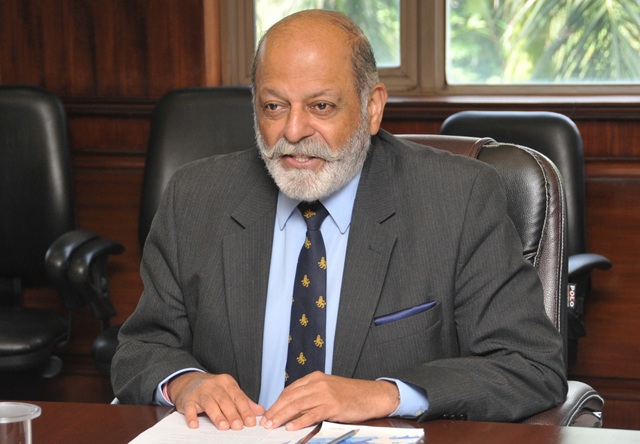
The Manohar Parrikar Institute for Defence Studies and Analyses occupies a discreet position within Delhi’s top security institutions. Winter light lay flat and pale across the office passages, lending the space a deliberate quiet, removed from the urgency that usually defines the capital of the world’s most populous nation. Before the scheduled meeting, I was given a tour, including the library, which houses one of the most fascinating collections of books. Ambassador Sujan R. Chinoy, Director General of this non-partisan and autonomous institution dedicated to policy-relevant research on defence, security and international relations, spoke without haste. The cadence of the exchange appeared governed less by immediacy than by the weight of the questions under examination.
The institute bears the name of Manohar Parrikar, a political leader remembered for administrative exactitude and a stripped-down seriousness about national security and institutional reform. “Honesty without output is of no use. It’s not that if you are honest then you can’t deliver… you have to take a clear, conscious decision in the interest of the nation,” Parrikar once remarked. That ethic of unsentimental responsibility seemed to linger in the room as Chinoy turned to the condition of the contemporary international system, which he characterised not as broken, but as progressively less capable of meeting the demands placed upon it.
Ambassador Sujan R. Chinoy is a career diplomat whose public service from 1981 to 2018 spans over four decades, including senior postings as India’s Ambassador to Japan and Mexico and as Consul General in Shanghai and Sydney. A specialist on China and politico-security affairs, he led negotiations on confidence-building measures on the India–China boundary from 1996 to 2000 and later served at the National Security Council Secretariat handling external and internal security. His career covers political, defence, trade and economic diplomacy, with postings at the United Nations in New York and in Saudi Arabia. Fluent in Mandarin, he is the author of World Upside Down: India Recalibrates Its Geopolitics and Global Tumult: India as a Pole Star.
Global uncertainty: The present moment reflects “a lot of uncertainty and unpredictability” as the global normative order embedded in the UN Charter is “increasingly proving to be… ineffective.”
When asked about the turbulence characterising the international system, Chinoy was careful with terminology. “In my book what I have tried to outline is the global uncertainty,” he said, framing the present moment not as rupture but as flux. For him, flux denotes “a lot of uncertainty and unpredictability because the order, the global order, the normative order as we know it which is embedded in the United Nations and the UN Charter, that order is increasingly proving to be… ineffective in dealing with some of the priorities and challenges before the global community.” His concern was not abstract dissatisfaction with multilateralism, but a specific diagnosis of institutional fatigue. The structures built in the aftermath of the Second World War were designed for a particular distribution of power and responsibility, and over time they have struggled to adapt to a world in which those distributions have shifted profoundly.
The United Nations Security Council occupied a central place in this assessment. Chinoy observed that “major power contestation and contradictions within the United Nations Security Council among the permanent members have also made the UNSC quite ineffective in rising up to the current challenges.” Whether the issue is climate change, economic instability, or questions of war and peace, the council, in his view, increasingly finds itself paralysed. This paralysis has consequences. “The UNSC has found itself being sidelined by unilateralism and action that is taking place outside the normative order,” he noted, pointing to a pattern in which states act first and justify later, or sometimes dispense with justification altogether.
Yet Chinoy resisted the temptation to describe the world as already fragmented. “I would say that the world is not yet fragmented,” he said, emphasising the enduring density of global connections. Even in what he described as “a somewhat de-globalised world,” it remains “very difficult to fragment the world into absolute camps because forty years of globalisation has led to a situation where even adversaries are engaged in economic relations.” Trade, technology, and finance continue to bind states together in ways that blunt the possibility of clean separations. The relationship between the United States and China served as his primary illustration: “They have some adversarial relations and yet they are heavily engaged and continue to be engaged in trade and economic terms.”
UNSC ineffectiveness: “Major power contestation and contradictions” have made the UNSC “quite ineffective,” leaving it “sidelined by unilateralism.”
From this observation flowed a broader description of contemporary international behaviour. “We are today living in a world in which there is multi-alignment, there is hedging, there is issue-based alignment,” he said, adding that “almost all the members of the international community are connected in one way or the other with all the leading economies.” The implication is that alignment has become situational rather than doctrinal. States calibrate relationships issue by issue, balancing economic needs against security concerns, and doing so in ways that would have appeared contradictory in an earlier era.
This reality is particularly evident for smaller and medium-sized economies. “A country like India, a country like Sri Lanka would be economically connected with the United States of America as well as the People’s Republic of China,” Chinoy observed, describing a condition that has become normal rather than exceptional. He contrasted this with the Cold War, when “the two camps were a little more clear-cut and the camps did not trade or engage in technological cooperation with one another.” Today’s environment, by contrast, resists such binary organisation.
For Chinoy, the central question is therefore not fragmentation but endurance and relevance. “The question is one of a prolonged transition,” he said, one in which the normative order “has been around for eighty years” and “has failed to accommodate changes in the balance of power.” That balance, he reminded, “has shifted over the last eighty years; it has not remained constant.” The refusal or inability of institutions to reflect these changes has produced growing dissatisfaction among states that exist outside the core of decision-making authority.
He drew attention to the numerical and qualitative transformation of the international community. “Since the UN was set up in 1945, the membership has expanded from 51 to 193,” he noted, but expansion alone has not translated into influence. Many of the countries outside the so-called normative power centre are “not only growing in numbers… but many of these countries… are also growing in strength and in terms of their influence and agency.” Yet the Security Council, in particular, has “refused to reform itself” and “refused to give up the deeply inegalitarian and unequal privileged powers” vested in its permanent members. What may have been “the best possible deal in 1945” now sits uneasily with contemporary expectations.
This institutional rigidity has, in his account, contributed to a broader erosion of faith in multilateral problem-solving. At the same time, it has encouraged states to seek alternative arrangements. “Countries are seeking solutions in their neighbourhood, in the region,” Chinoy said, “and trying to create some reliable supply chains for themselves.” Strategic autonomy, once associated with a small group of post-colonial states, has become a widely shared objective. Countries pursue it “in order to protect their sovereignty and territorial integrity” and, crucially, “in order not to be forced into binary choices.”
Such dynamics point towards multipolarity, but Chinoy was careful to qualify the term. “In a multipolar world also, it is not to say that all poles are equal,” he said. Power exists along a spectrum, ranging “from the very powerful poles, to somewhat medium poles, to lesser poles.” The same logic applies to categories such as middle powers. There is “no benchmark for classification,” only broad indicators such as GDP, military capability, population, and technological capacity. Even then, differences are stark. Countries commonly grouped together under this label occupy very different positions, and India, he suggested, is markedly different from the somewhat smaller or less diversified economies that are classified as Middle Powers. “I would say India is a middle power plus,” he remarked, arguing that comparisons with countries such as Australia or Indonesia may be overlooking scale, aspirations of the world’s largest population as well as delivery on global issues ranging from international peace-keeping to climate change.
These ambiguities become even more pronounced when applied to the Global South. Chinoy acknowledged the term’s usefulness as a departure from Cold War-era language, but he stressed its conceptual looseness. The Global South, he explained, “does not have a membership criterion or a secretariat. It does not have regular funding. It does not have a set presidency or even a rotating presidency.” In this respect, it differs fundamentally from the Non-Aligned Movement or the G77 plus China, both of which possess defined structures. Instead, the Global South functions as “a loosely knit conglomeration of developing countries of Africa, Latin America and Asia.”
He also drew attention to the changing nature of agency in international affairs. Today, “NGOs, individuals, the private player, big tech, all of them are exercising agency way beyond what they did in the past, even internationally.” As a result, economic stress and underdevelopment cannot be neatly mapped onto geography alone. Underprivileged populations exist in every part of the world, including within countries traditionally categorised as part of the Global North. This further complicates the idea of a singular Global South constituency.
World not fragmented: “The world is not yet fragmented,” as even adversaries remain “engaged in economic relations” after forty years of globalisation.
China’s position within this discourse appears unique and worthy of further analysis. “The question is whether an economy with a per capita GDP of $13,000 can logically be a member of the Global South,” he said, while acknowledging Beijing’s desire to be recognised as a leader of that grouping. The risk, in his view, is that the Global South could replicate the hierarchies it ostensibly seeks to challenge. “What the Global South doesn’t need is hierarchy,” he stated. “What it does need is initiative.” The distinction between the two, for Chinoy, is critical. Hierarchy implies domination; initiative implies responsibility without vested interests or the desire to control.
It was in this context that he described India’s approach, “While some may regard India as a natural leader of the Global South given its size and capacities, we ourselves don’t want to insist on a leadership perch in the Global South,” he said. Leadership, as he defined it, carries connotations of hierarchy and exploitation. Instead, India seeks to act as “a very sincere voice of the Global South,” attentive to its needs and willing to act “pro bono” where possible. Concepts such as Vishwa Bandhu and Vishwa Mitra, rooted in civilisational philosophy, informed this posture. India does not seek an overbearing role, but wishes to support others through genuine partnerships.
This framing extended naturally to his description of India as a stabilising pole star. “Yes, this is what I mean by India as a stabilising pole star,” he said, “as a guiding pole star.” It is a country “that people can turn to in times of need.” His reference to Sri Lanka was illustrative rather than exceptional. Assistance, in this telling, is offered without hesitation and without leading to feelings of unease. At the same time, Chinoy rejected narratives that externalise responsibility. “India does not seek to control its neighbourhood, nor would that approach sit well with smaller neighbours” he said. Neighbouring countries choose their own leaders and bear responsibility for their political trajectories. India’s role is to help address problems, not to create them.
This emphasis on agency and accountability carried over into his discussion of China. Chinoy resisted reductive labels, arguing that excessive focus on terminology risks obscuring lived realities. “India and China are large populous countries and neighbours, existing cheek by jowl across the Himalayas,” he said. Stability is therefore essential, but so is equality. An equal relationship, in his words, is one “in which there is no endeavour on the part of one to dominate or to coerce or to interfere in internal affairs.”
For the first time in history, he observed, two countries of this scale are growing simultaneously. Their development models differ, their political systems diverge, and their reform timelines are sui generis, yet both have transformed their economic standing. As neighbourhoods expand through trade, connectivity, and infrastructure, overlap becomes unavoidable. This overlap can be managed constructively, he suggested, through transparency and dialogue. Without these, it becomes contested, breeding suspicion and mistrust.
The distinction between a shared and a contested neighbourhood became sharper as Chinoy elaborated on India–China dynamics beyond the border question. Expanding neighbourhoods, he argued, are not destabilising in themselves. “We are in an era in which everybody’s neighbourhoods are expanding due to trade and economic ties, due to regional partnerships, due to globalisation, due to technology, due to infrastructure and hyper connectivity,” he said. Such expansion in engagement becomes problematic only when it proceeds without interlocution with others or reassurance. “When that process is opaque,” he observed, “instead of being a shared neighbourhood, it becomes a contested neighbourhood because there is lack of transparency. There is lack of any clarity with regard to purpose, intention, motivations.” In such circumstances, initiatives taken unilaterally, without consultation, generate suspicion and erode trust.
Against this backdrop, Chinoy spoke at length about efforts to stabilise India–China relations after the rupture of 2020. He was careful not to overstate progress, yet he emphasised that the relationship is no longer frozen. “Currently, there is peace and tranquillity along the Line of Actual Control,” he said, noting that disengagement has taken place at friction points. High-level political contact has resumed, with meetings between Prime Minister Narendra Modi and President Xi Jinping at multilateral forums. “The thaw in our relations has progressed,” he remarked, situating recent developments within a longer arc of cautious normalisation.
Multi-alignment: Today’s system is marked by “multi-alignment, hedging, and issue-based alignment” rather than fixed camps.
He also described practical steps taken to restore people-to-people and economic linkages. “We have resumed direct flights. The pilgrimage, the Kailash Mansarovar Yatra, has been resumed. Visa issuance has been resumed,” he said, listing measures that signal intent even while substantive disagreements remain unresolved. His own involvement in dialogue efforts highlighted the significance he attached to sustained engagement. Leading a high-level track-two dialogue in Chengdu to mark the seventy-fifth anniversary of diplomatic relations, he described the gathering as a rare jointly commemorated event, bringing together senior strategic thinkers from both sides. The symbolism mattered, not as closure, but as continuity.
Economic relations, however, remained a point of concern and opportunity. Chinoy was explicit about the need to recalibrate the terms of engagement. “We want to redefine economic engagement with China,” he said, arguing that the relationship should move beyond platform-based investments and large infrastructure bids reliant on imported labour. Nor, he added, is it desirable for India “simply to be seen as an export market.” What India seeks instead is participation aligned with domestic priorities. “What we want China to do is to genuinely participate in the Atmanirbhar Bharat and Make in India programmes,” he said, particularly in sectors relevant to small and medium enterprises.
India and the Global South: India does not seek “a leadership perch in the Global South,” but aims to be “a very sincere voice.”
His reasoning was pragmatic rather than ideological. Manufacturing partnerships, he suggested, could benefit both sides. “If Japan can manufacture the Baleno car in India and re-export it back to Japan,” he asked, “why cannot China think of doing that?” Such arrangements would allow China to leverage India’s labour cost advantages while embedding itself more constructively in the Indian economy. He acknowledged that some Chinese companies have entered production-linked incentive schemes, but he also pointed to structural constraints within China’s own economy. Excess capacity, intense competition among provinces, and a longstanding export orientation have encouraged practices that are difficult to reconcile with India’s objectives. “That’s not how we think the relationship should go forward,” he said.
The China–Pakistan relationship inevitably surfaced as a complicating factor. Chinoy described it as “very deep-rooted,” extending across military manufacturing, nuclear capabilities, and intelligence systems. He noted that China does not appear inclined to reassess this relationship, even though it is clear that improved ties with India are in its national interest. “Pakistan is a factor in our bilateral ties, and has been one for long,” he said, adding that India has repeatedly sensitised China to the implications of this alignment. The shadow it casts, he suggested, is persistent and unsettling, particularly given Pakistan’s posture towards India. It harbours the potential, according to Chinoy, to erode China’s credibility on tackling the menace of international cross-border terrorism.
Infrastructure projects undertaken through contested territory were cited as a specific grievance. “China should have known better than to conduct infrastructure projects… through contested territory,” Chinoy said, framing such actions as violations of basic principles of international cooperation. The China–Pakistan Economic Corridor, in this respect, is clearly a bug-bear for India. These issues, he implied, cannot be wished away through rhetoric about partnership; the implications of such actions require acknowledgement and adjustment if trust is to deepen.
From geopolitics, the conversation shifted towards deterrence and security in South Asia. Chinoy approached the subject with characteristic restraint, situating recent events within a broader strategic logic. “Operation Sindoor sets a new benchmark for deterrence,” he said, describing it as a demonstration of resolve rather than escalation. India’s message, in his view, was unambiguous: “India will do what it takes to give a robust retaliatory response to Pak-based terrorism.” In doing so, India made clear that “it will not make any distinction between terrorists based in Pakistan and their networks and supporters.”
This articulation of deterrence, he argued, should prompt reflection in Islamabad. At the same time, he rejected alarmist characterisations of South Asia as uniquely unstable. “I do not give so much credence to this interpretation of South Asia as being a nuclear hotspot,” he said, pointing instead to the “lot of space under the so-called nuclear overhang for conventional action.” Operation Sindoor, in this sense, demonstrated how military pressure could be applied without crossing thresholds that invite unbridled escalation.
Questions about narrative management and international perception elicited a firm response. “Not at all,” Chinoy said when asked whether India needed a communication campaign to explain its actions. “The facts were very plain.” Terrorist attacks were traced to Pakistan-based networks, and India’s response was measured. “The military took action in a very responsible, non-escalatory manner,” he said, emphasising initial targeting limited to terrorist bases and efforts to avoid civilian casualties. As circumstances evolved, India “took appropriate steps to put the necessary military pressure on Pakistan,” but always within a framework of restraint.
His confidence in India’s position was reinforced by diplomatic experience. As part of an all-party delegation, he along with members of parliament engaged leaders across regions, from the Gulf to West Africa. “We were very successful in communicating our viewpoint to the senior-most people at the highest level,” he said, listing meetings with presidents, vice-presidents, foreign ministers, parliamentarians, and civil society actors. The messaging, he noted, was “very effective and timely and appreciated.” Claims that India’s actions damaged relations with the United States or empowered Pakistan diplomatically did not, in his account, align with reality. India’s decisions, he reiterated, are grounded in strategic autonomy. “Whatever decisions we have taken were based on our strategic autonomy. Absolutely.”
The discussion of autonomy flowed naturally into reflections on the Indo-Pacific, a region Chinoy knows intimately from his time as ambassador to Japan. He described the Indo-Pacific not as an imposed construct but as an evolution reflecting economic, strategic and demographic realities. The older Asia-Pacific framework, he argued, had a defined historical role, corresponding to patterns of growth concentrated in East Asia during the second half of the twentieth century. “Beginning this century,” he said, “you find that growth and prosperity has spread beyond East Asia to Southeast Asia to South Asia, even to the east coast of Africa.” The Indo-Pacific, by contrast, “represents a space which is far more inclusive, far more accommodating of the aspirations of many more countries and many more people across a wider geography.”
Resistance to the concept puzzled him. “To oppose the Indo-Pacific is to claim a privileged status for oneself to the exclusion of all others,” he said. The region’s interconnectedness, across trade, energy, security, and ideology, makes it analytically indispensable. “What happens in the areas to the west of India has an impact in southern Thailand, in Indonesia, even in the Philippines,” he observed, illustrating how challenges such as radicalism, terrorism, piracy and maritime security traverse artificial boundaries. Sea lines of communication bind the region together, as does the presence of major naval powers. In this context, the Indo-Pacific is not a transient slogan but “here to stay.”
India’s role within this space, Chinoy suggested, does not require formal alliances. Balance can be shaped through presence, partnership, and principle. The emphasis, once again, is on inclusion rather than exclusion, on shared security rather than zero-sum competition. This logic extends to India’s immediate neighbourhood. Asked about external actors deepening their presence in South Asia, Chinoy framed the issue in terms of transparency. India, he said, has never claimed that others cannot have relations with its neighbours. The concern arises only when engagement is opaque or destabilising.
Stabilising role: India is presented as “a stabilising pole star,” guided by Vasudhaiva Kutumbakam, “of regarding the world as one family.”
“Our neighbourhood should remain a shared neighbourhood,” he said, reiterating a theme that had recurred throughout the conversation. India’s Neighbourhood First policy, in his telling, seeks to deliver public goods, without creating discomfort. Other actors can also contribute, provided their motives are transparent and their actions respectful. Problems arise when military footprints expand quietly or when economic initiatives obscure strategic intent. India’s own approach, he emphasised, is guided by the priorities and comfort level of the receiving country.
When the conversation touched briefly on political developments in neighbouring states, Chinoy exercised caution. He declined to comment on specific legal or political questions, but he expressed hope that participatory processes would restore stability where it has been disrupted. “We have nothing against any country,” he said, reaffirming a commitment to constructive relations across South Asia.
The final segment of the interview turned to generational change, protest movements, and the diffuse nature of power in a digitally connected world. Chinoy framed these phenomena not as regional anomalies but as global conditions. “In this world today, it is not just governments that have agency,” he said. Individuals, technology companies, NGOs, and private entities now operate across borders with unprecedented reach. Social media, in particular, has created transnational communities of sentiment, mobilisation and transnational allegiances. “You can see how wokeism united many, many young people,” he observed, often without deep engagement with underlying issues.
This expansion of agency carries risks as well as possibilities. Information flows are no longer filtered primarily through national institutions. “The information that he or she at any age is fed… is coming not only from national sources, government sources, but also from private sources, from international players, many with vested interests,” Chinoy said. Misinformation and disinformation circulate easily, and young people can be “misled” or instrumentalised by actors beyond their own borders. The question of sovereignty becomes increasingly complex when platforms are global and servers located elsewhere. “What kind of sovereignty do you exercise over what you are reading in your phone?” he asked, posing the dilemma without presuming easy answers.
He was careful to avoid sweeping conclusions about a generation or a movement. Instead, he emphasised vigilance and awareness. Connectivity, he suggested, has altered the terrain of politics and protest in ways that defy traditional regulation. “You can’t even regulate that,” he said, acknowledging the limits of state control in a digital age.
Ambassador Chinoy’s insights did not resolve into a manifesto or a set of prescriptions. Instead, they formed a layered account of a world caught between institutions that endure and realities that have outpaced them. In his telling, flux is neither terminal nor trivial; it is a condition shaped by uncertainty, to be met with autonomy, transparency and restraint, alongside an acceptance that absolute certainty is a chimera. Chinoy felt that “in this era of transition, India is guiding the global community in the direction of a values-based future for humanity” drawing on its civilisational ethos of Vasudhaiva Kutumbakam– of regarding the world as one family”.