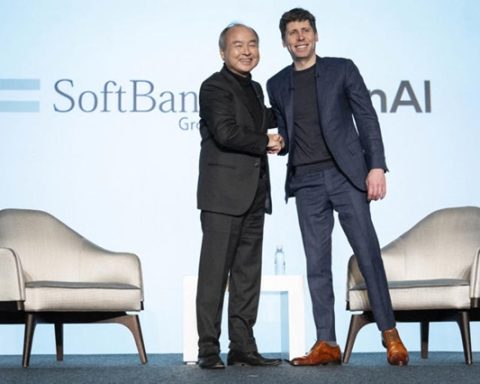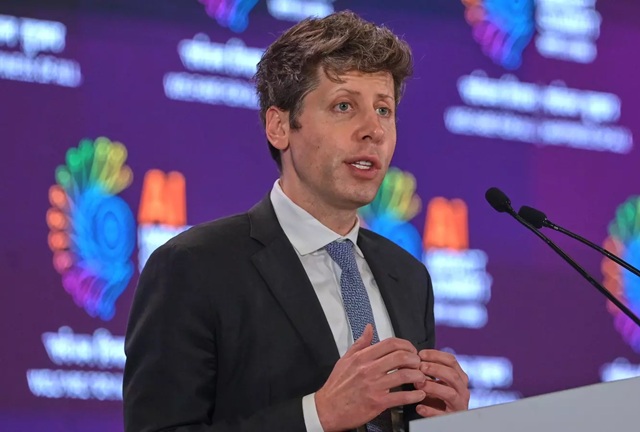
“It is time to democratize AI,” Sam Altman, CEO of OpenAI, said while addressing the AI Impact Summit in India. He began his remarks by expressing his enthusiasm for being in the country, stating, “It’s really a treat to be here in India and it’s incredible to see the country’s leadership in advanced AI.” His words immediately underscored the importance of India not just as a consumer of artificial intelligence, but as a pivotal player in shaping the technology’s future. Altman reflected on his prior visit, noting, “I was last here a little over a year ago and it’s striking how much progress has happened since then.” The speed of AI advancement, he emphasized, had been astonishing. “We’ve gone from AI systems that struggled with high school level math to systems that can do research level mathematics now and derive novel results in theoretical physics,” he said, illustrating the immense leap in capability that AI systems had achieved in a remarkably short period of time.
Altman’s appreciation for India’s own progress in AI was evident. He remarked, “It’s also striking how much progress India has made in its mission to put AI to work for more people in more parts of the country.” Highlighting India’s leadership in building sovereign AI infrastructure and large language models, he noted, “India’s leadership in sovereign AI building on infrastructure, SLMs, and much more has been great to watch.” He pointed out that India had already integrated AI into the daily lives of millions, stating, “More than 100 million people use ChatGPT every week. More than a third of them are students. India is also the fastest growing market now for Codex, our coding agent that works to help people develop software faster and better.” Altman’s remarks positioned India not just as a market, but as a leader in shaping the ethical and practical deployment of AI in society.
As he turned to the broader implications of AI, Altman did not shy away from bold predictions. “India, the world’s largest democracy, is well positioned to lead in AI, not just to build it, but to shape it and decide what our future’s going to look like. And it’s important to move quickly. On our current trajectory, we believe we may be only a couple of years away from early versions of true super intelligence.” The magnitude of this statement was evident, and Altman himself acknowledged the uncertainty: “If we are right, by the end of 2028, more of the world’s intellectual capacity could reside inside of data centers than outside of them. This is an extraordinary statement to make, and of course, we could be wrong, but I think it really bears serious consideration.” He painted a vision where AI systems could surpass human capabilities in ways that were previously unimaginable, suggesting, “A super intelligence at some point on its development curve would be capable of doing a better job being the CEO of a major company than any executive, certainly me, or doing better research than our best scientists.”
In addressing the immense power of AI, Altman outlined three core beliefs guiding OpenAI’s approach. The first was the principle of democratization: “We believe that democratization of AI is the only fair and safe path forward. Democratization of AI is the best way to ensure that humanity flourishes. On the other hand, centralization of this technology in one company or country could lead to ruin.” He framed this as a moral imperative: the desirable future must be one of “liberty, democracy, widespread flourishing, and an increase in human agency.” Altman cautioned against trading freedom for expediency, stating, “Some people want effective totalitarianism in exchange for a cure for cancer. I don’t think we should accept that trade-off, nor do I think we need to. AI should extend individual human will.”
The second principle focused on resilience. Altman explained, “AI resilience is a core safety strategy. We don’t mean that this is the only safety strategy. We will continue to need to build safe systems and solve difficult technical alignment challenges. But increasingly, we need to start broadening how we think about safety to include societal resilience.” He illustrated the stakes with real-world examples: “No AI lab, no AI system can deliver a good future on their own. For an obvious example, there’ll be extremely capable biomodels available open source that could help people create new pathogens. We need a societywide approach about how we’re going to defend against this.” Altman’s insistence on systemic preparedness highlighted that safety in AI extends beyond technical measures—it is fundamentally a societal challenge.
The third principle reflected humility and inclusion: “This future of AI is not going to unfold exactly like anyone predicts. And we believe that many people need to have a stake in shaping the outcome.” Altman acknowledged the unpredictability of technological development: “The development of AI has already held many surprises, and I assume there are bigger ones to come. We understand that with technology this powerful, people want answers. But it’s important to be humble about what we don’t know, and always remember that sometimes our best guesses are wrong.” He emphasized the intersection of society and technology as the locus of discovery: “Most of the important discoveries happen when technology and society meet, sometimes have some friction, and co-evolve.” He posed difficult questions that remain unresolved: “We don’t yet know how to think about some super intelligence being aligned with dictators and totalitarian countries. We don’t know how to think about countries using AI to fight new kinds of war with each other. We don’t know how to think about when and whether countries are going to have to think about new forms of social contracts.”
Altman’s approach to AI deployment was iterative and reflective: “We continue to believe that iterative deployment is a key strategic insight and that society needs to contend with and use each successive new level of AI capability, have time to integrate it, understand it, and decide how to move forward. This has been working surprisingly well so far.” He also touched on the economic consequences of AI: “If systems continue to improve at this pace, it’s going to change the economics of a lot of things. A really great thing about AI progress is that it looks like many things are going to get much cheaper and have much faster economic growth.” Altman cited practical benefits already visible: “We’re already seeing what AI is doing for access to high-quality healthcare, education, and more. In the coming years, we expect to see robots make many products and physical goods cheaper as supply chains get automated. The limit to how far this cost reduction can go may only be government policy.”
Yet, he did not ignore the disruptive impact on labor: “The other side of this coin is that current jobs are going to get disrupted. AI can do more and more of the things that drive our economy today. It’ll be very hard to outwork a GPU in many ways.” However, Altman reassured audiences that uniquely human qualities—empathy, creativity, and curiosity—remain central: “For example, we really seem hardwired to care about other people much more than we care about machines. We’re somewhat less concerned about the long-term future. Technology always disrupts jobs. We always find new and better things to do.”
He reflected on the long arc of human progress: “The people of 500 years ago would have thought that our current jobs often look silly, like ways to entertain ourselves, create stress. And the people 500 years from now hopefully will look at us like impossibly rich people playing games, trying to find ways to pass their times. But we should all hope that they feel much more fulfilled than we do today. I’m confident we will keep being driven to be useful to each other, to express our creativity, to gain status, to compete, and much more. But the specifics of what we do day-to-day will probably look very different.”
Altman underscored that AI amplifies humanity’s collective potential: “Each generation has built on the work of the generations before. And with new tools, the scaffolding gets a little taller. This collective external lattice, the set of tools that we have built up around ourselves, is remarkable. And we are capable of doing things that our great-great-grandparents couldn’t have dreamed possible. It is a moral imperative to make sure that our great-great-grandchildren can stay the same. And technology, and especially AI, is how we’re going to get there.” For a truly democratic AI future, he explained, agency and power must be widely shared: “It is not enough to just give people tools and wealth. We also need to give them agency and power. The vision that AI companies lay out fundamentally reduces to either unilateral control or decentralized power. Sharing control means accepting that some things are going to go wrong in exchange for not having one thing go mega wrong. Cemented totalitarian control. This is a fundamental trade-off of democracy, and it is one that we believe in very strongly as the way to give everyone collective agency over the future.”
Acknowledging the need for regulation, Altman said, “Of course, this is not to suggest that we won’t need any regulation or safeguards. We obviously do urgently, like we have for other powerful technologies. In particular, we expect the world may need something like the IAEA for international coordination of AI and especially for it to have the ability to rapidly respond to changing circumstances. The next few years will test global society as this technology continues to improve at a rapid pace. We can choose to either empower people or concentrate power.”
Throughout his speech, Altman maintained a sense of optimism grounded in responsibility. He highlighted how AI can expand human curiosity and enable people to pursue meaningful goals: “The fundamental fuel of human capability has always been the same: curiosity. We need to look at AI as the next great generator for human curiosity and we need to take some inspiration because we all know the world could use a little more inspiration.” He illustrated this through historical analogies, noting, “Before the invention of the washing machine, it took someone almost always a woman between six and eight hours to wash a load of laundry. But as the washing machine improved, that was compressed to 30 minutes. Do you know what happened? Everyone wanted to wear cleaner clothes. Everyone expected to wear cleaner clothes. People did their laundry a lot more often. They had better clothes and had more time, and they put that time to work to do more with their lives.”
Altman concluded with a call to collective responsibility: “Ultimately, that is the question for us, and this too is not just a question for companies. This is what tech will do to people: people will use technology to do for, and it’s not people who create products. It’s every government, it’s every company, it’s every nonprofit, it’s every employer, because we all have the opportunity to work with our people to manage through the change that is coming, to show people how with the right AI skills, they can create jobs and careers that will be brighter for their future.” He emphasized the need for a global vision of progress: “Each of these AI summits is a proud moment for a great nation. But we have an opportunity rather than have summits that are islands that are disconnected from the summits before or that follow. We need to build bridges. We need to define clear goals. We need to have common measurement systems. And every year we need to ask the same question: Did we make 12 months of progress in the year that just preceded our meeting? How can we build on that progress to do more and move faster in the year ahead? Let’s aim higher, not just for technology, but for what technology can do for people.”