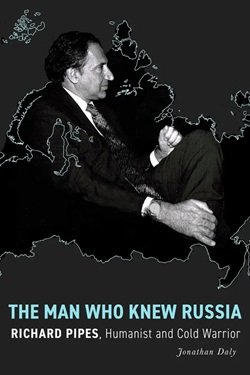
Jonathan Daly’s The Man Who Knew Russia, through its sustained intellectual portrait of Richard Pipes, is best read not as a neutral scholarly biography but as a forceful argument about Russia’s historical nature and its supposed resistance to liberal political development. The book does not merely describe Pipes’s ideas; it stages them as a comprehensive interpretive system that seeks to explain Russian history from the tsarist period through the Soviet collapse and into the Putin era. At the centre of this system lies a provocative and controversial claim: Russia is not simply a country that failed to become liberal in a Western sense, but one whose political culture has repeatedly reproduced authoritarian outcomes across radically different historical periods.
The opening provocation is framed as a question that already contains its own interpretive direction: “Why is Russia, which otherwise has much in common with Europe, so very ‘other’?” This formulation is deceptively simple, but it establishes the entire analytical structure that follows. Russia is treated as an anomaly within a presumed European norm, and difference itself becomes the object of explanation. Yet this framing raises an immediate methodological problem: if similarity is acknowledged but difference is privileged, then Russia is positioned as both part of and apart from Europe, making it perpetually legible only through comparison rather than on its own terms.
From this starting point, the argument develops into a broader civilisational thesis. Liberal values, we are told, “did not easily take root in Russia. Authoritarian values and practices did.” This botanical metaphor of political development is revealing. Liberalism must be cultivated, while authoritarianism appears as the default condition, suggesting an almost natural affinity between Russian society and autocratic rule. The effect is to shift explanation away from institutions, historical contingencies, or policy decisions, and toward something closer to cultural destiny.
This idea is further reinforced in the claim that Russia possesses a “persistent authoritarian political culture.” Once this premise is accepted, the diversity of Russian historical experience risks being flattened into repetition. Tsarist autocracy, Bolshevik rule, and post-Soviet authoritarianism are interpreted not as distinct political formations with different ideological foundations, but as expressions of a continuous underlying pattern. Even the Soviet system is described as emerging when “Soviet totalitarianism thus grew out of Marxist seeds planted on the soil of tsarist patrimonialism,” a formulation that fuses ideology and environment into a single explanatory model. Marxism becomes a catalyst, but the determining force remains the pre-existing Russian political soil.
The consequence of this interpretive framework is a strong tendency toward continuity over rupture. The Bolshevik seizure of power is characterised as a coup rather than a mass revolution, reinforcing the claim that “rebellions happen; revolutions are made.” In this view, historical transformation is not primarily driven by popular movements but by organised minorities capable of capturing the state. The emphasis on elite agency over mass participation leads to a narrowing of historical causality, where society is often reduced to a passive backdrop for political action.
This interpretive direction culminates in one of the most controversial claims associated with Pipes: that without the Russian Revolution there would have been no Nazi Germany and no Holocaust. The implication is not merely that Bolshevism influenced later authoritarian regimes, but that it occupies a foundational position in the genealogy of twentieth-century totalitarianism. Such a claim deliberately collapses distinctions between ideologically distinct regimes, placing communism and fascism within a single explanatory continuum. While intellectually bold, it risks flattening important differences in ideology, historical context, and institutional development in favour of a unifying narrative of modern political catastrophe.
At the heart of Pipes’s thinking, as presented in Daly’s account, is a strong belief in enduring features of human nature. Humans, it is argued, “tend toward ownership, speaking their minds, and believing in a higher power,” and systems that deny these tendencies are ultimately unsustainable. Private property is described as a “fundamental bulwark of political freedom,” elevating economic arrangements into the foundation of political order. This anthropological assumption provides the philosophical grounding for Pipes’s rejection of Marxism, but it also introduces a form of determinism that sits uneasily with the complexity of historical change.
If human nature is relatively fixed, and if political systems succeed or fail according to their alignment with it, then history becomes less a field of contingency and more a demonstration of structural inevitability. This logic supports Pipes’s claim that ideologies such as Marxism are inherently flawed because they conflict with immutable human tendencies. Yet such reasoning struggles to account for the endurance of systems that appear, at least for significant periods, to contradict those supposed tendencies.
The Cold War dimension of Pipes’s thought extends this structural pessimism into strategic analysis. The Soviet Union is described as simultaneously “menacing but vulnerable because of its political illegitimacy,” a formulation that combines ideological critique with geopolitical forecasting. Soviet leaders are said to compensate for this illegitimacy through expansionism, suggesting that external behaviour is a direct expression of internal weakness. This reading of international relations prioritises systemic interpretation over situational complexity, treating foreign policy as an almost mechanical extension of regime character.
Equally significant is Pipes’s portrayal of intellectual life, particularly his relationship with revisionist historians and academic critics. He is depicted as deeply sceptical of scholarly trends that emphasise social history or reinterpret Soviet power in less absolutist terms. His dismissal of younger historians as contributing little of value reflects a broader intellectual posture marked by certainty and resistance to methodological pluralism. Critics, in turn, characterise his work as overly generalising and insufficiently attentive to nuance, particularly in its treatment of Russian society as a homogeneous political culture.
This tension between interpretive confidence and scholarly contestation is central to understanding Pipes’s intellectual legacy. On one hand, his work offers a clear, coherent narrative of Russian political development that connects centuries of history into a single explanatory arc. On the other hand, that very coherence can appear to come at the cost of analytical flexibility, reducing historical complexity to a set of recurring patterns.
Pipes’s personal worldview further complicates this picture. He is portrayed as a figure marked by intellectual independence, personal discipline, and a strong sense of moral seriousness about historical interpretation. Yet this self-assurance also translates into what critics perceive as rigidity. His belief that he was consistently right in his judgments reinforces an intellectual style that privileges conviction over ambiguity, clarity over interpretive openness.
In Daly’s account, Pipes’s understanding of Russia is ultimately inseparable from his understanding of modernity itself. Russia becomes a case study in the dangers of ideological abstraction, the persistence of authoritarian political forms, and the limits of revolutionary transformation. Whether one accepts this interpretation or not, its significance lies in its ambition: it seeks not merely to explain Russian history, but to use Russia as a lens through which to interpret the moral and political failures of the twentieth century.
Yet this ambition is also its central vulnerability. By organising vast historical complexity around a small number of enduring explanatory principles—authoritarian culture, weak liberal traditions, and ideological continuity—it risks transforming analysis into affirmation. Russia becomes less a changing historical entity than a recurring illustration of a predetermined thesis. The result is a powerful, controversial, and intellectually provocative framework, but one that continually invites the question of whether the search for deep historical continuity ultimately obscures as much as it reveals.