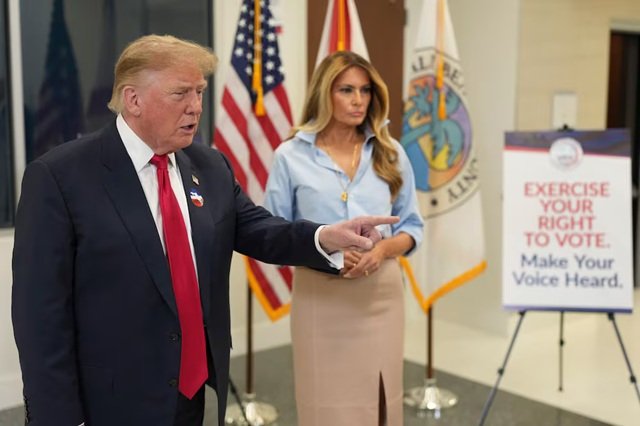
With 10 days remaining before the United States midterm elections, election officials, voting rights advocates and legal experts are warning that President Donald Trump’s efforts to undermine confidence in the electoral system could intensify if the results favour the Democrats. Although courts have repeatedly blocked attempts to change election rules, concerns persist that the administration could use federal agencies, legal challenges and public allegations of fraud to obstruct the outcome or discourage people from voting.
An investigation by Spanish newspaper EL PAÍS, drawing on interviews with about a dozen election specialists, identifies eight potential scenarios that could threaten the process before polling day, during voting and in the weeks between the election and the certification of results. The experts broadly agree that the American electoral system has safeguards capable of resisting political interference, but describe the current campaign as unprecedented in the country’s history. Their central concern is that the administration could exploit a close result to challenge legitimate outcomes, prolong uncertainty or undermine public confidence in democratic institutions.
The risks are particularly sensitive because Trump has repeatedly refused to accept electoral defeat. After losing the 2020 presidential election to Joe Biden, he promoted false claims of widespread fraud, culminating in the 6 January 2021 attack on the Capitol by his supporters seeking to prevent the peaceful transfer of power. Election specialists now face a difficult balance between warning the public about possible interference and avoiding alarm that could discourage participation. The White House maintains that its actions are intended to “safeguard electoral integrity and promote security in the democratic process”.
One of the most immediate dangers, according to the experts, is voter intimidation. Since entering national politics a decade ago, Trump has repeatedly promoted unsubstantiated allegations of mass electoral fraud, questioned voting machines and cast doubt on postal and early voting. He has also pressed for changes to electoral district boundaries that would benefit Republicans and supported legislation that would make voting more difficult for millions of Americans. His administration has sought access to voter registration records and sent the FBI to seize ballots cast in 2020. Yet investigations have repeatedly failed to substantiate claims of widespread fraud or systematic failures in vote-counting machines.
Jasleen Singh, an expert at the non-partisan Brennan Center for Justice, argues that discouraging participation may be the most consequential outcome of these efforts. “It will have been a success [for Trump] if people stay home and do not go out to vote on 3 November,” she said. The administration’s highly publicised operations against alleged illegal voting, including arrests in California, could reinforce the impression that the electoral process is unreliable, even though voting by non-citizens has repeatedly been shown to be marginal.
Pressure on election officials presents another risk. Following the 2020 election, Trump attempted to persuade Georgia Secretary of State Brad Raffensperger to find enough votes to reverse his defeat in the state. Election workers subsequently faced death threats and intimidating telephone calls. This year, the administration has suggested that officials who refuse to follow federal directives could face fines or imprisonment. Experts argue that such threats would exceed the federal government’s authority, as elections are administered through a system involving state and county authorities.
Local officials have been preparing for possible interference, alongside more conventional emergencies such as natural disasters and cyberattacks. Colorado Secretary of State Jena Griswold said her state had updated contingency plans, hired additional staff and involved the governor’s office and attorney general in crisis exercises. “In these elections, the greatest threat does not come from foreign enemies, but from the White House,” she warned. Colorado has also enacted legislation preventing a presidential candidate from appearing on the ballot if they seek a third term in 2028, a possibility Trump has previously entertained.
A declaration of emergency to suspend elections or overturn their results is considered unlikely by the experts consulted, despite speculation among more radical Trump supporters. Asked by Time whether he might exploit an emergency to interfere with elections, Trump replied: “I neither rule anything out nor take anything for granted.” Benjamin Hovland, a former member of the Election Assistance Commission who was dismissed by the administration in July, said such statements could serve to generate uncertainty and make election day appear chaotic. Trump has also dismantled the commission’s previous cybersecurity programme, which monitored potential foreign interference.
The possible deployment of federal agents at polling stations is another concern. Trump, Homeland Security Secretary Markwayne Mullin and FBI Director Kash Patel have repeatedly declined to rule out sending Immigration and Customs Enforcement or FBI personnel to voting locations on 3 November. Although the administration presents such a deployment as a means of preventing illegal voting, experts warn that the presence of immigration officers could deter eligible voters, particularly Hispanic Americans. Singh said such an operation would be illegal and could be halted immediately by a judge.
The Justice Department has also recruited approximately 1,000 election monitors for deployment nationwide, compared with 594 sent by the Biden administration in 2024. Jonathan Diaz of the Campaign Legal Center said their role was to observe voting and refer potential problems to local authorities, but expressed concern about how they would operate under an administration he accused of showing a willingness to violate constitutional and legal limits. The plan has faced resistance from Republicans as well as Democrats. Wyoming Governor Mark Gordon objected in August after monitors sought to interview voters during the state’s primary elections, forcing the federal representatives to leave.
Further risks concern the seizure of voting equipment or ballots and legal challenges to results. More than 98% of Americans vote using paper ballots or systems with physical verification, Hovland said, while pre-election testing, post-election audits and sample hand counts provide additional safeguards against machine errors. Nevertheless, reports of voting machines recording selections differently from those made by voters have circulated on social media. Experts say such incidents do not necessarily indicate widespread fraud, but fear that allegations could be used to justify seizures similar to the FBI’s January operation in Fulton County, Georgia, where agents took possession of 2020 ballots. Ten months later, it remains unclear what investigators were seeking or what they found.
The Justice Department’s preventive lawsuit challenging potential results in Alaska has added to concerns about post-election litigation. The department cited the presence of two candidates with similar names, Republican Dan S. Sullivan and independent Dan Sullivan, although the state’s Supreme Court had already addressed the issue. Federal election law specialist Aaron Blacksberg described the lawsuit as politically motivated and lacking merit. Unlike in 2020, when Justice Department officials refused to pursue Trump’s election claims and campaign lawyers brought the cases, Attorney General Todd Blanche has indicated a greater willingness to support the president’s strategy. Trump acknowledged on Friday that he had personally requested the Alaska lawsuit.
The most extreme scenario would involve Congress refusing to recognise duly elected members when the new session begins on 3 January 2027. Diaz described the possibility as “almost bordering on science fiction”, noting that state certification should resolve disputes over winners before they take office. Yet the weeks between election day and congressional swearing-in could provide an opportunity for political pressure, particularly if Republicans lose control of either chamber.
Kathy Boockvar, Pennsylvania’s former Democratic secretary of state, said election challenges had occurred repeatedly, with 2024 the exception because the candidates who had previously questioned results won. She argued that the system remained capable of resisting pressure and that courts and election officials would protect voters’ rights. Even so, Diaz acknowledged the uncertainty surrounding the months ahead with a final qualification: “Although anything is possible.”