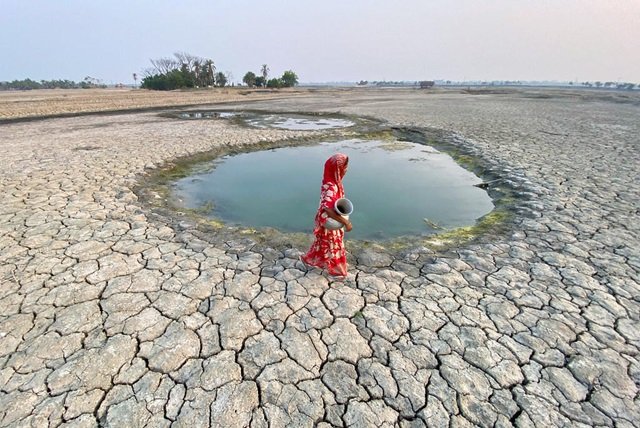
A relatively small region of the tropical Pacific is exerting an extraordinary influence on weather patterns across the world. The developing El Niño episode, already reaching exceptional intensity, is expected to approach record levels in December, bringing heightened risks of drought, flooding, wildfires and food insecurity. Its consequences could extend well beyond the event itself, with economic losses and public-health impacts lasting for years.
El Niño is a naturally occurring climate pattern that typically develops every two to seven years. It is characterised by unusually warm surface waters in the central and eastern tropical Pacific, which disrupt atmospheric circulation and alter rainfall and temperature patterns across distant regions. Each episode has different characteristics, but certain parts of the world repeatedly experience similar consequences.
The current event began during the summer of 2026 and is expected to continue at least until February. Its strength is determined largely by sea-surface temperatures in a section of the Pacific known as Niño 3.4, covering approximately six million square kilometres, an area comparable to Australia. Temperature anomalies in this region have exceeded 3.3 degrees Celsius, with forecasts suggesting they could approach four degrees in December.
Celeste Saulo, secretary-general of the World Meteorological Organisation (WMO), warned this week that the event could reach levels beyond the organisation’s existing monitoring capacity. Speaking at the United Nations climate summit, COP31, in Antalya, Türkiye, she described the intensity as potentially unprecedented.
The warning comes as climate change has slipped down the international political agenda. Brazilian President Luiz Inácio Lula da Silva, speaking at the summit, criticised the declining attention paid to global warming by major governments. He said climate change had disappeared from the speeches and documents of world leaders, with discussions at the G7 and G20 increasingly marked by silence.
The geographical consequences of El Niño are already becoming apparent. In parts of Central America, drought intensified by the phenomenon is damaging crops and threatening livestock across the Dry Corridor, which stretches from Guatemala to Nicaragua. In South America, the northern continent and the Amazon region face increased drought risks, while Ecuador and Peru, particularly their south-eastern regions and coastal areas, are more vulnerable to heavy rainfall and flooding.
The Galápagos Islands experienced intense rainfall in late October and early November, affecting thousands of people on Santa Cruz, the archipelago’s most populated island. Indonesia, meanwhile, has been experiencing extensive wildfires since the summer. Satellite measurements indicate that approximately 2.88 million hectares have already burned this year, an area comparable to the Spanish region of Galicia.
The effects extend across Asia and Africa. El Niño generally increases rainfall over parts of the Pacific and intensifies monsoon conditions affecting Sri Lanka and southern India, while raising flood risks in southern China. At the same time, reduced rainfall threatens Indonesia, the Philippines and several Pacific islands, increasing the likelihood of drought and fires.
In Africa, southern regions face heightened drought and famine risks, while increased moisture from the Indian Ocean can intensify rainfall in the Horn of Africa, contributing to floods, flash floods and malaria outbreaks. In North America, the phenomenon tends to shift storm tracks southwards, increasing rainfall and flood risks in parts of the region. Atlantic hurricane activity generally decreases, while activity in the Pacific can increase.
The economic consequences could be substantial. An analysis by Beatrice Tanjangco of Oxford Economics estimates that, under an extreme scenario in which the current event reaches record intensity, cumulative global economic losses between 2026 and 2031 could reach $4 trillion. The global economy could contract by 0.6% this year, with the impact reaching a maximum decline of 0.8% in 2028.
Previous severe El Niño episodes indicate that economic damage can persist long after the initial disruption. Tanjangco estimates that, under the extreme scenario, global gross domestic product could remain approximately 0.7% below its baseline level even five years later.
Asia is expected to account for the largest absolute economic losses. China, India, Pakistan and South-East Asia together could represent approximately two-thirds of the projected decline in global output. Africa’s share of total economic losses is estimated at only 4%, but the consequences for its population could be disproportionately severe. African economies are expected to experience the largest average increases in consumer prices, partly reflecting the effects of drought and disruption to agricultural production.
Food security organisations are already warning of worsening conditions in vulnerable regions. Action Against Hunger reported deteriorating conditions in parts of the Sahel, including Niger’s Diffa region, where vegetation is in its worst state for years, and northern Mali, where a shortage of pasture threatens livestock and agricultural livelihoods. The organisation estimates that 49 million people could face acute hunger by the end of 2027 as a result of the climate phenomenon.
The economic effects are not confined to countries directly exposed to droughts or floods. Agricultural losses and reduced labour productivity can disrupt production, while higher food prices spread through international markets and supply chains. Uncertainty can also weaken business and consumer confidence, potentially reducing investment and economic activity.
The scale of the damage will depend partly on how effectively governments prepare. Saulo has emphasised the importance of early-warning systems, which can help authorities anticipate extreme weather and intervene before it develops into a humanitarian disaster. The World Health Organisation has also activated a strategic response plan addressing public-health risks associated with El Niño. Its guidance warns that the greatest dangers arise when droughts, floods, extreme heat, wildfires and water shortages coincide with weak healthcare systems, food insecurity, population displacement and existing disease outbreaks.
El Niño is one phase of a wider climate cycle known as the El Niño-Southern Oscillation. Its opposite, La Niña, involves unusually cool surface waters in the same region of the Pacific, while neutral conditions occur between the two. Changes in the strength and direction of the trade winds help determine which phase develops. During El Niño, these winds weaken, disappear or reverse, allowing warm surface water to move eastwards towards the Americas. The resulting disruption affects subtropical and polar jet streams high in the atmosphere, altering storm tracks, humidity and temperatures across the globe.
The relationship between human-induced climate change and the development of El Niño and La Niña is not yet fully understood. However, the two processes interact. Julien Nicolas, a scientist at the Copernicus Climate Change Service, said the record ocean temperatures observed since September reflect both long-term ocean warming caused by climate change and the additional warming associated with El Niño itself. Once the underlying warming trend is removed, he said, the current event has not yet exceeded the historical peak recorded during the exceptionally strong episode of January 1983.
El Niño also temporarily raises global average temperatures, adding an estimated 0.1 to 0.2 degrees Celsius to existing warming. The previous hottest year on record was 2024, which coincided with another El Niño episode. The WMO expects 2026 to rank among the four warmest years recorded, with some scientists suggesting it could finish as the second-warmest or even the warmest.
There is also concern that the phenomenon could accelerate climate change itself. More frequent or extensive wildfires, together with the deterioration of vegetation during droughts, release additional carbon dioxide into the atmosphere. Scientists associated with the Global Carbon Budget estimate that emissions linked to land-use changes will increase by more than 15% this year, reversing a decade-long decline. Although fossil-fuel emissions remain the principal driver of global warming, the additional carbon released through vegetation loss could further intensify the crisis as the world confronts an exceptionally powerful El Niño.