Sri Lanka’s government has recommended abandoning a proposed Chinese oil refinery in Hambantota, a US$3.7 billion project previously promoted as the largest foreign investment in the country’s history, and instead modernising the existing Sapugaskanda refinery. The recommendation, made by a government-appointed committee chaired by the Head of the Presidential Secretariat, could mark a significant change in the country’s approach to foreign investment in its petroleum sector.
The committee has reportedly concluded that several conditions included in the proposed agreement with China’s Sinopec would adversely affect Sri Lanka’s national interests and requirements. Its recommendation is to cancel the existing arrangement and pursue the modernisation of Sapugaskanda rather than proceed with the new refinery in Hambantota. The decision comes after the project had attracted considerable attention as a major Chinese investment in the island’s energy infrastructure.
Two major refinery developments had been under consideration since the current government came to power. The first was the Hambantota project, agreed with Sinopec under the Ranil Wickremesinghe administration. The second involved constructing a large-scale refinery adjacent to the existing Sapugaskanda facility. Sinopec has also expressed interest in modernising Sapugaskanda, although other countries, including the United States, have reportedly shown interest in the same opportunity. Reports have additionally suggested that Sinopec sought a greater ownership share of the land earmarked for the refinery.
The proposed Hambantota investment has been associated with different figures in reports, including US$3.5 billion and US$3.7 billion. Its cancellation would nevertheless represent a substantial reversal of an agreement that had been presented as a major opportunity to expand Sri Lanka’s industrial capacity and attract foreign capital. The central issue is not simply the choice between two refinery locations, but the competing interests surrounding the ownership, administration and development of strategically important infrastructure.
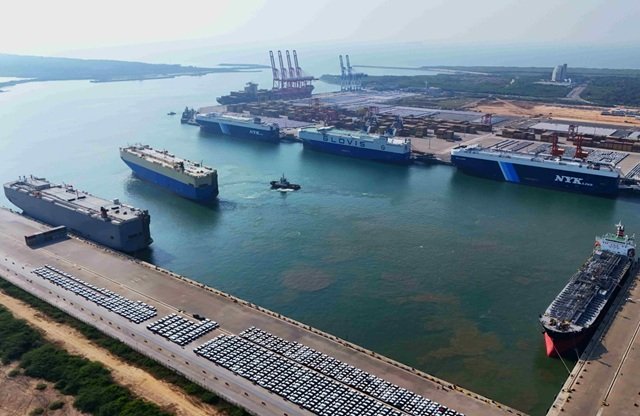
China’s expanding presence in Sri Lanka has long been closely associated with the Hambantota Port, which was handed over to Chinese administration under a 99-year lease following negotiations between successive governments. Located approximately ten nautical miles from international shipping lanes, the port occupies a strategically important position for maritime services. Its development was also connected to China’s Belt and Road Initiative, launched by President Xi Jinping in 2013 as a network of maritime and land-based trade routes.
The source material argues that China’s involvement in the initiative reflects an ambition to expand its economic influence rather than simply support Sri Lanka’s development. It also recalls reports that China sought a similar long-term arrangement for Mattala International Airport after obtaining the Hambantota Port, but that proposal did not proceed. The account further refers to China’s attention turning towards Colombo Port in May 2020. These developments have contributed to concerns about the extent of Chinese involvement in Sri Lanka’s strategic assets.
During President Anura Kumara Dissanayake’s recent visit to China, an agreement was signed with Sinopec concerning the establishment of an oil refinery in Hambantota. The project was expected to bring a major injection of foreign capital into the country, with supporters anticipating economic benefits from refining operations linked to the port. The government’s latest position, however, indicates that the refinery would be developed under Chinese administration, while the committee’s recommendation has called for the existing agreement to be abandoned.
Sri Lanka’s experience with foreign petroleum companies provides an important historical dimension to the debate. In the 1950s, Shell was the dominant player in the domestic oil trade, controlling approximately 60 per cent of the market in 1956. The multinational company had first entered Sri Lanka in 1903. Under the Petroleum Corporation Act introduced by Sirimavo Bandaranaike’s government in 1961, the foreign companies’ monopoly was abolished from 1962 and control of the petroleum trade was transferred to the state.
Caltex, Shell and Esso, together with 13 other multinational companies, received compensation as their commercial monopolies were brought under government control. The establishment of the Sapugaskanda refinery followed this policy shift. Initially designed to process imported crude oil, the facility later became affected by changing geopolitical conditions and disruptions to supplies. Sri Lanka turned to Arab and Soviet countries for crude oil during the 1970s, while imports from Iran were subsequently disrupted by American sanctions. The country was consequently forced to purchase refined petroleum products from third-party suppliers, including Singapore, contributing to substantial losses at the Petroleum Corporation.
Singapore is presented as an example of how refining can support economic development even in countries without domestic oil reserves. By importing crude oil, processing it and exporting refined products, countries can establish a substantial petroleum industry. Sri Lanka’s access to Hambantota Port and its proximity to major international shipping routes have similarly been cited as potential advantages for developing an export-oriented refining sector.
However, concerns about Chinese investments extend beyond the refinery. The source recalls allegations of substantial financial contributions by Chinese companies to political campaigns during previous administrations. Following Maithripala Sirisena’s victory in the 2015 presidential election, disclosures emerged concerning US$76 million allegedly provided by China Harbour through an account maintained at Standard Chartered Bank to support Mahinda Rajapaksa’s election campaign. The money was reportedly used to purchase T-shirts, sarees and other items for distribution among voters supporting Rajapaksa. The source also refers to reports of China Harbour’s relationships with ministers in the Yahapalana government established in 2015, while acknowledging that Chinese investments in Hambantota Port created thousands of employment opportunities for Sri Lankans.
More recent developments have intensified concerns about the government’s investment policy. A Chinese investor planning to establish a logistics centre at Colombo Port reportedly suspended the project two weeks before the publication of the source account and recovered part of the money already deposited. This followed the government’s cancellation in 2023 of an agreement with another Chinese company to establish an automobile assembly plant in Hambantota, involving an investment of nearly US$390 million.
At the same time, a US$390 million American investment was also scheduled for a major logistics complex at Colombo Port. The newly appointed US Ambassador recently conducted an inspection tour of a proposed logistics centre there. The source suggests that the Chinese investor’s withdrawal may have been connected to the entry of the American company, although no evidence is provided establishing that the two developments were directly linked.
Sri Lanka currently operates four ports, but only two are being developed, according to the source. Logistics facilities are considered necessary for expanding port operations and attracting shipping-related investment. Delays in developing these facilities could encourage prospective investors to pursue opportunities in neighbouring countries instead.
The government is entitled to reconsider agreements that are detrimental to national interests. However, the reported establishment of a cabinet-appointed committee to review new construction projects has also prompted concerns about whether foreign investment decisions are becoming increasingly dependent on the preferences of external powers. The source raises the possibility that investments from countries such as China and India could face restrictions unless they receive American approval, although no formal government policy establishing such a requirement has been presented.