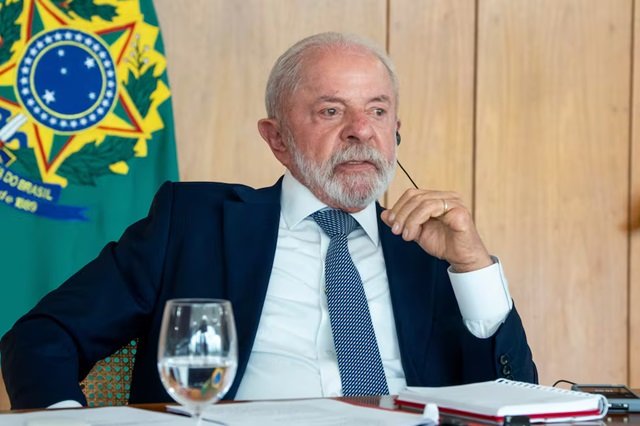
Brazilian President Luiz Inácio Lula da Silva has highlighted growing trade with China and Southeast Asian economies as evidence of the country’s efforts to reduce dependence on the United States, presenting economic diversification as a central element of Brazil’s international strategy.
Speaking in Manila during the 49th ASEAN Summit, Lula said Brazil’s trade surplus had increased from 50 billion reais to 80 billion reais, equivalent to approximately $14.12 billion. He also noted that the United States’ share of Brazil’s goods trade had declined to 9.2 per cent.
Lula attributed the shift partly to tariffs imposed by the administration of US President Donald Trump, arguing that rather than weakening Brazil’s economy, the measures had encouraged Brasília to redirect its commercial activities towards partners in Asia and Europe.
“Instead of crying or begging the U.S. government to have mercy on Brazil, we decided to look for other partners to sell to and buy from,” Lula said during a press conference in Manila.
The figures presented by the Brazilian president indicate growing commercial exchanges with several major economies. Trade with China increased by 20 per cent, while commerce with Indonesia rose by 15 per cent. Trade with Germany expanded by 15.8 per cent and with Vietnam by 13 per cent.
Brazil’s engagement with the Association of Southeast Asian Nations (ASEAN) has also expanded considerably. Trade between Brazil and the regional bloc increased from $530 million in 2003 to more than $6.7 billion in 2026. Lula has set a target of doubling the current trade volume, seeking to establish Brazil as a permanent economic partner of the grouping.
The president presented the expansion of these commercial relationships as part of a broader effort to strengthen Brazil’s economic sovereignty and reduce its exposure to external pressure. He argued that expanding partnerships with countries in the Global South offered an alternative to protectionist trade policies and demonstrated the value of multilateral economic cooperation.
The diplomatic outreach in Manila also included efforts to rebuild relations with Venezuela. Lula reaffirmed Brazil’s willingness to restore bilateral relations at the highest level following his recent meeting with Venezuela’s acting president, Delcy Rodríguez, during the COP31 climate summit.
The proposed restoration of relations covers political, economic and energy cooperation, with both countries seeking to strengthen commercial and energy links across South America. The renewed engagement also forms part of Brasília’s broader regional integration agenda.
Brazil’s diversification strategy comes amid increased trade tensions following the imposition of US tariffs on Brazilian products. The measures include tariffs of 25 per cent and 12.5 per cent on different categories of goods, according to the report.
Brasília’s response has focused on expanding access to Asian and European markets while strengthening relations with regional partners. The strategy reflects Lula’s argument that a broader network of trading partners can give Brazil greater economic autonomy and reduce its vulnerability to decisions taken by individual governments.
The ASEAN summit provided an opportunity to advance this diplomatic and commercial engagement, although translating the expanding trade relationships into formal agreements will require further coordination between Brazilian government institutions, private-sector organisations and partner countries.
Lula’s stated objective is to double Brazil’s trade with ASEAN from its 2026 level of more than $6.7 billion, consolidating the country’s position as a long-term economic partner of the Southeast Asian bloc.