In the southern suburbs of Beirut, where Hezbollah’s influence runs deep, the symbols of conflict and sacrifice remain ever-present. At a cemetery lined with yellow flags and portraits of fallen fighters, young mourners gather in quiet reflection. According to reporting originally published by Times UK, two teenage boys stand beside the graves of relatives killed in recent conflicts—one in the strike that eliminated longtime leader Hassan Nasrallah in 2024, the other in Syria during Hezbollah’s campaign alongside Bashar al-Assad’s forces. Their words reflect a mindset shaped by decades of conflict: a determination to continue fighting despite mounting losses.
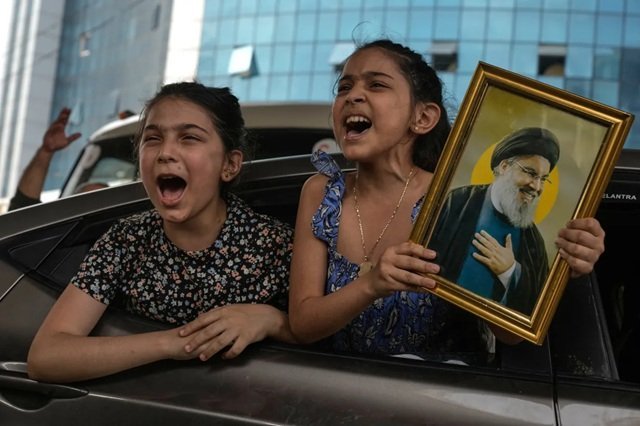
This scene unfolded just hours before a ceasefire between Israel and Lebanon came into effect, a truce brokered under international pressure. In Beirut, celebratory gunfire and fireworks lit up the night sky as displaced families began returning home. Yet uncertainty lingered. Hezbollah, not formally bound by the agreement, left observers questioning whether attacks on Israeli targets would truly cease.
For now, the truce appears to be holding. But skepticism runs deep. Hezbollah’s identity as an armed resistance movement, backed by Iran, complicates any path to lasting peace. Its flag—a raised hand gripping a rifle—symbolizes a commitment to armed struggle that many analysts argue is central to its existence. Without its military role as a proxy for Tehran, the group risks losing both financial backing and strategic relevance.
International pressure is mounting. The United States has urged the Lebanese government to take decisive action to prevent further attacks. However, Lebanon’s leadership faces a dilemma: confronting Hezbollah directly could risk plunging the country back into civil war. This tension echoes past ceasefires that ultimately failed, raising doubts about whether this latest agreement will fare any better.
In neighborhoods like Hay El-Sellom, the human cost of the conflict is stark. An Israeli airstrike earlier this month killed around 80 people, including women and children. Israel maintains that such attacks target Hezbollah command centers embedded within civilian areas. Yet on the ground, verifying these claims is nearly impossible. Residents insist the victims were civilians, while Hezbollah tightly controls access and narratives.
During a guided visit for international media, a Hezbollah-affiliated parliamentarian condemned both Israel and Western leaders, framing the strike as unjust aggression. Nearby, grieving youths displayed images of friends killed in the attack, expressing unwavering loyalty to the group. For many there, Hezbollah is not just a militia but a provider of essential services—schools, hospitals, and welfare—creating a system where allegiance is reinforced by both ideology and necessity.
Experts say recruitment into Hezbollah is a gradual and secretive process, often beginning in mosques and progressing through ideological and military training. The group’s structure allows individuals to serve in various roles, from fighters to civilians employed in its institutions. This layered involvement blurs the line between civilian and combatant, complicating both military targeting and international perceptions.
Hezbollah’s roots trace back to 1982, formed in response to Israel’s invasion of Lebanon and inspired by Iran’s Islamic revolution. Its ideology is deeply tied to Shia theology, with leaders historically claiming religious authority that demands obedience. Although current leader Naim Qassem lacks the same lineage as his predecessors, the organization continues to emphasize indoctrination, particularly among youth movements that instill loyalty from an early age.
Financial incentives also play a crucial role. In economically marginalized Shia areas, Hezbollah offers stability and support that the state often cannot. For many families, joining the group provides a pathway to security and livelihood. However, this dependence also raises the stakes in debates over disarmament. Analysts warn that dismantling Hezbollah’s armed wing could destabilize not only the group but entire communities reliant on its network.
Despite recent losses, Hezbollah’s military capabilities remain significant. Weapons continue to flow through Syria, including rockets, anti-tank missiles, and drones. While its arsenal has been tested, it is far from depleted. What may be eroding, however, is its political capital. Earlier this year, Lebanon declared Hezbollah’s armed wing illegal after a series of retaliatory strikes drew widespread criticism and displaced more than a million people.
Public sentiment is divided. Some Lebanese, particularly those who remember life before Hezbollah’s rise, accuse the group of prioritizing foreign interests over national stability. Others, however, rally behind it, driven by a sense of resistance and distrust of external powers. This complex landscape reflects Lebanon’s diverse sectarian fabric, where political allegiances shift across regions and communities.
As Lebanon stands at a crossroads, the ceasefire offers a moment of pause but not resolution. The forces that sustain Hezbollah—ideology, external backing, and local dependence—remain firmly in place. Whether this truce can evolve into lasting peace depends on factors far beyond the battlefield, in a country where war and politics remain deeply intertwined.