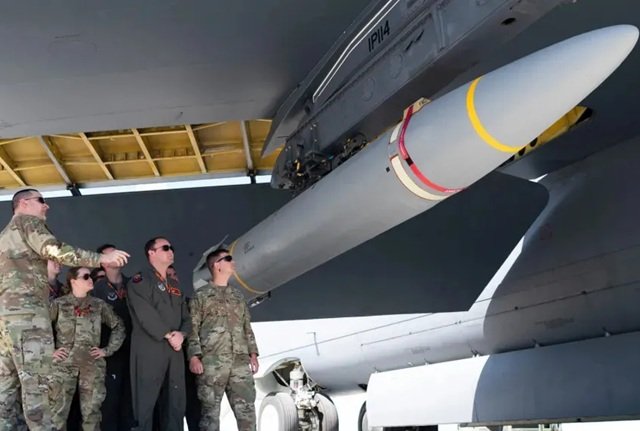
For the first time, the U.S. Air Force has revealed imagery of its B-1B Lancer bomber carrying the AGM-183 Air-launched Rapid Response Weapon, or ARRW, marking a pivotal moment in the evolution of America’s hypersonic strike capabilities. The development underscores a broader strategic shift, as the Pentagon moves to revive a once-troubled missile program while extending the operational life of one of its most versatile bombers well into the next decade.
The footage, which surfaced via official channels and was first highlighted by The Aviationist, shows the B-1B flying with the large hypersonic missile mounted externally. Although details about the specific test flight remain unclear, the imagery alone represents a significant milestone. For years, the integration of hypersonic weapons onto U.S. bombers has been a key objective, but tangible evidence of progress had remained limited.
Originally designed during the Cold War to carry nuclear weapons, the B-1B transitioned to a conventional role after the collapse of the Soviet Union. Its external hardpoints, once intended for nuclear-tipped cruise missiles, fell largely into disuse. Now, those same hardpoints are being repurposed for a new era of warfare, one defined by speed, precision, and technological sophistication.
The ARRW itself has had a turbulent development history. Once expected to become the United States’ first operational hypersonic weapon, the program faced setbacks and uncertainty, including plans for cancellation in 2023. However, recent budget proposals indicate a dramatic reversal. The Air Force is not only pushing forward with procurement but is also investing in an upgraded version, known as ARRW Increment 2, alongside a separate effort to develop a new air-launched ballistic missile.
At the core of ARRW’s appeal is its boost-glide technology. The missile uses a rocket booster to accelerate a hypersonic glide vehicle to extreme speeds and altitudes before releasing it toward its target. Traveling at speeds exceeding Mach 5 and following unpredictable flight paths, such weapons are exceptionally difficult to intercept, compressing decision-making timelines for adversaries to mere moments.
The B-1B’s role in this program is equally significant. Once slated for retirement by 2030, the aircraft is now expected to remain in service until at least 2037. This extension reflects not only the bomber’s adaptability but also the growing demand for platforms capable of carrying large, advanced weapons. With the ability to handle heavy payloads both internally and externally, the B-1B has emerged as an ideal testbed for hypersonic integration.
Central to this effort is the development of the Load Adaptable Modular, or LAM, pylon. Designed to carry oversized weapons, including hypersonic missiles, the system allows the B-1B to mount up to six pylons, each capable of supporting substantial loads. This flexibility enables the bomber to carry a mix of weapons tailored to specific mission requirements, enhancing its operational versatility.
Testing has already demonstrated the aircraft’s ability to carry and release large payloads from these pylons, a capability that could prove decisive in future conflicts. The same mounting points have been used in trials involving other advanced munitions, including precision-guided bombs and long-range cruise missiles, highlighting the platform’s evolving role in modern warfare.
The renewed focus on hypersonic weapons comes amid intensifying global competition, particularly with China, which has made significant advances in this المجال. Beijing’s development of hypersonic systems, including air-launched ballistic missiles, has raised concerns within the Pentagon about maintaining technological parity. The reemergence of ARRW, along with parallel programs like the Hypersonic Attack Cruise Missile, reflects a broader effort to close that gap.
Budget documents reveal the scale of this commitment. The Air Force plans to invest heavily in hypersonic development over the coming years, accelerating production and expanding capabilities. While specific procurement numbers remain undisclosed, the emphasis is clear: hypersonic weapons are no longer experimental concepts but central components of future U.S. strike doctrine.
At the same time, the modernization of the bomber fleet remains a top priority. In addition to extending the B-1B’s service life, the Air Force is investing in upgrades to ensure its continued effectiveness. These improvements aim to enhance the aircraft’s survivability, connectivity, and ability to integrate with next-generation systems.
The broader context for these developments is a rapidly changing security environment. Recent operations in the Middle East, combined with ongoing global deployments, have underscored the importance of maintaining a robust and flexible bomber force. As tensions with major powers continue to rise, the ability to project power quickly and decisively has become more critical than ever.
The B-1B’s transformation into a hypersonic weapons carrier reflects this reality. No longer just a relic of Cold War strategy, the aircraft is being redefined as a cornerstone of 21st-century warfare. Its capacity to deliver large numbers of advanced weapons over long distances makes it a key asset in scenarios ranging from regional conflicts to great power competition.
Reporting from The War Zone has consistently highlighted the importance of such capabilities, particularly as the United States adapts to new forms of warfare. The integration of hypersonic weapons onto existing platforms represents a pragmatic approach, leveraging proven systems while developing cutting-edge technologies.
Looking ahead, the trajectory of both the B-1B and the ARRW program suggests a renewed sense of urgency within the Pentagon. The challenges of modern warfare—speed, complexity, and global reach—demand solutions that can keep pace with rapidly evolving threats. In this context, the image of a B-1B carrying a hypersonic missile is more than just a technical achievement; it is a symbol of a broader strategic transformation.
As the United States prepares for an uncertain future, the convergence of legacy platforms and next-generation weapons may prove निर्णायक. The return of ARRW from the brink, coupled with the extended life of the B-1B, signals that the race for hypersonic dominance is far from over—and that its outcome could shape the balance of power for years to come.