The beaches of San Antonio in the Philippine province of Zambales are usually alive before dawn. Fishing boats return with fresh catches, villagers crowd the shore and traders prepare for another day’s work. But now the coastline has fallen unnervingly silent. Nets lie untouched on the sand while fishermen sit idle beneath makeshift shelters, watching military aircraft roar overhead.
For many residents, the sea is no longer a source of survival but the stage for a dangerous global contest.
Just offshore, the United States and the Philippines have been conducting Balikatan, the largest joint military exercises ever staged between the two allies. Thousands of troops, advanced missile systems, drones and amphibious assault units have transformed this once-peaceful region into a theatre of war preparation. Though officials rarely state it directly, the message behind the exercises is unmistakable: China is the target.
The drills, reported extensively by The Times UK, are unfolding at a moment of escalating tensions across Asia. China’s growing military assertiveness in the South China Sea and around Taiwan has pushed the Philippines into an increasingly precarious position, placing the archipelago at the frontline of a strategic struggle between Beijing and Washington.
For villagers such as fisherman Madardo Agasa, however, the geopolitical calculations mean little compared with the loss of daily income. Fishing bans imposed near exercise zones have prevented many residents from going to sea for days at a time.
“It’s very sad because we cannot go fishing,” Agasa said while sitting beside his unused boat on the shore. “We have no income to support our family.”
The restrictions come at a time when many Filipinos are already facing severe economic pressure. Fuel prices have surged following instability in the Middle East, particularly after the widening conflict involving Iran and US-backed military operations in the region. The Philippines, which imports nearly all of its energy supplies from abroad, became the first government to declare an energy emergency after prices more than doubled.
For fishing communities, the impact has been devastating. Even before the military exercises began, many small-scale fishermen could barely afford enough fuel to leave harbour. Now, with temporary exclusion zones closing off large stretches of water, thousands of families are struggling to survive.
The Balikatan exercises, whose name means “shoulder to shoulder” in Filipino, have become the centrepiece of America’s renewed military presence in Asia. Around 17,000 service members have participated this year, including troops from Japan and Australia alongside Filipino and American forces.
The drills reflect how rapidly the security landscape in the Indo-Pacific is changing. China’s military expansion, especially in disputed waters of the South China Sea, has alarmed neighbouring countries and prompted Washington to deepen defence partnerships across the region.
To the west of the Philippines, Chinese coastguard ships increasingly patrol contested waters claimed by both Manila and Beijing. Filipino fishermen regularly report intimidation at sea, while China continues to fortify reefs and coral atolls with military infrastructure. To the north lies Taiwan, the democratic island Beijing has vowed to reunify with mainland China, by force if necessary.
The Philippines sits dangerously close to both flashpoints. Its northern islands are less than 100 miles from Taiwan, raising fears that any future conflict could drag Manila directly into war.
Military planners are preparing accordingly. This year’s Balikatan focused heavily on modern battlefield tactics, especially the use of drones and unmanned systems inspired by conflicts in Ukraine and the Middle East. Beaches in northern Philippines echoed with live-fire exercises, missile launches and coordinated amphibious assaults designed to simulate a defence against invasion.
Romeo Brawner, chief of staff of the Philippine armed forces, said the exercises reflected the changing nature of warfare. Modern conflicts, he said, increasingly depend on unmanned technologies and rapid-response coordination between allies.
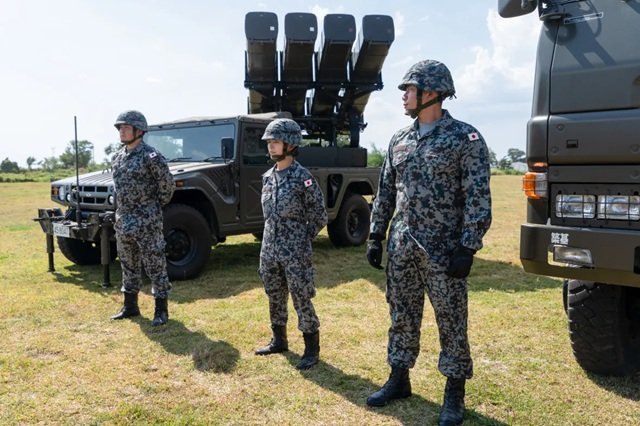
China has condemned the drills, accusing participants of destabilising the region and “playing with fire”. Beijing reacted particularly angrily to Japan’s participation, marking the first time since the Second World War that Japanese combat troops had operated on Philippine soil.
The symbolism was impossible to ignore. At a naval base under sweltering tropical heat, Japanese soldiers displayed military equipment on islands once occupied by Imperial Japan during the brutal Pacific War. Beijing accused Tokyo of accelerating remilitarisation, while many Filipinos viewed the development with mixed emotions shaped by both history and present fears.
Yet even as governments strengthen military alliances, public opinion inside the Philippines remains divided.
In Manila, protesters gathered in public squares demanding the withdrawal of US troops from the country. Activists stitched together giant American flags before burning them in demonstrations condemning Washington’s growing military footprint.
“The current military bases here in the Philippines are magnets of danger and violence,” activist Kyla Benedicto said. “They can easily be attacked by China.”
The Philippines currently hosts US forces at nine military sites under a 2014 defence agreement that permits rotational American deployments. Supporters argue the arrangement is essential to defend Philippine sovereignty against Chinese expansion. Critics warn it risks turning the country into a battlefield in a future US-China war.
That anxiety is increasingly visible in communities living near military sites. Residents fear they could become immediate targets in any regional conflict, while local economies remain strained by inflation and disruptions linked to global instability.
Labour groups say the pressure is becoming unbearable for ordinary workers. Jerome Adonis, chairman of the country’s largest trade union federation, said many families are now skipping meals while children are being forced out of school because of rising costs.
“It’s really hard to feed our family,” he said. “Many of our children have stopped going to school.”
Adonis blamed Washington for intensifying global instability, accusing the United States under Donald Trump’s leadership of fuelling military confrontations that have worsened economic suffering worldwide.
For many Filipinos, the crisis is no longer abstract geopolitics but an immediate struggle tied to food, fuel and survival. Fishermen who once worried about storms now speak about naval patrols and missile systems. Villages that depended on the rhythm of the sea now exist under the shadow of military exercises and superpower rivalry.
As American warships, Japanese troops and Chinese patrol vessels converge around the Philippines, the country finds itself standing at the fault line of a rapidly changing world order. What was once a distant contest between great powers is now reshaping the daily lives of ordinary people across the archipelago.
On the beaches of San Antonio, where silence has replaced the noise of fishing boats, that transformation already feels complete.