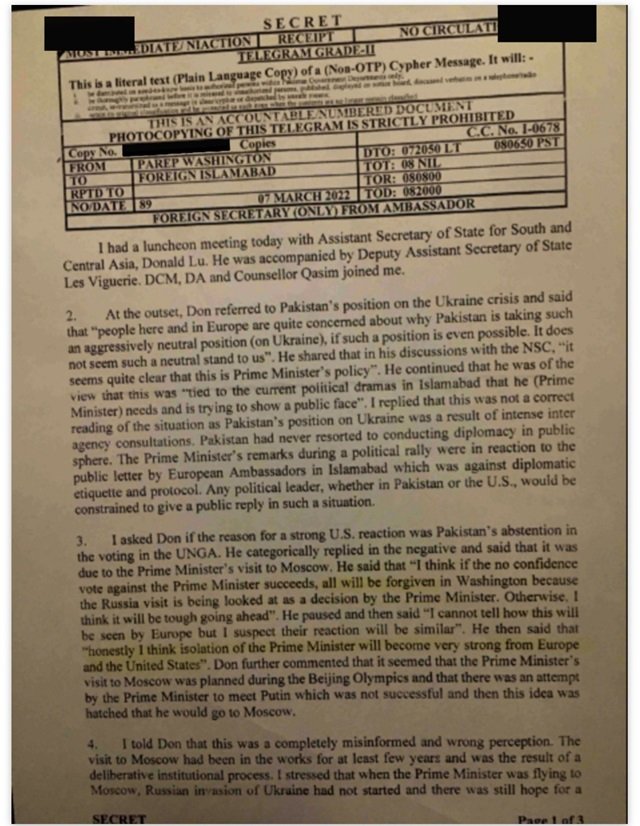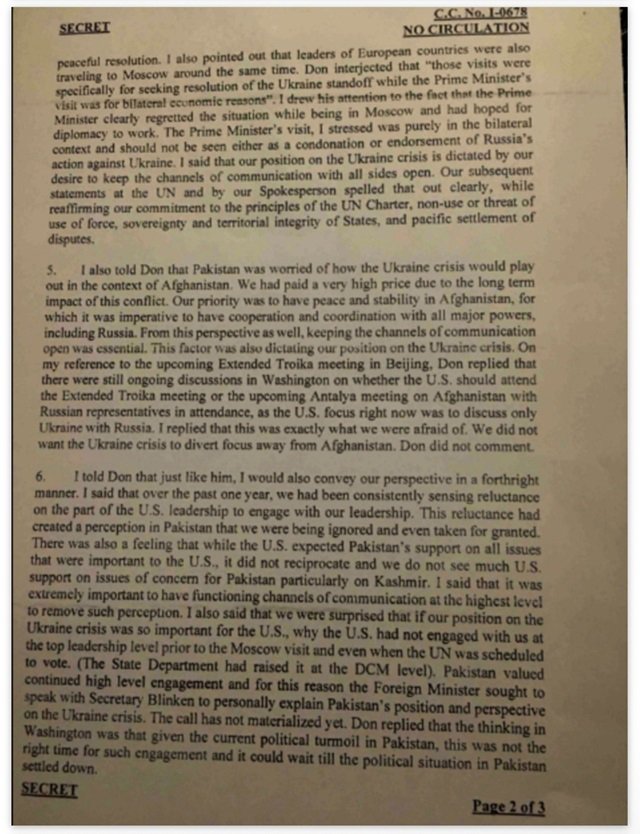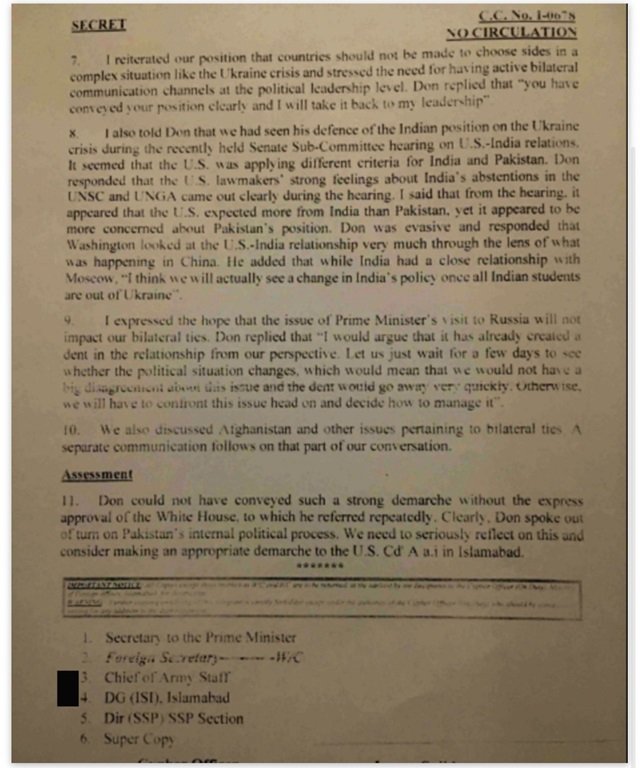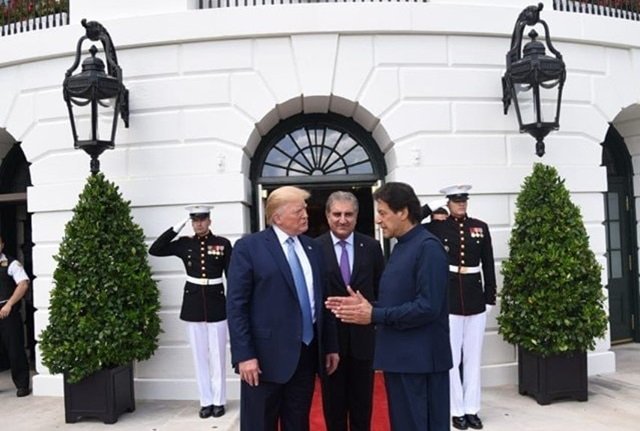
Drop Site News has published what it describes as the full transcript of Cable I-0678, a classified Pakistani diplomatic cypher dated March 7, 2022, which sits at the heart of former Prime Minister Imran Khan’s long-standing claim that the United States played a decisive role in his removal from power. The document, previously reported in part by The Intercept in August 2023, has been framed by Drop Site News as a critical addition to the historical record of one of the most politically volatile episodes in modern Pakistani history, involving Pakistan and the United States.
At the center of the cypher is a meeting in Washington between Pakistan’s then-ambassador Asad Majeed Khan and Donald Lu, a senior U.S. State Department official overseeing South and Central Asian affairs. According to the cable’s contents, Lu conveyed a message that would later reverberate across Pakistan’s political landscape: grievances with Imran Khan’s government could be set aside, and “all will be forgiven” if Khan were removed through a parliamentary no-confidence vote. The phrase, as recorded in the diplomatic summary, has since become a focal point in debates over whether external pressure influenced Pakistan’s domestic political transition in 2022.
Drop Site News’s publication of the full transcript situates the document within a broader geopolitical narrative that extends beyond a single diplomatic exchange. The outlet notes that the cypher emerged during a period of intensifying global realignment following Russia’s invasion of Ukraine and increasing pressure from Washington on partners to align with its foreign policy priorities. In Pakistan, this period coincided with deepening tensions between Khan’s administration and both civilian and military power centers, culminating in his ouster in April 2022 through a no-confidence vote backed by the country’s powerful military establishment.
The Intercept was the first to report on the existence and implications of the cable, and its source—described as a member of Pakistan’s military—expressed concern about the internal consequences of the episode. According to that reporting, the source described growing disillusionment within parts of the armed forces over the institution’s involvement in political decision-making, warning that it risked undermining morale. The source went further, suggesting the trajectory of instability bore comparison to the events of 1971 that led to the secession of Bangladesh, a historical reference that continues to carry profound weight in Pakistani civil-military discourse.
Drop Site News further emphasizes that the document’s significance lies not only in its contents but in the institutional context it reveals. The cable is presented as evidence of a moment when diplomatic messaging intersected with domestic political upheaval, contributing to a chain of events that reshaped Pakistan’s leadership. Following Khan’s removal, Pakistan’s political order underwent rapid transformation, with allegations from Khan and his supporters that the military and external actors had aligned interests in his displacement. The subsequent rise of Shehbaz Sharif’s government and the consolidation of military influence under Asim Munir are presented by critics as part of a broader restructuring of power.
In the years that followed, Pakistan’s international positioning evolved in ways that deepened scrutiny of its foreign policy alignment. Drop Site News connects the 2022 rupture to a wider pattern in which Islamabad increasingly positioned itself as a flexible intermediary in global conflicts, including efforts related to negotiations involving Iran and the United States. While Pakistani officials have portrayed this role as evidence of diplomatic resurgence, critics and regional observers have questioned its consistency and credibility, particularly given shifting alliances and internal political constraints.
The publication of Cable I-0678 arrives at a moment when Pakistan’s role on the global stage is again under examination. As Islamabad continues to present itself as a potential mediator in high-stakes international negotiations, including discussions involving Washington and Tehran, questions persist about the independence of its diplomatic posture. Drop Site News frames the newly released document as central to understanding how Pakistan’s current position was shaped not only by regional dynamics but also by the contested events of 2022, when a classified exchange became a symbol of deeper geopolitical contestation between domestic sovereignty and external influence.
Taken together, the cypher, its earlier partial disclosures, and its full publication by Drop Site News now form a consolidated record that is likely to remain central to debates over the legitimacy of Pakistan’s political transition in 2022. Whether interpreted as evidence of coercive diplomacy or as a misread diplomatic exchange later politicized within Pakistan’s internal struggles, the document underscores the fragility of trust between Islamabad’s civilian leadership, its military establishment, and its international partners. As such, Cable I-0678 stands not only as a historical artifact but as a continuing point of contention in understanding how power, influence, and legitimacy intersect in modern South Asian geopolitics.