South Korea is experiencing a powerful export-driven economic upswing, fueled by surging global demand for artificial intelligence infrastructure, advanced semiconductors, and defence equipment, as well as a renewed wave of geopolitical rearmament across multiple regions.
The country’s economy expanded 3.6 percent year-on-year in the first quarter, accelerating from 1.6 percent in the previous quarter, supported by a sharp rise in exports that reached a record $220 billion. The performance has been driven largely by strategic industries where South Korea maintains global competitiveness, particularly chips, shipbuilding, and defence manufacturing.
Much of the export boom is linked to artificial intelligence demand, which has significantly increased global purchases of memory chips and data infrastructure components. Semiconductor sales alone contributed $31.9 billion in April, helping push total monthly exports to $85.89 billion, also a record high. Leading chipmakers Samsung Electronics and SK Hynix have both surpassed $1 trillion in market valuation, placing them among the world’s largest corporations.
The expansion of AI-related infrastructure has also triggered demand for supporting electrical systems, including ultra-high-voltage transformers used in data centres. Companies such as Hyosung Heavy Industries, HD Hyundai Electric, and LS Electric have seen a combined order backlog of 32 trillion won, reflecting sustained global investment in digital infrastructure. Hyosung Heavy Industries has additionally reported a dramatic surge in share value over recent years, underscoring investor confidence in the sector’s long-term trajectory.
Officials and analysts have pointed to the semiconductor cycle as a central driver of broader economic performance. Bank of Korea Governor Shin Hyun-song said recent chip sales growth alone is expected to add 0.7 percentage points to 2026 GDP, offsetting negative economic pressures linked to external shocks including conflict in Iran.
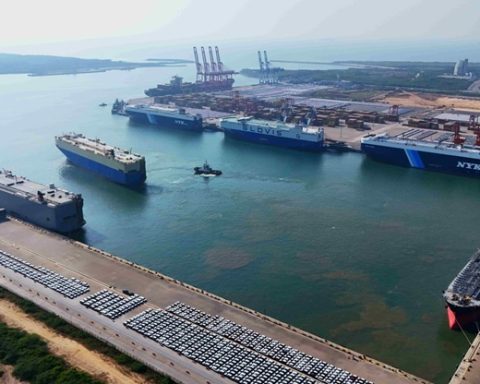
At the same time, South Korea’s shipbuilding industry has regained global prominence amid tightening competition between leading producers. The sector, dominated by firms such as Hyundai Heavy Industries, Samsung Heavy Industries, and Hanwha Ocean, has benefited from rising demand for liquefied natural gas carriers and naval vessels. Hyundai Heavy Industries alone has secured orders for 16 LNG carriers this year, significantly outpacing previous annual figures.
The global strategic environment has reinforced this momentum. The United States has increasingly looked to South Korean shipbuilders amid concerns over domestic production capacity, including a Pentagon feasibility study into outsourcing warship design and construction. Industry sources describe production facilities operating near full capacity, with order books extending well into the coming years.
Defence exports have also expanded rapidly as global conflicts and security tensions increase demand for military hardware. South Korea has signed contracts with multiple countries, including Poland, Norway, Peru, and the United Arab Emirates, covering fighter jets, tanks, and rocket systems. The defence sector’s export backlog has grown sharply, reflecting sustained international demand for relatively cost-competitive systems with fewer operational restrictions compared with Western alternatives.
Beyond heavy industry, South Korea’s economy has also benefited from growth in consumer-facing sectors. Cosmetic exports continue to expand, supported by global interest in Korean popular culture, while tourism has recovered strongly, with millions of arrivals recorded in the first quarter.
Despite these gains, structural pressures remain significant. Energy dependence, high living costs, and employment challenges persist, particularly among younger workers. More critically, several traditional manufacturing industries, including steel and petrochemicals, face increasing pressure from lower-cost competitors, particularly from China, as well as rising input costs linked to global energy prices.
Economists warn that China’s rapid advancement into high-value sectors poses a long-term competitive challenge for South Korean industry. Some analysts argue that South Korea has already lost ground in multiple manufacturing categories, with semiconductors remaining one of the few areas where it retains a clear advantage.
Despite these concerns, industry leaders describe a persistent cycle of competitive urgency as a defining feature of the economy. The country’s diversified industrial base, spanning conglomerates active in sectors from electronics to shipbuilding, continues to underpin growth even as global competition intensifies and technological leadership becomes increasingly contested.