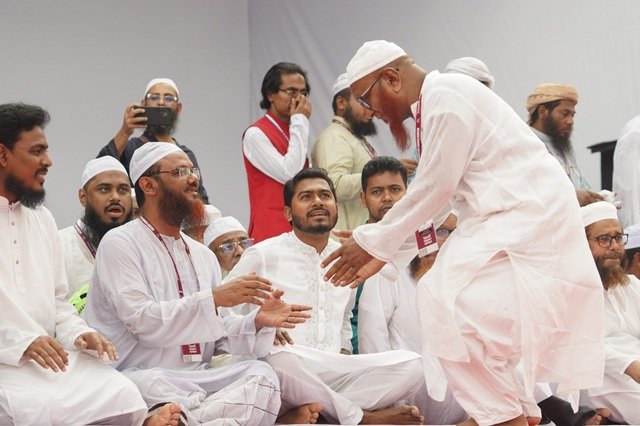
On June 27, 2026, Islami Andolan Bangladesh (IAB) announced its new central committee, appointing Maulana Gazi Ataur Rahman as Secretary General. The party also named four joint secretaries general, four assistant secretaries general and a 54-member central committee. The announcement was made following a special meeting of the party’s central Majlis-e-Shura (Advisory Council) at a hotel in Dhaka’s Bijoynagar. It was also decided that, Charmonai Pir Mufti Syed Muhammad Rezaul Karim would continue as IAB’s Chief (Ameer). The party retained Mufti Syed Muhammad Faizul Karim, Maulana Abdul Awwal and Maulana Abdul Haque Azad as naib-e-ameers (vice presidents). The newly appointed joint secretaries general were Ashraful Alam, Hafeez Maulana Sheikh Fazle Bari Masud, Shah Iftekhar Tariq and Maulana Nesar Uddin. The assistant secretaries general were Maulana Syed Eshaq Muhammad Abul Khair, Maulana Ahmad Abdul Qayyum, KM Atikur Rahman and Sheikh Fazlul Karim Maruf.
IAB has made its own place in the political landscape of Bangladesh after the 2024 elections, as a Qawmi Madrassa based party, headed by the Charmonai Pir. In the February 2026 General Election, IAB made history by winning its first-ever parliamentary seat in Barguna-1, with Mohammad Oli Ullah securing victory, though its overall performance remained modest, with limited seats and vote share compared to the dominant Bangladesh Nationalist Party (BNP) and Jamaat-e-Islami (JeI). In early 2026, IAB was part of broader Islamist discussions, but exited the 11-party alliance led by JeI to contest independently, citing differences over seat distribution and strategy.
Formed on March 13, 1987 as the Islami Shashontontro Andolan (Islamic Constitution Movement), a coalition of various Islamist figures and organizations seeking to establish Islamic governance, the group later evolved into a full-fledged political party and was registered with the Election Commission in 2008 as IAB, adopting the “hand fan” (hathpakha) as party symbol.
With regard to its electoral performance, in the 8th parliamentary polls of 2001, IAB stood 16th (with a total of 5,944 votes). In the 9th parliamentary elections of 2008, its votes surged to 658,254. In a dramatic turn, it boycotted the 10th parliamentary elections of 2014 to protest the government’s decision to abandon the caretaker government system. In the 11th parliamentary elections of 2018, it received the third-highest number of votes – approximately 1,255,373, with the Awami League-led Grand Alliance and Bangladesh Nationalist Party (BNP)-led Jatiya Oikya Front winning the first and second places, respectively. However, IAB boycotted the 12th General Election of 2024, calling it a ‘dummy election’ by the ruling Awami League government.
Ideologically, IAB positions itself as a proponent of Sharia-based governance, and also promotes the formation of a “Kalyankami Rashtra” (welfare state) guided by Islamic principles. It emphasizes Da’wah (propagation), social reform, anti-corruption measures, good governance, and economic justice. For Da’wah, IAB relies on public lectures, leaflets, handbills, CDs, DVDs, posters, organizational books, and newspapers. In pursuance of this objective, its Mujahid Committee aims to deliver about 10, 000 religious sermons and political statements in Bangladesh annually.
IAB has clearly stated in its Nitimala (or guiding principles) that its main agenda is two-fold. First, to transform Bangladesh into an Islamic welfare state by implementing the Islamic ideals inspired by the Khilafat Rasheda model – which dictates that the responsibility of all peoples and governments is to please Allah, and, as a reward, they would have sustained progress on earth and peace (for the faithful believers) in the hereafter. In pursuance of the second agenda, IAB aims to ensure the promotion of a welfare state system. The party also positions itself as distinct from other Islamist groups by focusing on Sufi traditions, and on political activism. Its slogan – Shudhu neta noy, nitir poriborton chai“, which translates to “Not just a change of leaders, but a change of policies” – reflects a call for policy change alongside leadership renewal.
IAB’s “Manifesto of People’s Expectations” for the 13th General Election, published on February 4, 2026, demonstrated that, under its policy stance on state formation, IAB would govern in accordance with the basic principles of Sharia, across all areas of state administration. The manifesto also committed to protecting the rights and dignity of religious and ethnic minorities, stating that no citizen would face discrimination on the basis of religion or ethnicity. Describing corruption as the country’s most pressing challenge, the manifesto outlined a zero-tolerance policy against political and institutional corruption, with particular emphasis on the banking sector, public recruitment processes and service delivery institutions. IAB also announced some welfare schemes and development plans.
Relating to its structure, the party is led by an Ameer who is elected for a five-year term by a 300- member Majlis-e-Shura; the Ameer has the power to appoint, from among a cohort of Islamic scholars, academics, intellectuals and professionals, a special 7-to-11-member committee of advisors. The Ameer is also the president of the three central councils: the Majlis-e-Shura, the Majlis-e-Sadarat (Presidium Council) and the Majlis-e-Amila (Executive Council).
Various reports suggest that IAB maintains its strongest support base, cadres, and organizational presence in the Barisal division, particularly around Charmonai village in Barisal District, which serves as its spiritual and political heartland due to the influence of the Charmonai Pir. Further, IAB has decent support base in the urban centers of Barisal, Dhaka, and Khulna. The party has also highlighted increasing influence among women of Bangladesh, including plans for a dedicated female student wing.
IAB’s electoral evolution suggests a systematic consolidation of influence and its Islamist political agenda in Bangladesh.