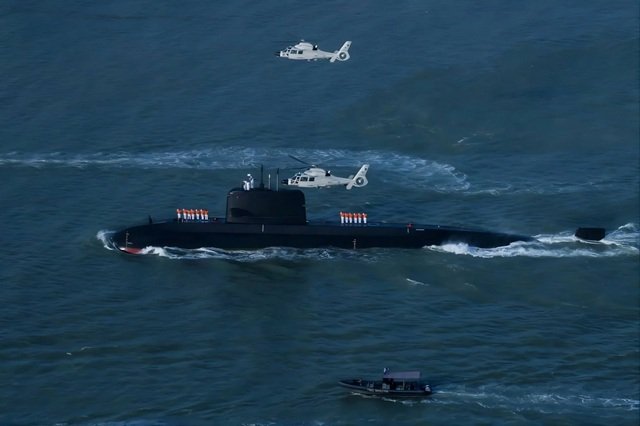
Pakistan’s induction of its first advanced Chinese-built stealth attack submarine is being described as a potential shift in the naval balance of power with India, as the South Asian rival expands its undersea capabilities for the first time in more than half a century, according to reporting by The Independent UK.
The submarine, identified as the PNS Hangor, was commissioned in April and arrived at Karachi port on 11 June after being received in China’s Hainan province. The vessel is the first of eight planned submarines of its class, with the fleet expected to be gradually completed through 2032, according to Pakistani naval sources and defence officials cited in the report.
Pakistan’s navy has framed the induction as a major leap in capability, with Commodore Omer Farooq describing the platform as a “gamechanger” that would extend operational reach deep into the eastern Indian Ocean. The submarine’s design includes air-independent propulsion technology, allowing it to remain submerged for extended periods and enhancing its stealth profile compared with older platforms.
The development marks a notable expansion for Pakistan’s undersea forces, which had previously been constrained by ageing French-built Agosta-class submarines. Officials involved in the programme say part of the Hangor fleet will be built in China, while others will be assembled domestically under a transfer-of-technology arrangement, reinforcing long-term naval cooperation between Islamabad and Beijing.
According to the report published by The Independent UK, Pakistani President Asif Ali Zardari attended the commissioning process in China and said the new submarines would be equipped with advanced weapons and navigation systems intended to support maritime stability in the region.
Although India continues to maintain a significantly larger submarine force, operating around 19 vessels, Pakistani officials and defence analysts argue that even a smaller fleet of modern stealth submarines could alter operational risk calculations in contested waters. The Hangor’s deployment is expected to strengthen Pakistan’s ability to maintain a persistent underwater presence in strategic zones including the Arabian Sea and broader Indian Ocean approaches.
The submarine programme also carries symbolic weight in Pakistan’s naval history. The last time Pakistan operated a submarine in the Bay of Bengal during the 1971 war with India, it was destroyed, and the navy has not projected sustained undersea operations in those waters for decades. Officials now suggest the new class could enable broader reach, including protection of sea lines of communication across key maritime corridors.
Regional tensions form the backdrop to the development. The report references last year’s clashes between India and Pakistan following Indian airstrikes, which were triggered by an attack in the Kashmir region. Retired Pakistani naval officials quoted in the report said the recent conflict demonstrated that conventional military gaps between the two countries were narrower than previously assumed, particularly in certain operational domains.
Experts cited in the report offered differing assessments of the strategic impact. Some argued that Pakistan’s upgraded submarine capability could force India to adjust its maritime planning, particularly as its own sub-surface fleet includes a mix of ageing platforms alongside a limited number of nuclear submarines under development. Others noted that India’s broader naval power and anti-submarine warfare capabilities remain significantly more advanced overall.
A Carnegie India analyst referenced in the reporting said Pakistan’s expansion would likely enhance its “anti-access and area denial” posture in nearby waters, even if India retains overall maritime superiority. The analyst also noted that China’s role in Pakistan’s naval modernisation forms part of a wider regional dynamic involving multiple external powers.
The broader strategic context includes wider Indo-Pacific military developments, including the AUKUS defence partnership between Australia, the United Kingdom, and the United States, which focuses on next-generation submarine and advanced defence technologies. Analysts quoted in the report suggested that such parallel developments reflect a broader pattern of maritime capability expansion across multiple regions.
While Pakistan’s navy presents the Hangor programme as a stabilising upgrade to its fleet, regional analysts cited in the Independent UK report describe it as part of a gradual shift in undersea deterrence dynamics in the Indian Ocean. The full impact of the programme will depend on delivery timelines, operational deployment, and how India adapts its own naval modernisation strategy in response to evolving capabilities.