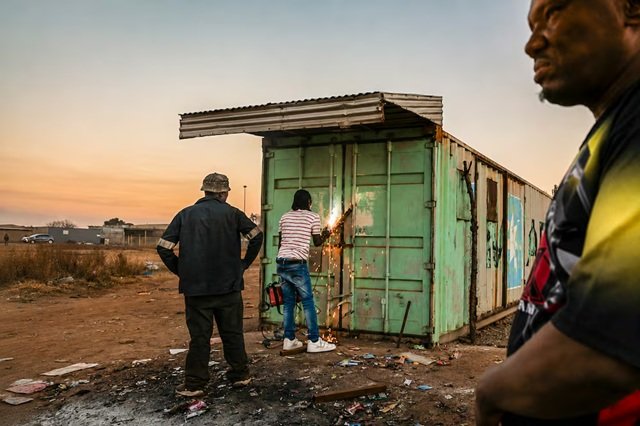
A rusted shipping container in the Johannesburg township of Katlehong has become an unlikely symbol of a growing crisis in South Africa. As sparks fly from a welding machine sealing its heavy metal doors shut, Ethiopian shopkeeper Biranu Hajiso watches silently. The container had served as his small neighborhood grocery store until repeated attacks forced him to close. After being looted for the third time, Hajiso no longer knows whether he will remain in South Africa or return to Ethiopia. For now, he has chosen to lock away not only his business but also an uncertain future.
His story, reported by El País, reflects a broader wave of xenophobic violence that has spread across South Africa in recent months. What began as an anti-immigration campaign led by the movement March & March has evolved into a nationwide debate over migration, unemployment, and public frustration, placing foreign nationals at the center of one of the country’s most contentious political issues.
Around Hajiso’s former shop, signs of destruction remain visible. Broken bottles, discarded merchandise, and scattered debris cover the ground. Nearby businesses bear similar scars, with vandalized interiors and burnt remnants serving as reminders of recent attacks. These scenes have become increasingly familiar in working-class neighborhoods where foreign-owned businesses have come under pressure.
March & March emerged from Durban before expanding rapidly through social media and local community networks. The movement calls for the expulsion of undocumented migrants, stricter border controls, faster deportations, and greater priority for South African citizens in employment opportunities and access to public services. While its stated objective focuses on undocumented immigration, the impact has extended far beyond that group.
Many of those affected include refugees, asylum seekers, permanent residents, and even naturalized South African citizens who have lived in the country for years or decades. Citizens from neighboring Zimbabwe, Lesotho, Mozambique, and Malawi have become primary targets, alongside migrants from countries such as Ethiopia, Somalia, and the Democratic Republic of Congo.
The tensions escalated after June 30, when March & March’s deadline for the government to remove undocumented migrants expired. Thousands of supporters demonstrated across cities nationwide. In the weeks that followed, protests evolved into neighborhood patrols and door-to-door campaigns in which groups of residents searched communities for individuals they believed to be foreign nationals, demanding proof of legal status or instructing them to leave the country.
According to Loren Landau, a migration expert at the University of Oxford quoted by El País, the movement represents more than opposition to immigration alone. He argues that it reflects years of accumulated frustration among citizens who believe the state has failed to fulfill many of the promises made after the end of apartheid. In that environment, immigration has become the issue through which wider public dissatisfaction is expressed.
South Africa continues to face severe economic and social challenges. The country, identified by the World Bank as the world’s most unequal society, has an official unemployment rate exceeding 30 percent. Economic growth has remained largely stagnant for more than a decade, while high crime rates and deteriorating public services have added to widespread public discontent. Those conditions have created an environment in which movements such as March & March have gained traction by directing attention toward migration.
Despite its growing influence, migrants account for only around four percent of South Africa’s population of approximately 63 million people.
At the center of the movement stands Jacinta Ngobese-Zuma, a former radio presenter who has become the public face of March & March within a year. Although she has rejected accusations that the movement is xenophobic, insisting its campaign targets only undocumented migrants, reports indicate that many victims of recent attacks have held legal immigration status or South African citizenship.
Landau notes that in practice, distinguishing between documented and undocumented migrants often becomes impossible during these confrontations. Instead, suspicion frequently rests on language, accent, or physical appearance, making legal status increasingly irrelevant during encounters.
The South African government has sought to respond as tensions have intensified. President Cyril Ramaphosa has pledged stronger border security while emphasizing that only the state has the authority to enforce immigration laws. Nevertheless, neighborhood patrols and door-to-door campaigns have continued despite those statements.
Questions also remain over the political dimensions of the movement. Some leaders and members of the uMkhonto weSizwe (MK) party, founded by former President Jacob Zuma, have participated in demonstrations and publicly supported some of March & March’s demands. However, according to experts interviewed by El País, there is no evidence proving that the party directs or finances the movement. Likewise, March & March’s financial structure remains unclear, with Ngobese-Zuma denying financial backing from political parties or business interests.
Yeshelen Govender, spokesperson for the anti-xenophobia coalition Siyafana Sonke, says many demonstrations have occurred in KwaZulu-Natal and municipalities in Gauteng that historically housed Zulu mine workers during apartheid. Those communities remain influential centers of local organization and overlap with areas where the MK party performed strongly in the 2024 elections. While this geographic connection does not establish direct control, Govender notes that existing community networks have provided spaces through which the movement has expanded.
For many migrants, however, political debates have become secondary to immediate concerns for personal safety. Ghanaian tailor Kwame, who has lived in Johannesburg’s Yeoville suburb for a decade, has closed his business out of fear of becoming another target. He says he would rather lose income than lose his life. Zimbabwean resident George describes Johannesburg as a city he once viewed as difficult but welcoming to those willing to work. Now he avoids certain streets and makes sure to return home before dark.
The violence has also affected individuals with recognized refugee status. According to Bishop Raphael Bahebwa, six refugee barbers were attacked at a Durban market, with two requiring hospitalization. Such incidents have reinforced fears among migrant communities regardless of their legal status.
Landau warns that once groups become widely viewed as responsible for broader social problems, reversing that perception becomes increasingly difficult. In such circumstances, distinctions between documented and undocumented migrants begin to disappear in the public imagination.
As South Africa moves toward municipal elections scheduled for November, uncertainty surrounds the future of March & March. It remains unclear whether the movement will develop into a formal political force or continue operating as a pressure group. Government assurances have so far failed to halt neighborhood patrols or anti-migrant campaigns, leaving affected communities uncertain about what lies ahead.
Back in Katlehong, Hajiso climbs into his aging truck after watching workers finish welding thick iron bars across the entrance to his former shop. The campaign may officially claim to target undocumented migrants, but the business now sealed behind steel belongs to a man whose immigration documents are entirely in order. That distinction has offered little protection as South Africa’s debate over migration continues to unfold.