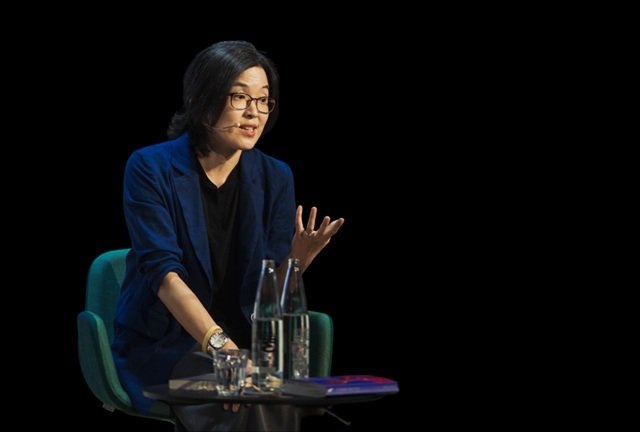
South Korean author Bora Chung has built an international reputation by blending speculative fiction, horror and satire into stories that challenge conventional ideas about history, power and humanity. Since her short story collection Cursed Bunny was shortlisted for the International Booker Prize in 2022, her work has reached readers across the world through English translations by Anton Hur. Her latest novel, Red Sword, continues that trajectory, drawing inspiration from a little-known chapter of Korean history while transporting its characters into a distant science-fiction future.
In an email interview with Frontline India, Chung reflected on the historical roots of Red Sword, the enduring appeal of ghost stories, the evolution of Korean science fiction and the political ideas that shape her fiction. Throughout the conversation, she repeatedly returned to questions of memory, identity, power and resistance, arguing that fiction provides a way to revisit both historical trauma and contemporary anxieties.
Red Sword is rooted in the military conflicts of 1654 and 1658, when Korean soldiers were mobilised by the Qing dynasty to fight Russian forces. Chung said the idea for the novel emerged while she was teaching a university course on Russian culture. Those wars, she explained, represented a tragedy in which Koreans, weakened after the Japanese invasions of the late sixteenth century and reduced to a satellite state under the Qing Empire, found themselves fighting on behalf of another power. At the same time, the Russian commander leading the opposing force was himself a hired mercenary.
“It was a great historical drama in itself, and a tragedy for the weak and the powerless,” Chung said, explaining why she wanted to revisit the episode through fiction.
Rather than retelling the conflict as historical fiction, Chung transposed it into a far-future setting. Red Sword follows a slave-turned-reluctant heroine navigating alien worlds while gradually uncovering the truth about her identity. Although the novel features spaceships and advanced technology, its central object is a sword. Chung said that decision reflected both the historical origins of the story and her personal interest in kendo while writing the novel. She also described sword combat as capable of producing more intricate and compelling confrontations than modern gunfights when handled within the right narrative.
Beyond its action, Red Sword continues Chung’s exploration of one of science fiction’s oldest questions: what it means to be human. She said the novel was heavily influenced by discussions with students while teaching science fiction, where debates frequently centred on whether machines capable of thinking and reacting like humans could themselves be considered human. Those conversations, she said, became central to the novel’s themes.
Although Red Sword unfolds in a futuristic universe, many of its concerns are firmly anchored in present-day realities. Asked about the genre’s ability to imagine resistance against powerful institutions, Chung pointed to the ways technology already shapes activism in the modern world. She noted that activists communicate through secure messaging applications, organise demonstrations using digital tools and receive real-time information about wars and human rights abuses through smartphones. According to Chung, resistance evolves alongside technology, and science fiction merely extends those possibilities into imagined futures.
The novel also examines the way powerful states construct enemies to justify violence. Chung said that dynamic was neither fictional nor confined to history.
“I think all tyrants want to create some imaginary enemy,” she said.
Drawing on examples from the Korean peninsula, Chung referred to North Korea, South Korea’s period of military dictatorship during the 1980s and the language used by some contemporary far-right groups. She argued that authoritarian systems often portray political opponents as enemies while encouraging unquestioning loyalty to those in power.
“Cults and dictatorships have that in common,” she said.
Questions of resistance also extend to the novel’s portrayal of women. Historical records of the seventeenth-century Korean-Russian conflicts mention women only briefly as enslaved captives. Chung deliberately reversed that narrative by placing women at the centre of Red Sword as soldiers, fighters and leaders of resistance. She said many scenes were informed by her own experiences of solidarity with women activists in South Korea, describing young people, women and gender minorities as influential participants in contemporary social movements.
Chung also reflected on the distinctive evolution of Korean science fiction. She said leading Korean writers have argued that the genre developed differently from its Western counterpart because of Korea’s own history of invasion, colonial rule and war. While science fiction in the United States and the Soviet Union often evolved during the Cold War alongside geopolitical competition, Korea’s literary development was delayed by conflict and economic hardship. According to Chung, Korean science fiction only began to flourish during the 1990s, when writers increasingly examined the consequences of imperialism, colonialism and the Cold War.
She acknowledged that Korean science fiction was once criticised by readers for being smaller in scale and less spectacular than Western works. Three decades later, however, she believes readers have become more familiar with its emphasis on ethics, coexistence and self-reflection.
Ghosts remain another defining feature of Chung’s fiction. She described them as practical storytelling devices capable of recovering forgotten memories and presenting perspectives beyond the experiences of individual protagonists. More importantly, she said ghost stories across Asia often preserve historical trauma and collective memory that societies were once unable to discuss openly because of political pressure or social taboos.
Chung cited feminist novelist Park Wan-Seo as one of her greatest influences, praising her portrayal of ordinary women living through Japanese colonial rule and the Korean War. She also pointed to Nobel Prize-winning South Korean writer Han Kang’s Human Acts as another work demonstrating how ghosts can embody historical trauma and state violence.
Her international readership, Chung said, often approaches her work differently depending on cultural background. Asian readers, she explained, generally recognise familiar traditions, superstitions and shared cultural references, making them more comfortable with her stories. Western readers, by contrast, sometimes assume that fantastical elements are rooted in authentic Korean folklore when, she said, many of them are entirely fictional creations.
Despite the serious themes running through her novels, Chung stressed that horror and science fiction remain forms of popular literature created for enjoyment. “We read and write genre literature for fun,” she said. “I hope you have fun.”
She also praised her long-standing collaboration with translator Anton Hur, who has translated nearly all of her work into English while she translated his debut novel Toward Eternity into Korean. Chung said the partnership succeeds because of mutual trust, describing what she called a “no touch” approach in which neither interferes with the other’s creative process.
Looking ahead, Chung revealed that she has completed another novel, this time centred on vampires battling artificial intelligence. Written in Korean, she said she does not yet know when—or whether—it will appear in English translation. For now, Red Sword stands as the latest chapter in a body of work that continues to draw upon history, speculative fiction and the enduring questions surrounding power, memory and what it means to be human.