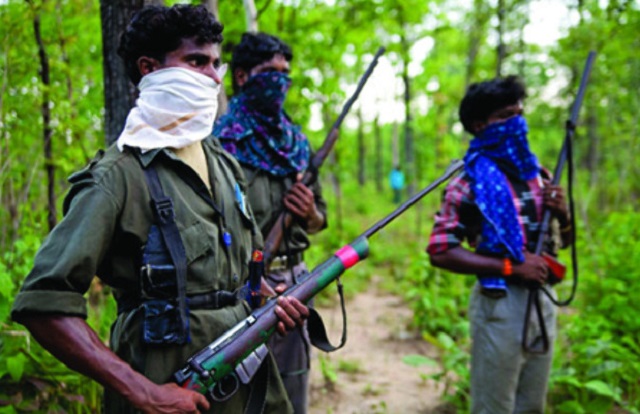
On July 29, 2026, the last known active Communist Party of India-Maoist (CPI-Maoist) ‘Politburo’ member, Misir Besra aka Sunirmal aka Sagar Da aka Bhaskar Da (65), carrying a cumulative reward of over INR 22 million, was arrested along with another two senior Maoist leaders during Operation Daura Pahad in the Maniadih area under the Barwadda Police Station limits of Dhanbad District in Jharkhand. The intelligence-led operation was jointly conducted by the Jharkhand Police, the Central Reserve Police Force (CRPF), its Commando Battalion for Resolute Action (CoBRA), and intelligence agencies. Security Forces (SFs) recovered three AK-47 rifles, eight magazines and 288 rounds of ammunition during the operation.
Besra, a member of the CPI-Maoist’s ‘Central Committee’ (CC), ‘Politburo’ and ‘Central Military Commission’ (CMC), was wanted in about 175 cases across Jharkhand, Odisha and West Bengal. He was apprehended along with senior Maoist functionaries Mehnat aka Mochhu and Gaurav. More than the arrest of another veteran insurgent, the operation represents one of the most significant operational successes in India’s campaign against Left Wing Extremism (LWE), as it effectively removes the last active member of the organisation’s traditional apex leadership and leaves the CPI-Maoist without a nationally recognised command structure.
For nearly four decades, Besra occupied a pivotal position within the Maoist movement. Emerging from the erstwhile Maoist Communist Centre (MCC) during the 1980s, he rose steadily through the organisational hierarchy following the September 21, 2004, merger that created the CPI-Maoist. Over time, he also became a member of the Eastern Regional Bureau, overseeing operations across Jharkhand, Odisha and West Bengal. Security agencies linked him to several of the insurgency’s most significant operations, including the 2005 Jehanabad jailbreak (November 13, 2005), multiple attacks on SFs, arms-looting operations and a series of improvised explosive device (IED) attacks.
Besra’s importance, however, lay less in his operational record than in his organisational role. Unlike regional commanders whose influence remained geographically confined, Besra belonged to the generation that transformed scattered revolutionary groups into a centrally directed insurgent movement spanning large parts of eastern and central India. He represented institutional continuity within the CPI-Maoist, connecting successive phases of the movement’s evolution from the MCC to the unified organisation established in 2004. His ability to evade SFs for almost two decades after escaping from Police custody during the Maoist attack on the Lakhisarai Court Complex in Bihar on June 23, 2009, further enhanced his stature within the organisation.
Besra’s arrest also completes a process of leadership attrition that has accelerated since 2024. The decisive turning point came on May 21, 2025, when CPI-Maoist General Secretary Nambala Keshava Rao aka Basava Raju aka Ganganna aka Krishna aka Vijay aka Prakash (70), was killed during a major SF operation in Chhattisgarh. His death deprived the insurgency of its supreme political and military leader and triggered an unprecedented erosion of the organisation’s upper echelons. Thereafter, sustained intelligence-led operations, coupled with an expanding surrender policy, steadily removed successive members of the ‘Politburo’ and ‘Central Committee’ through arrests, surrenders and fatalities, progressively dismantling the organisation’s apex command.
The cumulative impact has fundamentally altered the character of the insurgency. At its peak, the CPI-Maoist possessed a hierarchical structure that enabled the ‘Politburo’ and ‘Central Committee’ to formulate strategy, coordinate military operations, oversee recruitment and maintain organisational cohesion across multiple States. Today, the organisation appears reduced to scattered regional formations operating with limited strategic direction. Local commanders may retain the ability to organise isolated attacks or sustain extortion networks, but they no longer appear capable of directing a coordinated nationwide insurgent campaign. The circumstances surrounding Besra’s arrest further underscore this transformation. Forced out of the Saranda Forests after sustained SF pressure, he reportedly shifted towards the Parasnath region in search of a new operational base. Security agencies tracked his movement through sustained intelligence gathering, aided by information obtained from recent arrests and surrenders, before intercepting him near the Dhanbad-Giridih border. The operation illustrates the growing effectiveness of intelligence-led counter-insurgency operations and the increasing penetration of Maoist logistical and communication networks.
Nevertheless, caution remains warranted before declaring the complete end of the Maoist insurgency. Armed squads continue to operate in pockets of Chhattisgarh, Jharkhand and adjoining States, while hidden arms caches, extortion networks and residual overground support structures persist. Moreover, many of the governance deficits that historically enabled Maoist mobilization – including inadequate infrastructure, limited access to public services and livelihood opportunities in remote tribal areas – remain only partially addressed. These conditions continue to offer limited space for residual extremist activity, even as the organisation’s strategic capabilities decline.
The strategic significance of Besra’s arrest lies not in the elimination of every remaining armed cadre, but in what it reveals about the trajectory of the insurgency. Over the past years, sustained operational pressure, systematic attrition of the senior leadership, expansion of the security grid into former Maoist strongholds and calibrated surrender policies have progressively dismantled the CPI-Maoist’s command structure. With Besra’s capture, the organisation appears to have lost the last active leadership element among those who built and directed the nationwide Maoist insurgency for more than two decades.
Whether the CPI-Maoist can reconstruct a credible national leadership remains uncertain. Replacing experienced leaders is easier than rebuilding the institutional authority, organisational cohesion and interstate networks that once sustained the movement. Misir Besra’s arrest should therefore be viewed as a strategic milestone rather than merely another operational success. It does not, by itself, signify the end of LWE in India. It does, however, provide perhaps the clearest indication yet that the CPI-Maoist, as a centrally directed insurgent organisation capable of orchestrating a nationwide campaign of armed violence, has entered what may well prove to be its terminal phase. Sustaining these gains will, however, depend on maintaining security pressure while ensuring that security gains are consolidated through responsive governance and sustained socio-economic development.