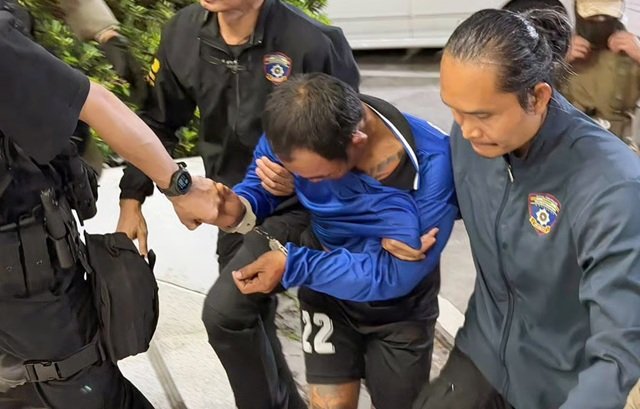
The alleged mastermind behind the killings of two Russian siblings and a Thai family of three was released from prison just seven weeks before the first murder, triggering intense criticism of Thailand’s justice system. The case has fuelled debate over the monitoring of repeat offenders, the balance between punishment and rehabilitation, and the country’s ability to protect both citizens and foreign visitors from violent crime.
Thailand’s criminal justice system has come under intense public scrutiny after a repeat offender, released from prison only seven weeks earlier, allegedly confessed to orchestrating the murders of five people, including two Russian siblings and a Thai family of three. The case has sparked widespread criticism of the handling of violent offenders and prompted renewed questions over public safety and post-release monitoring.
The bodies of Russian nationals Diana and Roman Nazimov were discovered in a shallow grave in a forested area of Chonburi province on Friday, several days after their mother reported them missing. Their deaths led police to uncover another gruesome crime, finding the remains of a Thai family buried in a nearby coconut plantation.
Following a manhunt, police arrested Thana “Pong” Kerdthong, 43, and Thongchai “Thong” Srinil, 39, who were found hiding in a fruit orchard in Sa Kaeo province near the Cambodian border. According to local media, Thana admitted that the pair attempted to steal a motorcycle from the Russian siblings. He allegedly shot 17-year-old Roman during a struggle before beating 22-year-old Diana to death.
As investigators searched for the missing Russians, they also uncovered the bodies of Thai couple Wichian and Chantana, together with their 18-year-old daughter Nichapha. Police said the family had been shot, bound and buried, withholding their surnames to protect their privacy. The suspects have also allegedly confessed to those killings, after the family’s disappearance had been reported in late June.
Police have since arrested two additional men, Chatchanan Paen-aiam and Atsadang Chuwong, as alleged accomplices. Investigators believe the murders were motivated by robbery, while warning that further crimes linked to the group may yet emerge.
Prime Minister Anutin Charnvirakul visited the crime scene on Saturday, apologising to the Russian people and pledging that none of the suspects would be granted bail.
“I apologise to our Russian brothers and sisters that this happened to Russian people,” he said, adding that investigators believed there could be “one or two more cases” connected to the group.
Public outrage has intensified following revelations that Thana had been released only seven weeks before the first killings after completing a seven-year prison sentence for attempted murder. Thai media reported that he also had a history of serious violent offences, including child abduction, rape and illegal gun possession.
The case has reignited debate over sentencing, rehabilitation and the monitoring of convicted offenders after their release. Social activist and television personality Panadda Wongphudee called for swift justice and urged the courts to consider imposing the death penalty, arguing that the crimes demonstrated careful planning rather than impulsive behaviour.
Seeking to contain growing criticism, authorities defended the actions of the justice system. Police in Chonburi rejected allegations that they had responded slowly to the missing persons report filed by the sister of the murdered Thai family. Meanwhile, the Department of Corrections said both Thana and Thongchai had been imprisoned in accordance with court orders and released only after completing their legally prescribed sentences.
The department also stated that it had followed every requirement under the Repeat Offence Prevention Act before releasing the suspects.
Nevertheless, criminal justice experts argue that the case exposes deeper structural weaknesses. Krisanaphong Poothakool, a leading criminologist and adviser to the Royal Thai Police on police reform, said protecting the public required a continuous approach extending beyond imprisonment. He called for stronger information-sharing between agencies, ongoing risk assessments for former inmates and greater involvement by local communities in monitoring offenders returning to society.
He also argued that police responses should be guided by urgency rather than public attention, warning that missing persons cases involving individuals with limited social networks often receive less pressure and fewer investigative resources. Every disappearance, he said, should receive a timely and proportionate response regardless of a victim’s social status.
The murders have also drawn international attention because the victims included two young Russian nationals. Although violent crime is not uncommon in Thailand, where high gun ownership, drug addiction and poverty continue to present challenges, killings of foreign visitors remain relatively rare. The case has therefore increased pressure on the Thai government to reassure international visitors about public safety.
Foreign Minister Sihasak Phuangketkeow described the murders as “shocking for every Thai”, particularly because the Russian victims were so young. He said the authorities would have to demonstrate through concrete action their determination to strengthen security and preserve confidence among the millions of tourists who visit Thailand each year.