A mysterious folded note handed to Mexican singer Chalino Sánchez during a concert in Culiacán became the haunting prelude to one of the most enduring mysteries in Latin American popular music. More than two decades after his killing, the circumstances surrounding the death of the “King of Corridos” remain unresolved, while his life and legacy continue to shape the modern global rise of narcocorridos.
Few moments in the history of Mexican popular music have become as iconic as the final public performance of Rosalino Sánchez Félix, better known as Chalino Sánchez. During a concert in Culiacán on the night of 15 May 1992, an audience member handed the singer a folded piece of paper. Such gestures were common at his performances. Chalino encouraged fans to climb onto the stage, take photographs with him and request songs. He was known not as an untouchable celebrity but as a ranchero celebrating with friends, a performer whose informal style made him one of the most beloved figures in regional Mexican music.
As the accordion introduced the next song, Chalino unfolded the note and silently read its contents while holding the microphone. The moment lasted only seconds, yet it would become one of the most analysed scenes in Mexican music history. Witnesses recalled how his expression suddenly changed. He wiped sweat from beneath the brim of his beige cowboy hat, stared into the distance as though trying to comprehend the message, folded the paper again, nodded discreetly towards someone standing to his left, and resumed singing “Alma Enamorada”.
By the following morning, he was dead.
His body was discovered near a stream with his eyes blindfolded, his hands tied behind his back, and two gunshot wounds to the back of his head. The identity of those responsible has never been conclusively established, transforming the singer’s final performance into one of the enduring mysteries of modern Mexican culture.
That evening, more than 2,000 people had gathered inside Salón Buganvillas in Culiacán, the capital of Sinaloa, a city Chalino had fled nearly two decades earlier on his journey to California. He was only 31 years old but had already become a cultural hero to millions of Mexicans on both sides of the United States-Mexico border. Despite possessing little formal education, no musical training and a rough, unconventional singing voice, he had transformed the traditional corrido into something that reflected the realities of contemporary Mexican life.
Historically, corridos emerged in northern Mexico during the nineteenth century, recounting the exploits of revolutionaries, outlaws and frontier figures as epic ballads. Chalino reimagined that tradition for a modern era. His songs told the stories of migrants confronting police abuse in Los Angeles, labourers pursuing better lives, and individuals whose paths led from small-scale marijuana trafficking to becoming powerful drug traffickers. A native of Sinaloa, like many of Mexico’s most notorious criminal figures, Chalino became one of the pioneers of narcocorridos, a genre that has since experienced remarkable international popularity.
Yet the violence depicted in his music often mirrored events from his own life.
According to El País, Chalino was only 11 years old when his only sister was raped by neighbours in the small village where the family lived. Everyone reportedly knew who was responsible. Four years later, when he was 15, he attended a party where the alleged attackers were present and shot them. Pursued afterwards, he crossed the border illegally into the United States and found refuge with an aunt in Los Angeles.
Life there remained difficult. He worked in agriculture and cleaning livestock farms while helping his older brother, who earned a living as a coyote smuggling migrants across the border from Tijuana. Tragedy struck again when his brother was shot dead while sleeping in a motel. Chalino later spent time in prison, where his musical career unexpectedly began. Sharing cells with thieves and drug traffickers, he transformed their life stories into songs while a cousin, who was also imprisoned, accompanied him on guitar.
After his release, he continued composing songs, frequently on commission. Payment sometimes came not in money but in watches or firearms. Chalino himself routinely carried a loaded revolver. Reserved, fiercely independent and proud, he embodied an image deeply rooted in Mexican rural culture. His music reflected those experiences, giving voice to migrants, social outcasts and ordinary people whose stories rarely entered mainstream culture. Some songs even described murders from the victim’s perspective, openly condemning and threatening those responsible.
Without support from major record companies and often banned from radio stations, Chalino distributed his recordings on cassette tapes sold through barbershops, petrol stations and street markets. The grassroots approach only strengthened his popularity.
His reputation for toughness became inseparable from his public persona. In January 1992, only months before his death, violence erupted during a concert in California’s Coachella desert. A man climbed onto the stage and opened fire with a .25 calibre pistol. Chalino immediately jumped from the stage and returned fire using his own weapon. The shooting left one person dead and ten injured, including Chalino himself, who suffered a gunshot wound to the lung. The incident attracted widespread media attention, further expanding his notoriety while demand for his cassette recordings surged.
Following that shooting, however, those close to him observed unexpected changes in his behaviour.
He distributed his prized collection of firearms among friends and sold the rights to his entire music catalogue to a small record company for approximately US$100,000. He used the proceeds to purchase a home in a middle-class suburb for his wife and son. Many began to suspect that Chalino believed his own death was approaching.
It was during this period that he accepted an offer to perform in Culiacán. Friends and relatives reportedly urged him not to return to Sinaloa. He had received threats, and the state no longer felt like home after years away. Nevertheless, organisers had paid approximately US$20,000 for the performance, half of it in advance, and Chalino considered himself honour-bound to fulfil the commitment.
The concert proved enormously successful. Afterwards, he left with two brothers and a cousin to have dinner. Before reaching the restaurant, two vans blocked their vehicle. Several armed men emerged, identified themselves as state police officers, and told Chalino, “My commander needs your help.” Accustomed to encounters involving bribery, he reportedly offered them money, but they refused. Instead, they removed one of his brothers from the vehicle. Chalino negotiated, and ultimately it was he, rather than his brother, who was taken away.
He was never seen alive again.
As El País notes, the investigation into his murder became another unresolved case within Mexico’s criminal justice system, producing few definitive answers. Yet in death, Chalino’s influence only grew stronger. More than 100 corridos were written about his killing in the months that followed—more than were composed about Pancho Villa. Like Elvis Presley or Michael Jackson, myths emerged claiming that he had survived, staged his death and disappeared to escape his enemies.
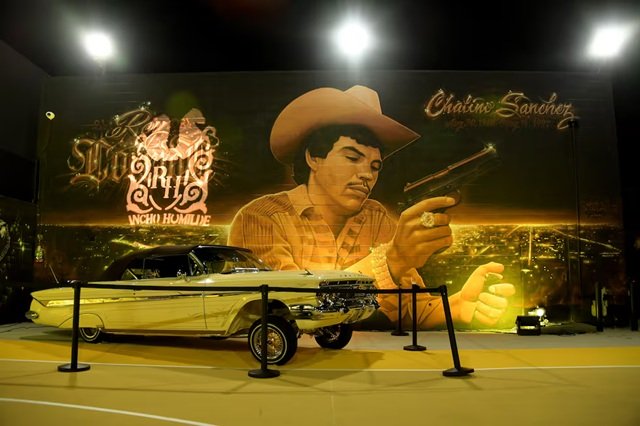
Today, a giant mural in the cemetery of his hometown preserves the image that has become inseparable from his legend: Chalino Sánchez wearing a cowboy hat, open shirt and boots, holding a microphone in one hand and a pistol in the other. Beside the portrait are the words that continue to define his enduring legacy: “Nunca tuve miedo” — “I was never afraid.”